




Reviewed 18 November 2026. A focused architecture guide using ASI and national tourism sources. Check current official visitor information.
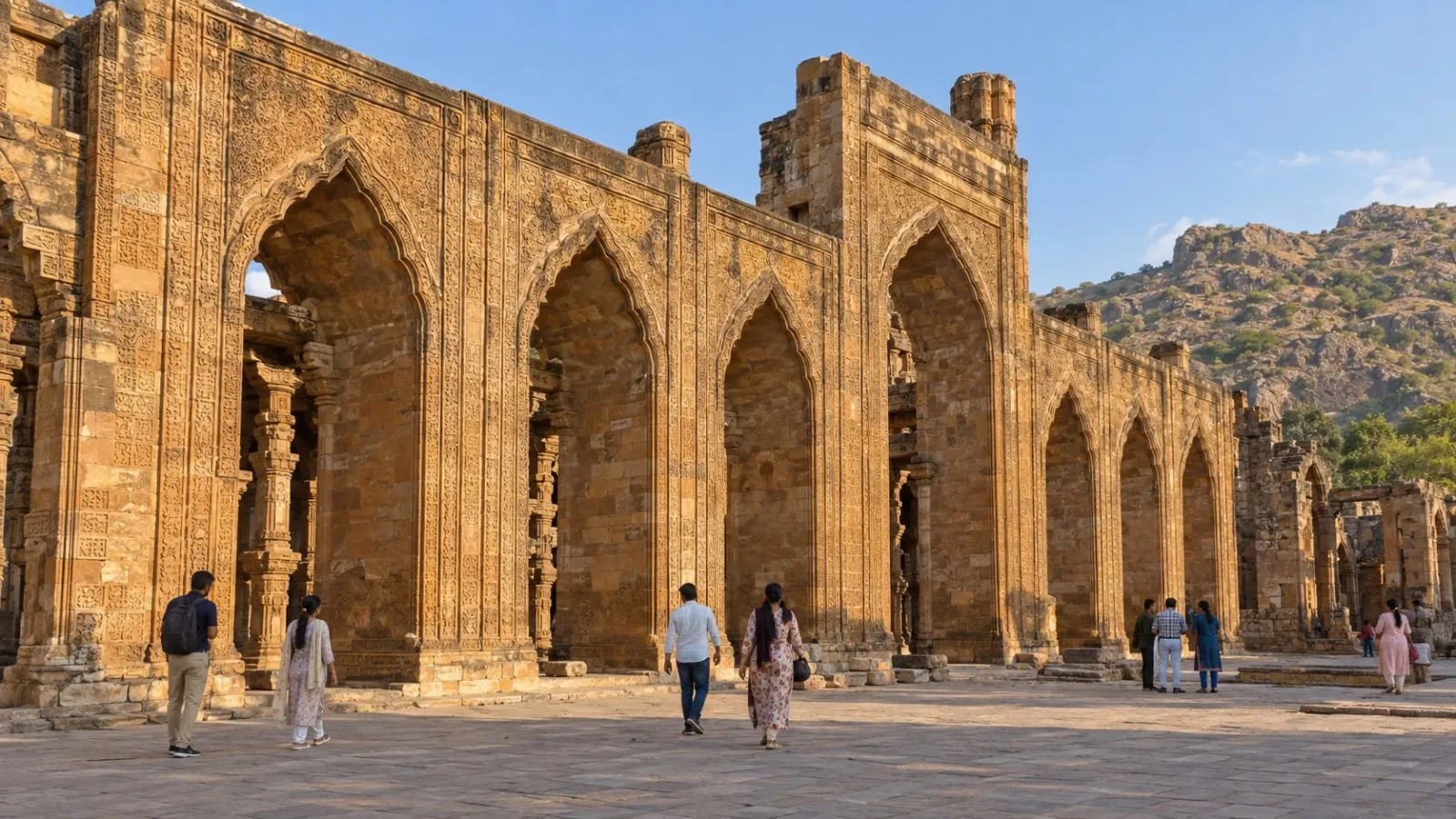
AI illustration: a fictional architectural scene inspired by Ajmer. Not an actual location, person, ritual, route inspection or service.
Choose a few architectural features
Adhai Din ka Jhonpra can be one focused architectural outing in Ajmer. Start with the arched screen and carved pillars rather than a target to complete every historic place in the city.
Our recommendation is a few features understood together, with a meal, a break and the return. Check current official visitor information before fixing the rest of the day.
Begin with the screen
ASI describes a screen pierced by corbelled, engrailed arches. National tourism describes a larger central opening with smaller arches beside it. Compare the centre, the repeated openings and the decorated surface.
An arch-shaped opening does not by itself explain the structural method. Keep the source’s distinction in mind rather than treating every curved opening as the same kind of construction.
Compare the pillars with the broad facade
The national tourism account draws attention to carved pillars, walls, ceilings and inscriptions. Those details offer another subject alongside the broad surface of the screen.
Compare the repetition of columns with the rhythm of the openings. Choose one carved surface to study instead of turning a published count into a challenge to find every pillar.
Read the name as a question, not a building schedule
ASI cautiously suggests that the name may refer to a fair lasting two and a half days. National tourism also identifies the rapid-construction account as a legend and distinguishes it from a longer building period.
Do not turn the name into proof that the whole monument was built in sixty hours. A memorable story can start a question without becoming a verified construction timetable.
Keep building phases and interpretation distinct
ASI associates the mosque with Qutb-ud-Din Aibak and the later screen with Iltutmish. That distinction helps explain why the structure should not be treated as one moment of work.
The sources discuss a layered history of materials. We do not assign an original building or exact age to each stone from its appearance, or use architectural history to make claims about people today.
Leave other Ajmer interests as separate choices
A focused visit here need not become an automatic extension of a shrine outing or a circuit through every museum and lake. Different places can matter for different reasons.
Check current official visitor information and keep the amount the group actually wants. A few features, a conversation, food, rest and the real return can be enough for one outing.
Sources
Questions people ask at the gate
What should we look at first?
The arched screen and its relationship with the carved, pillared spaces.
What does ASI say about the arches?
It describes the screen as pierced by corbelled, engrailed arches.
Does the name prove a sixty-hour construction?
No. ASI cautiously links it to a fair, while national tourism identifies the rapid-building account as a legend.
Which building phases does ASI distinguish?
The mosque associated with Aibak and the later screen associated with Iltutmish.
Can we identify the original source of every stone by looking?
No. We do not supply a stone-by-stone provenance or exact-age claim.
Must this become a wider Ajmer circuit?
No. Our recommendation is a focused architectural visit, current official visitor checks, food, rest and the return.
Next walk starts at a new gate.
Was this helpful?
one tap, no sign-up

A Miranda House graduate and lawyer who traded courtrooms for slow travel. Cheshta travels with the batches we host ourselves, with a soft spot for travelling alongside elders.