




Checked 12 November 2026. Air Costa's history connects a small Indian regional airline with a much larger aircraft-order headline. Scheduled services began in October 2013. The Ministry of Civil Aviation later recorded its suspended operations during 2017, and Embraer said in July 2018 that Air Costa's 50-aircraft E2 order was no longer in its backlog.
June 2013: an airline preparing to fly
An 18 June 2013 Embraer announcement filed with the SEC identified Air Costa as a new carrier from Vijayawada. It described three aircraft acquired for the launch: two E170s arranged through Embraer's wholly owned ECC Leasing subsidiary and one new E190 purchased from the manufacturer.
The announcement presented the airline's intended role as connecting underserved markets with more direct flights, including secondary and tertiary business centres. Air Costa's management said the aircraft size would help add frequencies without adding too much capacity.
This is evidence of the launch plan and aircraft arrangements, not proof that scheduled passengers were already flying on 18 June. A new-airline announcement, an aircraft order and the first passenger service need separate dates.
October 2013: scheduled service begins
The 13 February 2014 manufacturer filing supplies a retrospective milestone: Air Costa commenced scheduled services in October 2013. It identifies the airline as part of the privately held LEPL Group, whose wider interests included property and infrastructure development.
The filing describes a point-to-point regional proposition serving Indian cities such as Vijayawada, Jaipur, Bengaluru, Ahmedabad, Hyderabad and Chennai. Treat that list as the company's network description at the time, not a permanent route map.
The sources inspected here establish the month of the scheduled launch, but not a single exact first passenger departure date. This article therefore uses October 2013 rather than selecting a day from conflicting launch or ceremony accounts.
February 2014: 50 firm orders, not 100 operating aircraft
The same dated filing announced a definitive agreement for 50 E-Jets E2s: 25 E190-E2s and 25 E195-E2s. It also announced purchase rights for another 50, again split between those two variants.
The estimated value of the firm order was US$2.94 billion at 2014 list prices. The potential total of 100 aircraft and US$5.88 billion depended on exercising all the additional rights. Neither number was an operating fleet count, and list value is not proof of cash paid by the airline.
The release said Air Costa then flew four E-Jets, described as two E170s and two E190s. That dated manufacturer statement should not be stretched into a claim that all four flew every day, that the fleet stayed unchanged or that E2 aircraft had already arrived.
The proposed E2 fleet was a future plan
In February 2014, Embraer said Air Costa would take delivery of the E190-E2 in 2018, while the E195-E2 type was scheduled to enter service in 2019. These were forward-looking statements made years before the airline's suspension.
The 15 April 2014 first-quarter update confirmed that the 50-aircraft Air Costa E2 order was included in the manufacturer’s backlog. That supports the existence of the order at that reporting date. It does not turn the expected delivery timetable into an accomplished event.
For readers looking at old airline stories, this is the main distinction: an aircraft can be ordered and appear in a manufacturer's backlog without becoming part of the customer's operating fleet. The order headline describes ambition and a commercial commitment, not completed fleet growth.
March 2017: the order still appears as undelivered
The 13 April 2017 Embraer filing gives a further dated snapshot, with its commercial backlog measured at 31 March 2017. Air Costa appears in both the E190-E2 and E195-E2 customer tables.
Each row shows 25 firm orders, a dash in the delivered column and 25 in firm order backlog. Read the column headings as well as the customer name. Those rows are evidence of undelivered orders at that date, not 50 aircraft in service.
The table also shows why one company’s reporting date cannot establish another company's flight status. A manufacturer keeping an order in its backlog is not confirmation that the customer is still carrying passengers, solvent or about to restart.
The ministry records suspended operations in 2017
The Ministry of Civil Aviation Annual Report 2017–18, section 3.5.3.3, says Air Costa, Air Carnival and Quickjet Cargo suspended their operations during the period under review. That official record supports the 2017 operational endpoint used in this history.
The statement does not identify Air Costa's exact final revenue flight or give an individual flight number. It also does not, by itself, establish the date of permanent certificate cancellation, the legal dissolution of the company or the settlement of every passenger and employee claim.
Those exact endpoints remain unconfirmed from the primary records inspected for this article. We do not replace the ministry's narrower statement with a guessed “last flight” date or treat suspended operations as proof of a completed corporate liquidation.
July 2018: the 50-aircraft order leaves the backlog
Embraer's 20 July 2018 second-quarter delivery and backlog release says Air Costa's order for 50 E-Jets E2 was no longer considered in its backlog as of the end of the second quarter of 2018.
The manufacturer added that this adjustment had no impact on the E2 production or delivery schedule for 2018 or 2019. That is Embraer's statement about its programme, not a claim that Air Costa had received aircraft or resumed flights.
This is a later and different milestone from the ministry's record of suspended operations in 2017. The release establishes the backlog adjustment; it is not an aircraft-by-aircraft repossession record, an Air Costa court judgment or proof of a particular creditor recovery.
A short timeline without collapsing the events
Read the sequence in separate stages: launch preparations in June 2013; scheduled operations from October 2013; a large E2 order in February 2014; undelivered E2 orders still shown at March 2017; suspended operations recorded for 2017; and removal of the 50-aircraft order from Embraer's backlog by the end of the second quarter of 2018.
That sequence explains the airline's place in India's regional-aviation story without pretending the planned fleet was delivered. It does not establish a single cause of failure, an exact final flight or a current legal outcome. This is historical reading, not a current booking, refund or claim-filing guide.
For present-day travel, The Trip Keeper's trip-planning page is for building an actual itinerary, while its private-tour page explains family-specific planning. Neither link implies that the historic airline is available or that an old ticket or claim can be handled through a package.
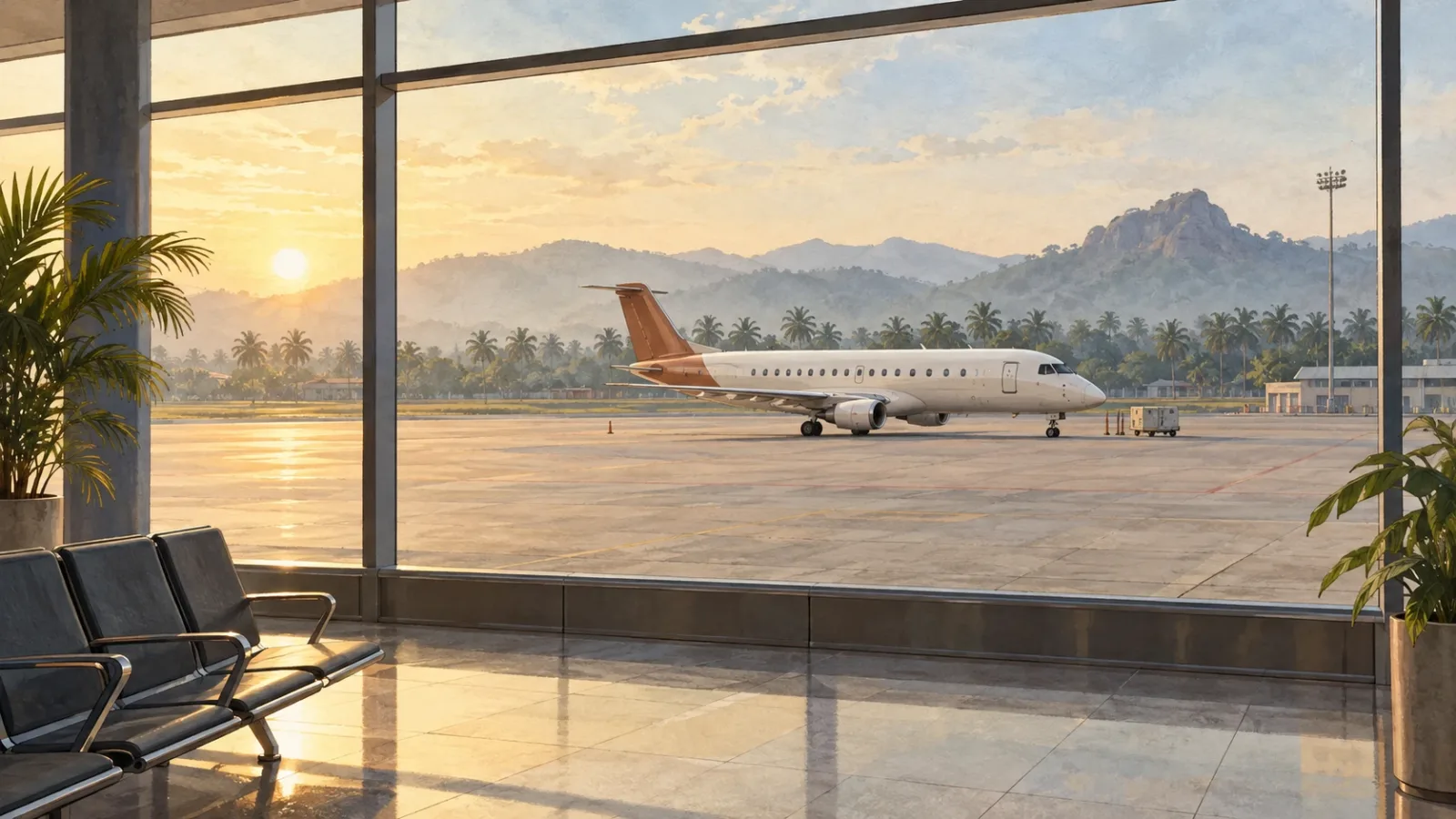
The hero is a fictional AI watercolor-style illustration of an invented regional jet and terminal. It is not an Air Costa aircraft, a real airport or a photograph documenting its operations.
Six dated primary records support this article: manufacturer announcements and backlog filings hosted by the SEC, and the Indian ministry's annual report. They were checked on 12 November 2026. Exact first-flight day, last revenue flight, permanent certificate endpoint and final corporate outcome remain unconfirmed here.
- Embraer, 18 June 2013: three E-Jets for a new Indian airline
- Embraer, 13 February 2014: 50 firm E2 orders and 50 purchase rights
- Embraer, 15 April 2014: first-quarter backlog update
- Embraer, 13 April 2017: orders, deliveries and backlog at 31 March
- Ministry of Civil Aviation, Annual Report 2017–18: section 3.5.3.3 on suspended operations
- Embraer, 20 July 2018: Air Costa order removed from backlog

A Miranda House graduate and lawyer who traded courtrooms for slow travel. Cheshta travels with the batches we host ourselves, with a soft spot for travelling alongside elders.
Planning your next trip?
We'll handle insurance, hotels, airport assistance and the itinerary — the same way we do it for every trip.
Questions on this article
asked by readers, answered by us
Was this helpful?
one tap, no sign-up