




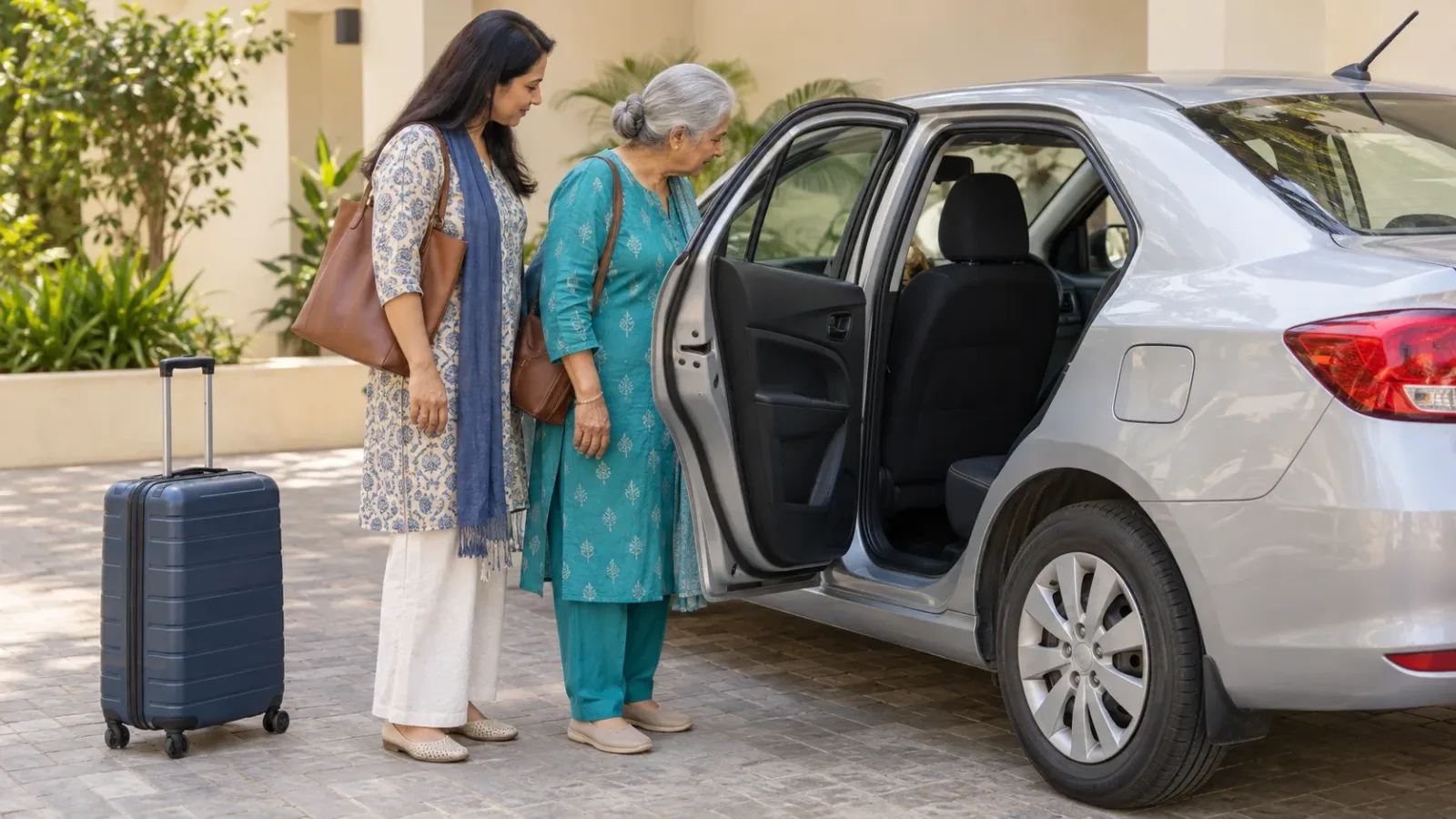
If a parent cannot climb into an SUV, do not solve the airport-to-hotel transfer by booking a larger SUV. Describe the boarding difficulty and ask the operator to confirm the actual passenger seat, door opening, entry height, luggage space and help available. A suitable lower-entry car may work for someone who can use a normal seat; someone who needs to remain in a wheelchair needs a different, specifically confirmed arrangement. Neither a vehicle category nor a request note proves fit.
AI-generated fictional photograph of a mother and daughter checking a plain car's open passenger doorway at a generic hotel driveway. Not an actual pickup, vehicle assessment or advertised service.
Describe the movement, not only the passenger's age
Start with what the parent can comfortably manage: walking from a meeting point, standing while a door is opened, stepping over a sill, reaching a seat and sitting in a normal vehicle seat. Say specifically that a high SUV step or seat is not manageable. Do not replace that information with "senior citizen", "VIP" or "needs a big car". Those phrases do not describe the entry problem.
Share functional requirements rather than a full medical history. If you do not know what movement or support is appropriate for the person, get individual guidance before choosing the transfer. This article does not assess fitness to travel or teach a lifting or passenger-transfer technique. Do not plan to make an unsuitable car work by having relatives or a driver improvise a lift.
Check the passenger doorway and seat separately
The Research Institute for Disabled Consumers' car-measurement guidance distinguishes door sill, opening, headroom, legroom and seat height. It says a passenger may prefer a higher or lower seat. Therefore, "lowest car available" is not a universal answer either. Compare the proposed entry with a car the parent already uses comfortably, where possible.
Ask for the actual model, model year or configuration if known, the passenger seat being offered, its height above the ground, the sill or step to cross, and clear photographs of the door fully open and seat entry. Ask which side can be used at pickup and drop-off. RiDC's measurement-method page shows why seat-edge height, sill height and headroom on entry are separate measurements. No numerical safe-height threshold for your parent is established here.
A photograph is a screening aid, not a personal fit test or safety certificate. A sedan, minivan and SUV can each have different entry geometry. If a particular seat position is essential, include that in the confirmation rather than assuming every seat in the same car is equivalent.
Do not confuse space with easy boarding
Blacklane's help page dated 26 September 2023 says its service varies with local regulations and vehicles and describes Business Vans/SUVs as its most spacious option for reduced mobility. That is the operator's broad space recommendation, not proof that a high seat works for a parent who cannot climb into it. Ask the provider to address the stated boarding limitation, not simply upgrade the category.
Count everyone and every bag after the usable passenger seat is agreed. Include a folded walking frame or wheelchair with its actual dimensions and folding needs. Blacklane's assistive-device page, dated 4 June 2021, specifically asks for device size so it can fit in the boot. Space for an empty folded chair is not confirmation that a passenger can travel while seated in that chair.
Use a different request if the parent cannot move to a car seat
Tell the provider if the passenger must stay in their wheelchair. Ask for its supported occupied-wheelchair vehicle arrangement, chair and passenger size/weight limits, access equipment, securement, companion seats and trained help. Have the provider explain its actual arrangement; do not infer it from a ramp photo or an accessible label.
Welcome Pickups' help page dated 10 February 2026 describes ramp-equipped minivans as potentially available in selected destinations, with seasonal variation, and asks travellers to mention the requirement in the notes. That is a lead for a specific enquiry, not a worldwide inventory promise or proof that adding a note reserves a suitable vehicle.
A vehicle's design can help frame the questions without becoming a booking recommendation. For example, Toyota's 23 October 2017 JPN Taxi launch release describes a low, flat floor and wide-opening sliding rear door. This is a historical design example, not confirmation of today's local fleet, your parent's fit or a vehicle available for your arrival.
Confirm the whole handover, including a substitute
Agree the actual meeting place, route to the car, walking or standing involved, who handles bags and what assistance the driver is able and authorised to provide. Ask the hotel which entrance the vehicle should use and who can meet the parent there. A car that works at an open forecourt may still be a poor plan if the agreed entrance requires an unmanageable walk or steps. Current airport pickup locations and assistance rules are not established by this article; check the actual airport and provider.
Before payment, ask what is guaranteed about the vehicle or its boarding features, how a substitution will be checked, the waiting and delay terms, and what happens if the arriving vehicle does not meet the written requirement. Get any extra cost, cancellation or replacement terms agreed rather than assuming an unsuitable vehicle creates a free replacement or automatic refund right. Keep a reachable operator contact and a separately checked alternative.
A short request you can adapt
My parent can use a normal car seat but cannot climb into a high SUV. Please confirm the actual passenger seat and vehicle, seat-entry and sill/step heights, door-opening photos, space for our people and bags, and the assistance you can provide. Please do not substitute a higher-entry vehicle without checking with us. Tell us the pickup-to-car and hotel-door handover, full price, waiting terms and options if the confirmed boarding requirements cannot be met.
Change the first sentence if a normal seat is not possible. Add actual passenger, bag and mobility-aid details, but do not include unnecessary medical documents. At pickup, compare the arriving arrangement with the confirmation before attempting entry. If it is not manageable, stop and contact the operator for a supported alternative; do not turn the curb into a trial of an improvised lifting method.
Reviewed 14 November 2026 against the six primary pages linked above. RiDC's pages were undated; the operator help dates and Toyota's historical release date are stated where used. No actual car, passenger, airport pickup, availability, fee or personal boarding ability was assessed. This is a practical booking checklist, not medical advice or a universal accessibility standard.

A Miranda House graduate and lawyer who traded courtrooms for slow travel. Cheshta travels with the batches we host ourselves, with a soft spot for travelling alongside elders.
Planning your next trip?
We'll handle insurance, hotels, airport assistance and the itinerary — the same way we do it for every trip.
Questions on this article
asked by readers, answered by us
Was this helpful?
one tap, no sign-up