




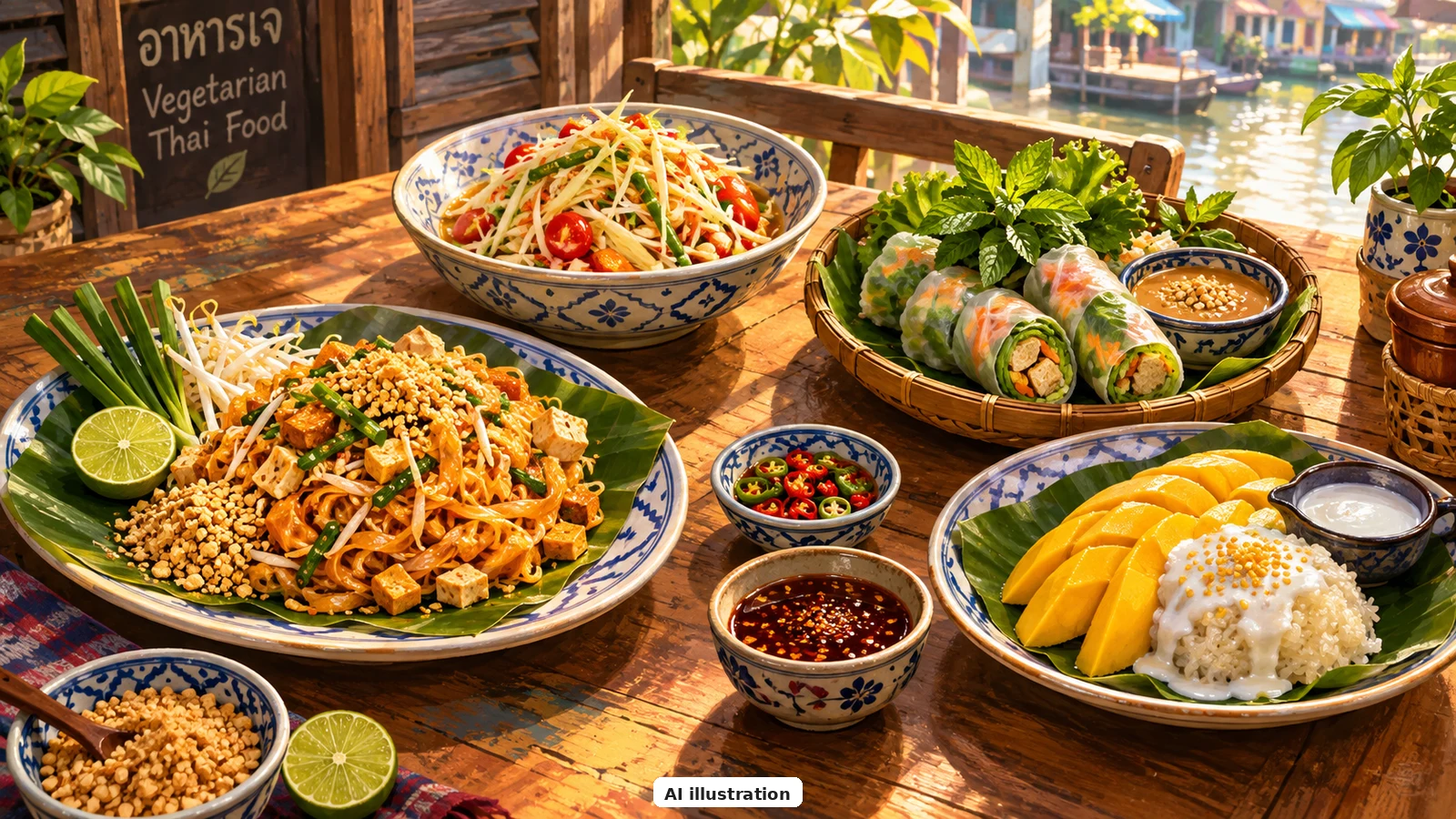
Thailand cooks some of the best vegetable food in Asia - and seasons almost all of it with fish sauce. For an Indian vegetarian, Bangkok is not hard, but it is specific: a few phrases work very well for some dishes and not at all for others, and one yellow flag removes the whole negotiation. This guide gives you the exact words, the dishes they cannot fix, and the places where nothing needs explaining.
1. The one thing to know first
Fish sauce (nam pla) is a foundation of Thai cooking, not a garnish - it carries both salt and umami, so it goes into dishes that look entirely plant-based. And it is not alone: oyster sauce seasons most stir-fried vegetables, shrimp paste (kapi) is ground into curry pastes before cooking, dried shrimp disappear into salads and fried rice, and many "vegetable" soups are built on pork or chicken stock. Ordering a vegetable dish is not the same as ordering a vegetarian one. The good news: cooks are used to requests, and made-to-order dishes can usually be adapted if you ask for the right things.
2. Two words worth learning: jay and mangsawirat
Jay (เจ) is the Chinese-Thai Buddhist way of eating: nothing from an animal at all - no meat, seafood, egg, milk, fish sauce, oyster sauce or shrimp paste - and usually no garlic or onion either. A shop flying a yellow flag or sign with a red เจ cooks this way for the whole menu, so there is nothing to explain: you point at the trays and eat. Mangsawirat (มังสวิรัติ) is the everyday word for vegetarian - no meat or seafood, but egg and milk are fine, and in practice many cooks read it as "no pieces of meat" while the sauces stay in. If you are strict, the flag beats the vocabulary.
3. The phrases that actually work
For anything cooked to order - fried rice, a stir-fry, pad thai - these get you most of the way:
- Gin jay (กินเจ) - "I eat jay." Lead with this at a regular stall; most cooks know it covers the sauces and the egg without you listing them.
- Mai sai neua sat dai mai? (ไม่ใส่เนื้อสัตว์ได้ไหม) - "Can you make it without meat?"
- Mai sai nam pla (ไม่ใส่น้ำปลา) - "No fish sauce."
- Mai sai nam man hoi (ไม่ใส่น้ำมันหอย) - "No oyster sauce."
- Mai sai khai (ไม่ใส่ไข่) - "No egg" - add this if you avoid egg.
- Som tam jay (ส้มตำเจ) - green papaya salad, jay version: a dish you can order by name, made without the dried shrimp, fish sauce and fermented fish of the usual one.
End a request with "khrap" (men) or "kha" (women) - the polite particle. Without it the same words sound blunt. If speaking feels risky, show the Thai script on your phone instead.
4. Where phrases stop working
Some things cannot be asked out of a dish, because they are in it before the vendor starts cooking. Curry is the main one: green, red, massaman and panang pastes almost all contain fermented shrimp paste ground in with the chillies, so a "vegetable curry" outside a jay kitchen is usually a curry with the meat left out and the shrimp paste still in. Broth is the other: noodle soups, tom yam and khao tom (rice soup) are typically made on pork or chicken stock, even when the bowl shows only tofu and vegetables. This is not carelessness - the cook has answered the question you asked. If you are strict, eat these dishes only at a jay kitchen, where the versions are built vegetarian from the start.
5. The famous dishes, one by one
Pad thai usually carries fish sauce, dried shrimp and egg, so it needs all three requests - or order it at a jay stall. Som tam is safe only as som tam jay; the standard version has dried shrimp and fish sauce pounded in. Green mango and pomelo salads are in the same boat - delicious, and dressed with fish sauce by default. Pad see ew adapts well with "no meat, no fish sauce, no oyster sauce". Thai-style vegetable soup (gaeng liang) is often made with prawns - ask for tofu and check the stock. Mango sticky rice, spring rolls from a jay stall, and plain morning glory stir-fried without oyster sauce are the easy wins.
6. Where to eat without explaining anything
Find the yellow flag first, then wander: the big Bangkok night markets usually have a few stalls flying เจ, and grazing stall-to-stall is how oyster sauce ends up in your dinner. Yaowarat (Chinatown) has jay shops that have run for generations, and the streets around Chulalongkorn University near Samyan have cheap student stalls. Jay canteens are mostly daytime businesses - they open early, sell rice with two curries ladled over it for about 50 baht, and close when the trays are empty, often by early afternoon, so make lunch the main meal. Google Maps finds them with the search "ร้านอาหารเจ" (jay restaurant). And if your dates line up with the Vegetarian Festival - 10 to 18 October in 2026 - whole streets of Chinatown go jay and the yellow flags are everywhere.
7. A simple plan for Indian vegetarians
At a regular stall, lead with "gin jay" and add "mai sai nam pla, mai sai nam man hoi" for stir-fries and fried rice. Skip curries and noodle soups anywhere without the yellow flag. Make one jay canteen lunch a day your anchor - it is cheap, fast and needs no Thai at all. Keep hotel breakfast as the reliable fallback (fruit, rice, eggs if you eat them), and carry a written card of the phrases for the times pronunciation fails. Strict vegetarians and Jains should treat the เจ flag as the only full guarantee: it is the one signal that covers garlic and onion too.
Before you eat
Check four things: the yellow เจ sign on the whole shop, not one "vegetarian" line on a menu; whether a curry paste or broth is involved (if yes, jay kitchen only); your phrase card saved offline in Thai script; and the Vegetarian Festival dates if you are travelling in October. This article reflects guides checked on 30 October 2026 - festival dates shift each year, so re-check for your travel dates.

A Miranda House graduate and lawyer who traded courtrooms for slow travel. Cheshta travels with the batches we host ourselves, with a soft spot for travelling alongside elders.
Planning your next trip?
We'll handle insurance, hotels, airport assistance and the itinerary — the same way we do it for every trip.
Questions on this article
asked by readers, answered by us
Was this helpful?
one tap, no sign-up