




To check whether an attraction has useful places to rest, ask where the visitor seating is on the route you will actually take, what kind of seats they are and how you can shorten the visit. "Benches available" does not tell you the longest stretch without a seat, whether the seat has a back or arms, or whether it is outdoors in the rain. Use the attraction's own access guide, map and a specific staff reply together; none reserves a free seat for your arrival.
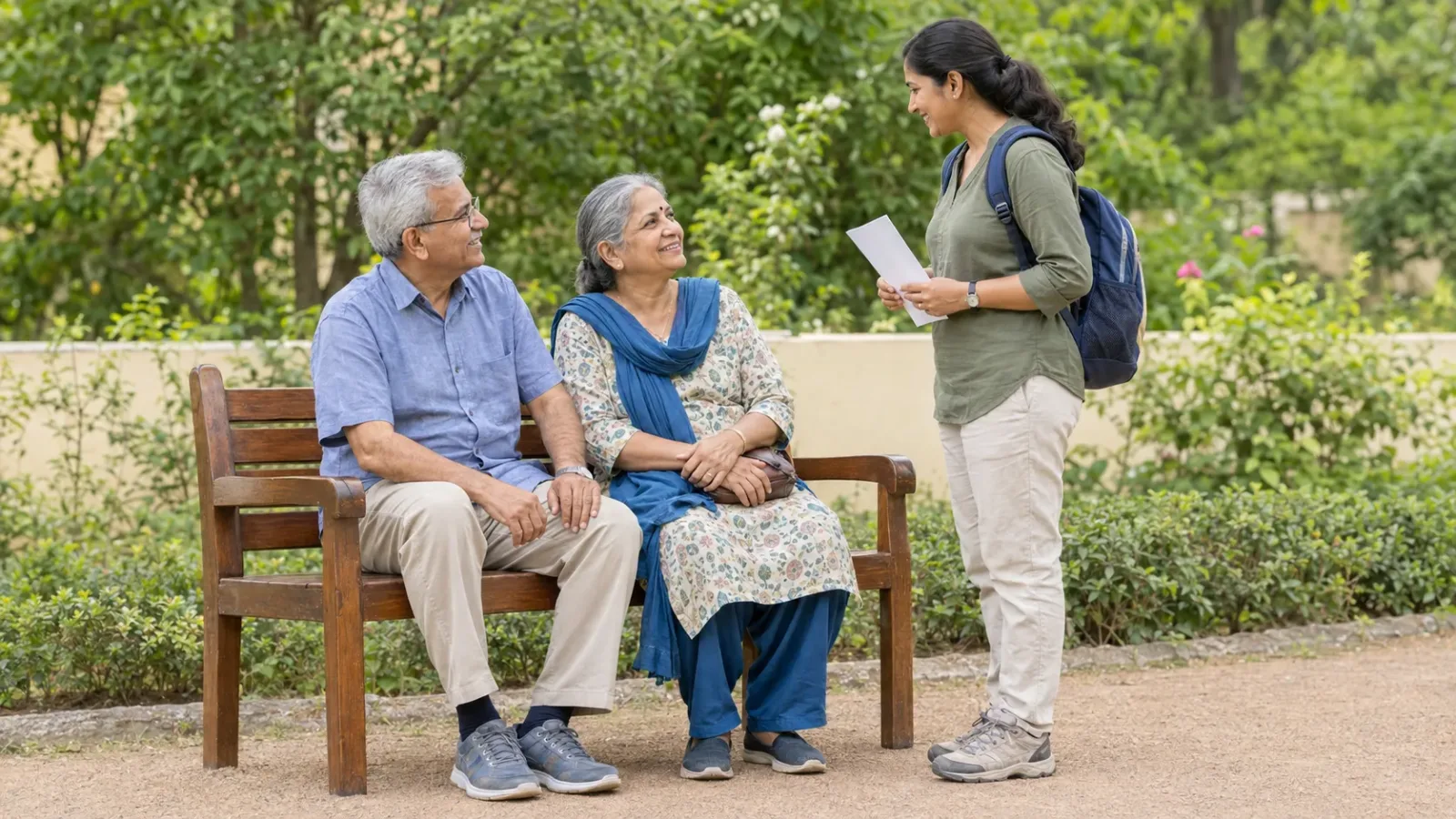
AI-generated fictional photograph of a couple resting on a garden bench while talking with their daughter. Not an actual attraction, verified route or promise of available seating.
Ask about your route, not the whole property
Choose the entrance, the one or two things the traveller most wants to see, and the exit or pickup point. Then look for seats along that sequence, including before entry, in any queue, between galleries or garden sections, and on the way out. A bench near the car park does not settle the route after the ticket barrier.
Ask staff to mark the nearest visitor-use seats on the current map and identify any longer stretch with no seating. Request approximate distances or a route description where available, and ask whether it includes steps, slopes or surfaces that matter to your group. Use the traveller's own preferences and familiar comfortable outings. This guide gives no medical walking limit or prescribed interval between rests.
Read the map with the access guide and visual story
A general tourist map may prioritise highlights rather than resting places. Kew's accessibility page recommends using its accessibility map alongside its visual guide. That is a useful method: a map shows relationships, while a guide or photograph can explain what a route and facility are like. It does not mean every access map contains a complete bench inventory.
Check the legend rather than assuming a picnic symbol, quiet area or viewpoint means a seat suitable for the traveller. Look for the document's date and current closure notices. Ask about missing details directly. Old visitor photos and reviews can suggest questions, but do not prove that the same seat remains in place, is reachable or is free to use today.
Check the kind of seat, not only the number
Ask about a backrest, armrests, seat height if it matters, shade or shelter, room beside the seat for a companion or mobility aid, and the approach surface. Tell staff which features the traveller needs rather than asking for a generic "senior-friendly bench". A low wall, stool, picnic table and backed chair are different options.
Knightshayes' access page describes different seating in its gardens, café and house, including chairs and benches with and without arms, and asks visitors to have a volunteer identify chairs that can be used. That is why a chair visible in a historic room is not automatically visitor seating. This is a named-site description, not a guarantee that a particular chair will be available.
Lanhydrock's access page separately describes garden benches and chairs, seats along the house route, and differing path surfaces and slopes. Seating somewhere on an estate does not establish easy access between all of those seats. Ask about the specific section you plan to use.
Distinguish a fixed seat, a borrowed stool and a café table
The National Gallery's access page describes seating in galleries and other areas, folding stools available during a visit and permission to bring a folding stool. Treat that as its own published arrangement, not a rule for every museum. For your attraction, ask where to collect and return a stool, current availability, whether it can go into the chosen exhibition and whether bringing your own is allowed.
A stool is only useful if the traveller can use it and someone can manage it through the route. Do not make an unsuitable stool, an unconfirmed loan wheelchair or carrying a seat the hidden condition for finishing a long visit. Ask the site about the equipment it actually supports; this article does not give setup, transfer or handling instructions.
The National Gallery's visual story says its eating and drinking spaces can be busy and noisy at lunch and their tables are for customers buying food or drink. A café icon is therefore not a guaranteed free rest base. Check opening, purchase or reservation requirements, access and likely waiting with the actual operator. Ask separately about public visitor seating if you do not intend to buy anything.
Do not turn a published spacing into a universal promise
Dunwich Heath's access page gives unusually specific information: benches described at 100 to 200 metre intervals and seat heights of 40 to 50 centimetres, with benches shown on maps. Those are that site's undated published details, not a recommended resting interval, today's inspection, a seat reservation or a pattern to assume at other attractions.
Ask about your planned path, closures, repairs and whether outdoor seats are exposed. A route with a seat every short section can still be unsuitable if those seats are wet, occupied or difficult to approach. Keep a shorter option that does not depend on a single bench being free.
Make the rest stop worth stopping for
Ask whether the traveller can enjoy the view, garden or artwork from the resting place, or whether it is only a waiting corner. Keep them involved in choosing the visit, rather than automatically leaving them at a café while everyone else sees the attraction. If the group separates by agreement, decide who stays, how you contact one another and where you rejoin.
For a tour or timed entry, ask whether pausing affects the group, re-entry or onward pickup. A ticket for an attraction is not confirmation that a tour guide will wait or that you can leave and return freely. Check the actual booking terms; no universal right or extra assistance is established here.
Keep a shorter route and verify again on arrival
Record a small chain: entrance, first desired sight, usable rest point, optional next section, and a way out. Ask staff where to turn back before a long unseated section and how to reach the agreed pickup without completing a one-way circuit. If the visit relies on a buggy, confirm its operation and conditions separately. Knightshayes' page, for example, says its volunteer-supported buggy depends on availability; a published buggy is not an unconditional rescue plan.
At arrival, check with the information desk about closed areas, moved seating and the current shortest return. If a key resting place or route is unavailable, shorten or change the visit before committing to the longer section. Do not pressure someone to continue because the next bench "should be just ahead".
Reviewed 14 November 2026 against the six primary pages linked above. Relevant revision dates for the seating passages were not established. These are named-attraction descriptions used to explain a checking method, not live seat availability, a complete access survey or medical advice. No seat, equipment, admission, tour or assistance was reserved or tested.

A Miranda House graduate and lawyer who traded courtrooms for slow travel. Cheshta travels with the batches we host ourselves, with a soft spot for travelling alongside elders.
Planning your next trip?
We'll handle insurance, hotels, airport assistance and the itinerary — the same way we do it for every trip.
Questions on this article
asked by readers, answered by us
Was this helpful?
one tap, no sign-up