




- Place
- Bhojpur
- Focus
- Unfinished construction evidence
- Source status
- India State Party tentative submission
- World Heritage inscription
- Not established by tentative listing
- Visibility / access
- Confirm actual permitted areas
Reviewed: 17 November 2026. Selective heritage outline, not a ticket or access guarantee.
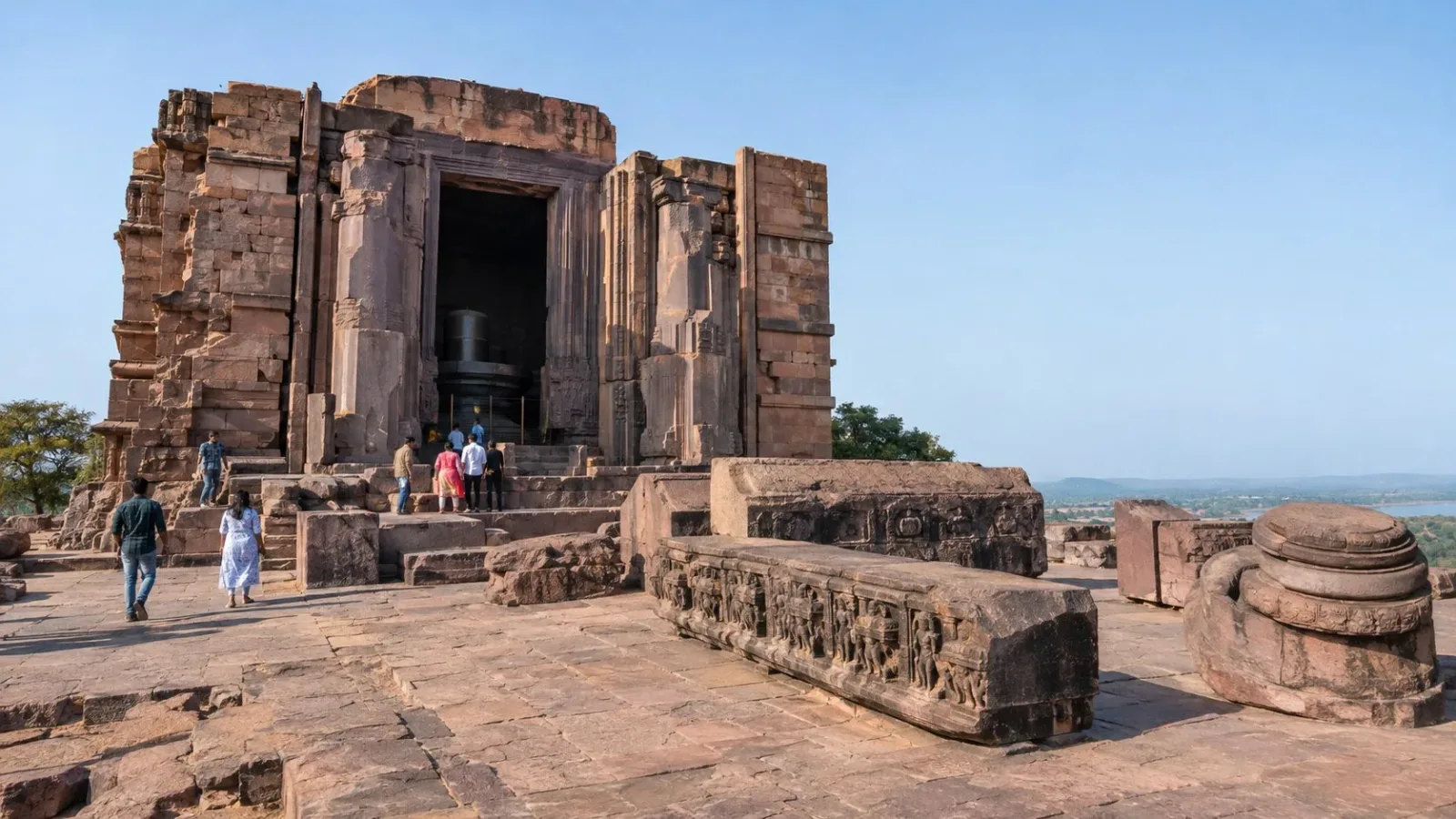
AI-generated fictional Bhojpur-inspired unfinished temple scene, not an exact reconstruction, material or sculpture identification, current viewing route or access record.
Bhojpur offers a question about making a building, not only looking at a finished one. India's tentative-list submission describes an unfinished temple alongside architectural working drawings cut into nearby rocks, unused carved masonry and earthen ramps. Read those as different kinds of evidence for planning and construction.
Start with the unfinished building
Both the tentative submission and Madhya Pradesh Tourism describe unfinished construction. That makes the distinction between intention and surviving work central to understanding the site. You do not need to imagine every missing part as though it had been completed.
The cited UNESCO-hosted page is India's State Party tentative submission, not inscription on the World Heritage List or UNESCO endorsement of every statement. Its descriptions can support this narrow construction question without becoming a current visitor map.
Distinguish drawings from built work
The submission describes drawings of architectural elements, including plans, pillars, doorways and other details, carved on nearby rocks. It relates those drawings to the intended design. That gives a useful distinction: a drawing records a proposed form, while surviving masonry shows built work.
Ask how a particular example is identified if an interpreter is available. This article does not label every line, provide a tracing exercise or certify a complete reconstruction. Do not touch, mark or trace a surface to make the connection for yourself. Visibility and permission must be established first.
Relate blocks and ramps to construction
The submission also describes unused carved blocks and earthen ramps associated with lifting masonry. Together with the drawings and unfinished structure, those features help explain the building process as the submission presents it.
They are not equipment for visitors to try. No block handling, ramp climbing or engineering demonstration is proposed. This article supplies no exact hypothetical height, world ranking or account of what every unfinished part would have become. The evidence can be interesting without turning an intended design into a completed building.
Check what is actually visible
Confirm whether the specific drawings, masonry and ramp remains you want to understand are currently visible from permitted areas. Heritage descriptions do not guarantee access to every surrounding rock surface or construction trace. Follow conservation directions and current barriers.
The sources also describe worship at the temple, but that does not settle today's eligibility, interior or ritual arrangements. Confirm these separately, along with opening, admission, last entry and photography. No shrine service or festival is reserved by this article.
Ask about the actual entrance, drop-off, walking, steps, surfaces, rest points, toilets, assistance and return. An old award or a general tourism itinerary is not proof of a continuous step-free route for your group. No complete visitor circuit, guide language, transport time or fixed duration is verified here.
Frequently asked questions
What is the main interest in this article?
How unfinished work, drawings, unused masonry and ramps provide different construction clues in the submission.
Is the tentative submission a World Heritage inscription?
No. It is India's State Party submission, with responsibility for its contents resting with that State Party.
Does a drawing prove the whole intended building was completed?
No. Intended design and surviving built work must be kept separate.
Can I touch drawings or climb the ramp remains?
No such activity is established here. Follow current conservation rules and confirm permitted viewing areas.
Does this article reserve a guide or transport?
No. Confirm the actual provider, language, meeting point, fee and return separately. A heritage description does not book a service.
Is there a fixed visit duration for every traveller?
No. This is a selective editorial outline. Check your group and actual route before adding further stops.
Official sources and limits
Official heritage descriptions support the named structures and architectural features, not current opening, final fees, combined ticket scope, services or continuous accessible routes. Verify the actual visit separately.

A Miranda House graduate and lawyer who traded courtrooms for slow travel. Cheshta travels with the batches we host ourselves, with a soft spot for travelling alongside elders.
Planning your next trip?
We'll handle insurance, hotels, airport assistance and the itinerary — the same way we do it for every trip.
Questions on this article
asked by readers, answered by us
Was this helpful?
one tap, no sign-up