



Plan by how you will pay on the actual trip, not by choosing cash or a forex card as a universal winner. Check which expenses require local notes and which accept your specific prepaid card, then price the complete purchase, use and return of the currency. A mix can be useful, but there is no fixed cash percentage for every destination.
First distinguish the two products
Cash is physical currency bought from an authorised provider. A prepaid forex card holds a loaded balance; it is not automatically the same as an international credit or debit card. RBI’s forex FAQ identifies authorised banks and money changers for travel exchange and describes permitted use of stored-value cards at overseas merchants and ATMs, subject to the applicable rules. Permission to issue a card is not a promise that every merchant accepts it. Official source.
Compare cash with the card before buying either
For cash, ask for the net local currency you receive for the total rupee payment, any commission and the buy-back quote for unused notes. Confirm useful denominations and the actual destination’s cash rules. For the card, ask about the load exchange rate, issuance, reload, ATM, conversion, taxes and refund process. Compare the same currency and amount on the same day, not an advertised rate with an all-in quote.
A named fee comparison, not a best-card ranking
The following HDFC Bank examples were checked on 28 October 2026. They show why “forex card” is not one price. These are selected published charges, not an all-in quote or a recommendation to buy either card.
HDFC Multicurrency Platinum ForexPlus Chip Card
Issuance: ₹500 plus applicable GST. Published USD ATM withdrawal fee: USD 2 per transaction. Cross-currency markup: 2% when the transaction currency differs from the currency available on the card; the page also lists 2% on wallet-to-wallet currency transfers. Other charges and taxes can apply.
HDFC Regalia ForexPlus Card
Issuance: ₹1,000 plus applicable GST. Published USD ATM withdrawal fee: USD 4 per transaction. The bank lists no cross-currency markup when the transaction currency differs from its USD wallet. That does not mean the whole transaction, cash withdrawal or initial currency purchase is free.
Reload needs a channel-specific quote
The Multicurrency fees page lists ₹75 plus GST per reload transaction, currency-wise. Its product page more specifically lists ₹75 plus GST for branch reloads and no fee through its Prepaid/Forex online portal. Confirm your exact channel before pricing a reload rather than applying one figure everywhere. The product page also says online reloading is for existing HDFC Bank customers only; do not rely on an untested reload route after leaving India. Official source.
Document flow: choose, apply, verify, activate, test
For this HDFC Multicurrency example, the eligibility page asks existing account holders for a self-attested valid passport and PAN if not already updated. Non-account holders are asked for passport, PAN, an international ticket or visa, and a passbook copy or one-year statement of the funding account, with a signed application. The bank may amend its requirements and activates the card only after KYC verification. Obtain the current checklist, submit through the bank’s secure route, confirm activation and set up the required access before travel. Never put PINs or full card details in a shared trip sheet. Official source.
Verify acceptance and access, not just the balance
Ask the actual hotel, transport provider or merchant about the payment method it accepts, especially for a deposit or pre-authorisation. Check the card’s enabled transaction channels and the issuer’s ATM conditions. HDFC’s terms warn that an ATM owner may add fees; its fee page notes that a lower acquiring-bank withdrawal limit can apply. A published daily card limit is not a promise that a particular ATM can dispense that amount. Official source.
Plan the unused balance before loading
Ask the issuer how to request partial or full encashment, which documents it needs, the conversion rate, taxes and any fees. HDFC’s fee pages say currency-conversion tax applies to load, reload and refund transactions. Do not assume a refund converts at the original load rate or arrives instantly. For unused physical notes, check RBI’s retention and surrender rules with the authorised provider; card balance and notes are not the same form of money. Official source.
Make the decision for this trip
Use local cash for the payments you have confirmed need it, and compare a forex card for the payments it can actually cover. For a separate backup plan, use our emergency-cash guide. Before paying, obtain a dated all-in quote and confirm the applicable regulatory and tax treatment with the authorised provider. This article supplies neither a personalised allowance nor a product approval.
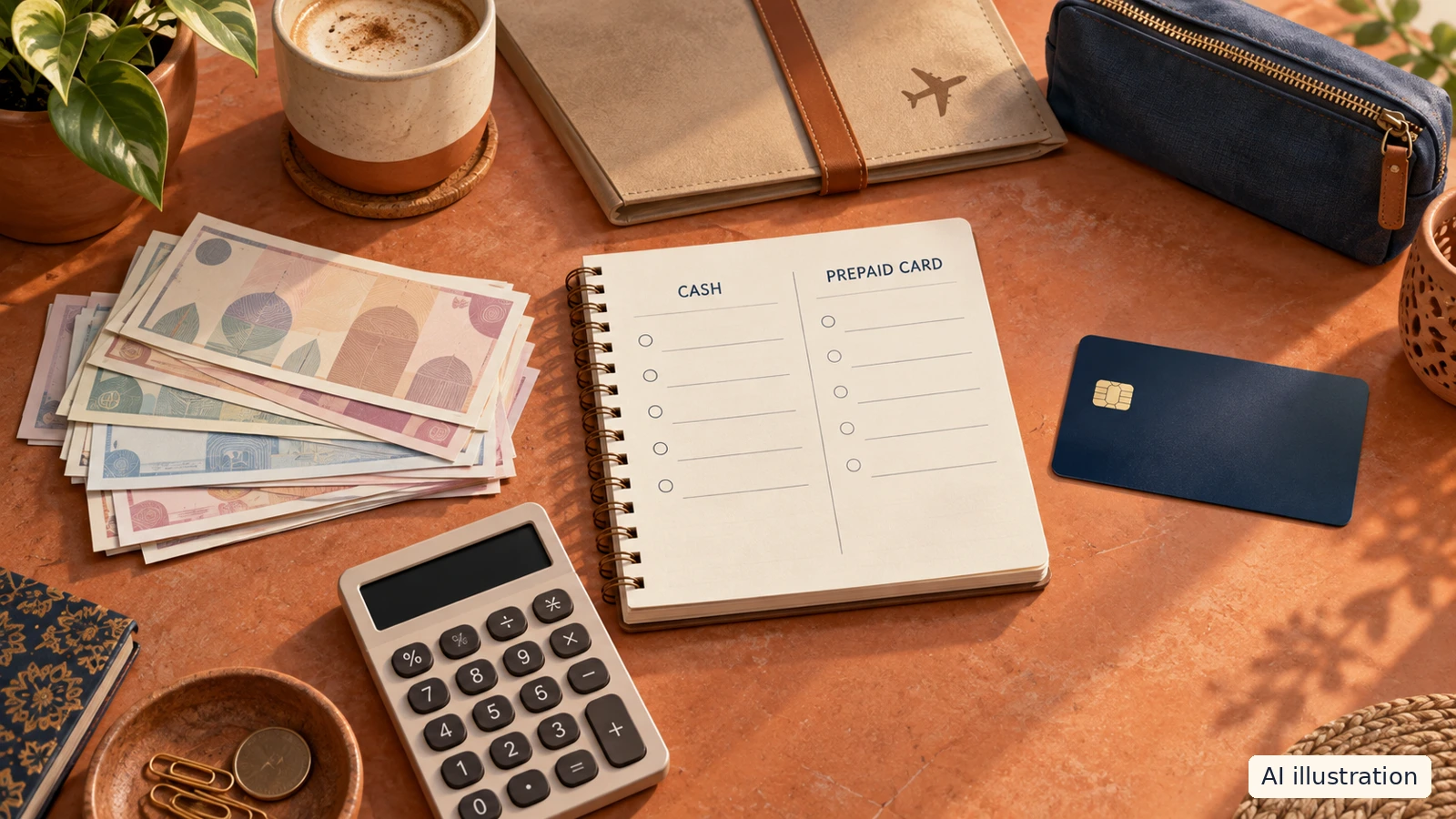
AI illustration: Fictional currency-shaped paper slips, a blank card prop and a cost notebook. Not real banknotes, a bank product, an exchange-rate quote or financial records.
Quick questions
Is a zero cross-currency markup card free to use?
No. Compare issuance, exchange rate, ATM, taxes and other applicable charges for the exact product.
Can every HDFC Multicurrency cardholder reload online?
The product page limits online reload to existing HDFC Bank customers. Confirm the usable channel and its fee before travel.
Does a forex card replace all cash?
Only if every required payment accepts it, which you must verify. Plan the actual expenses and a separate usable backup, not a fixed worldwide cash ratio.

A Miranda House graduate and lawyer who traded courtrooms for slow travel. Cheshta travels with the batches we host ourselves, with a soft spot for travelling alongside elders.
Planning your next trip?
We'll handle insurance, hotels, airport assistance and the itinerary — the same way we do it for every trip.
Questions on this article
asked by readers, answered by us
Was this helpful?
one tap, no sign-up