




- Subject
- Wooden form and surface finish
- Shaping described
- Lathe-turned curves
- Finish described
- Coloured lac
- Product certification
- Not established
- Reviewed
- 17 November 2026
Reviewed: 17 November 2026. Form-and-finish explanation, not a making lesson or individual-product assessment.
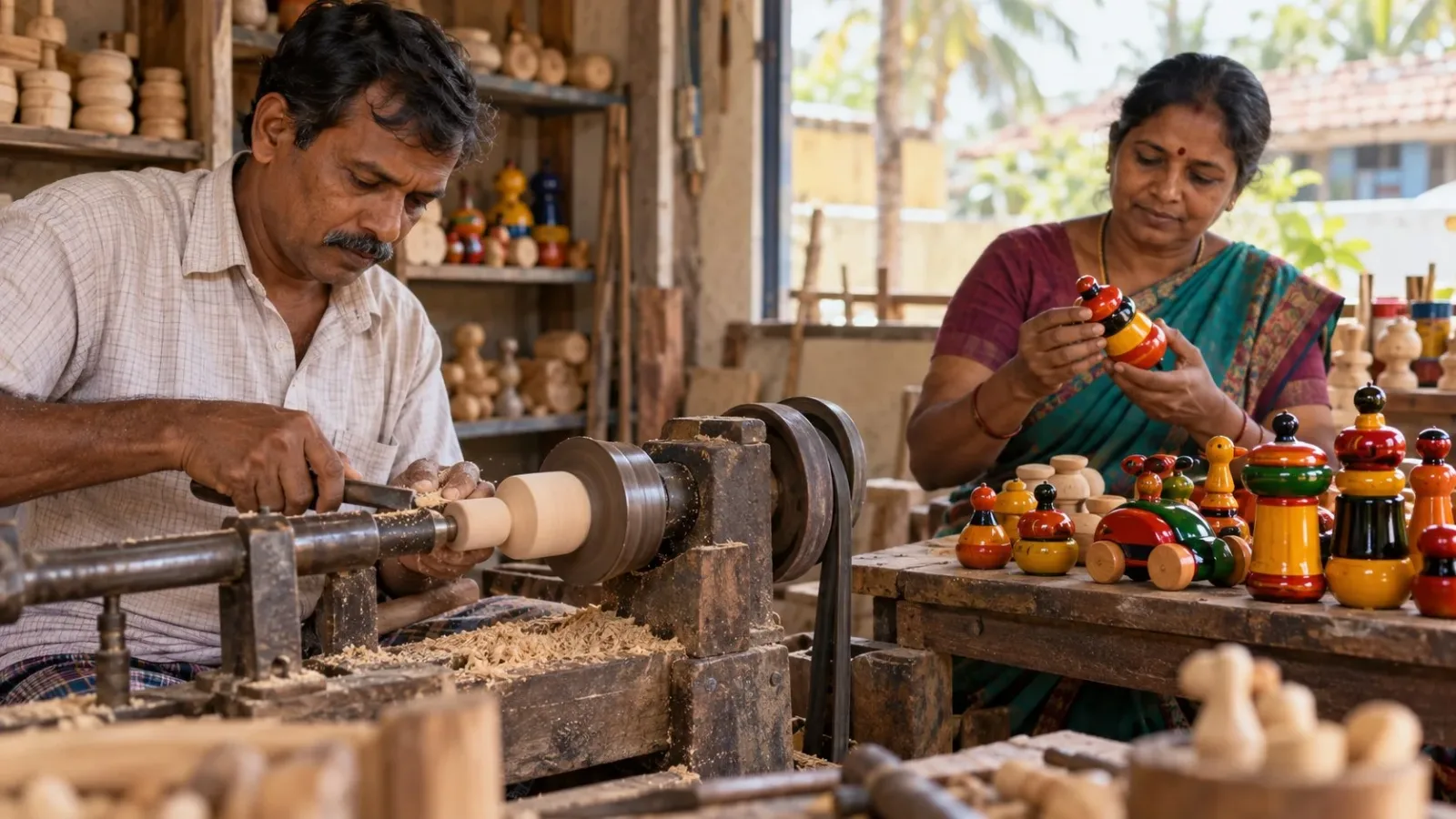
AI-generated fictional workshop scene with generic people; not an identified craftsperson, exact tool or finishing method, historical reconstruction, safety demonstration or current visitor activity.
For Channapatna toys, separate the wooden form from the lacquer finish. The Development Commissioner (Handicrafts) describes wood turned on a lathe to create curves, followed by a coloured lac finish. The shape and the finished surface are related, but they are not the same part of the work.
Give the wooden form its own attention
The official account describes shaping and smoothing the wood. In its description of turning, the lathe creates curves in the workpiece. This explains the reference to turned forms: the term concerns shaping the wooden object, not simply giving it a bright colour.
Keep the looking question modest. What belongs to the object's form, and what belongs to its surface finish? The source explains a craft relationship; it does not provide a map of every object or establish how a particular item in front of you was made.
This is not a guide to using a lathe, cutting wood or choosing a tool. No visitor participation or permission to handle workshop equipment is established.
Keep the lacquer finish distinct
The same account describes coloured lac applied to the shaped piece and calls the result a polished decorative finish. Its description of glossy lacquer concerns the surface of the wooden form.
Calling that surface a finish keeps the two ideas clear. The curve belongs to the described shaping work; the coloured lacquer belongs to the described finishing work. A finished toy brings them together, but colour is not another name for the wooden form.
No lacquer recipe, heating method or sequence for making a toy is supplied here. The point is to understand the terms in the official description, not reproduce the work.
Do not turn the description into a product test
A general craft account does not identify the wood, colourant or coating in an individual object. Nor does appearance certify that an item is authentic, suitable for a child or safe for food contact. Those claims are not established here.
Do not scratch, heat, taste or otherwise test a surface to settle the distinction. No material test is proposed. A photograph, glossy colour or place name is not treated as a certificate.
The narrow takeaway is form and finish: wood shaped by turning, and a coloured lac surface described separately. No seller, workshop, class, purchase or current production arrangement is verified by this explanation.
Frequently asked questions
What does turned form mean in this account?
The wood is shaped on a lathe to create curves.
What does the lacquer description concern?
The coloured decorative finish on the shaped wooden piece.
Does a glossy surface prove authenticity or child safety?
No such proof is established here. This is not an individual-product assessment.
Does this explain how to make a toy?
No. No tool instructions, heating method or lacquer recipe are given.
Does this identify a particular wood or colourant?
No. A general craft account does not establish materials in an individual object.
Is a workshop visit or purchase verified?
No. No seller, current workshop arrangement, class or purchase is confirmed.
Official sources and limits
Qualitative turned-form and coloured-lac-finish description only. No recipe, tool instruction, individual material identification, authenticity, child-safety or food-contact assessment, present workshop, seller or access claim is established.

A Miranda House graduate and lawyer who traded courtrooms for slow travel. Cheshta travels with the batches we host ourselves, with a soft spot for travelling alongside elders.
Planning your next trip?
We'll handle insurance, hotels, airport assistance and the itinerary — the same way we do it for every trip.
Questions on this article
asked by readers, answered by us
Was this helpful?
one tap, no sign-up