




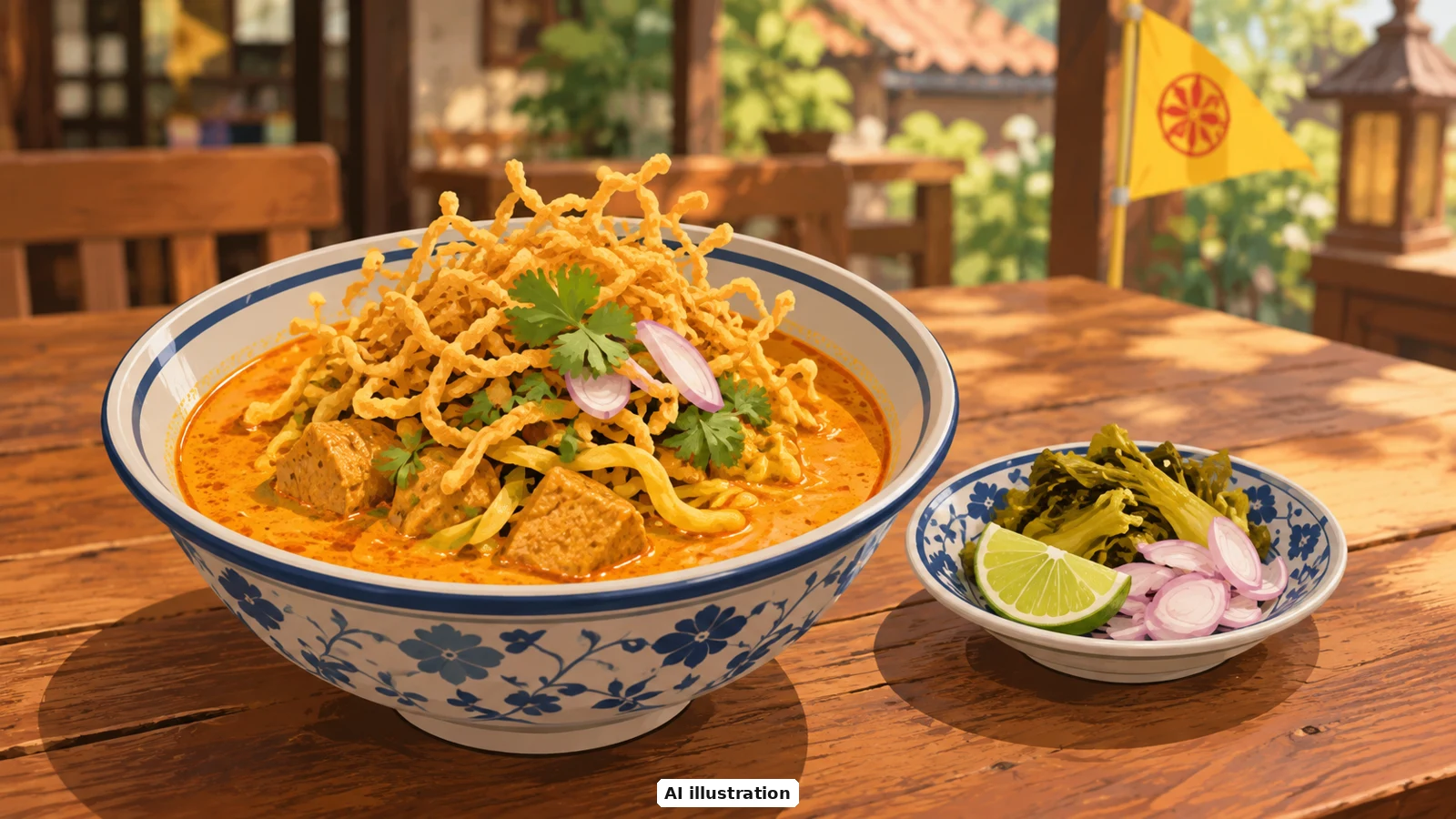
The one-line answer: learn one word - jay (เจ, sounds like "jair") - and eat better as a vegetarian in Chiang Mai than almost anywhere else in Southeast Asia. A yellow flag with red เจ characters means strict Buddhist vegan: no meat, fish, eggs, dairy, and usually no garlic or onion either - the closest thing Thailand has to a Jain kitchen. A full rice-and-curry plate at a jay shop costs ฿40-80 (Rs 115-230). Here is how the whole system works, including the famous khao soi.
First, the trap: "vegetarian" does not mean vegetarian
The Thai word mangsawirat (มังสวิรัติ) translates as vegetarian, but in practice it can include egg and dairy - and, far worse for Indians, dishes described as "vegetarian" or "just vegetables" routinely carry the Thai cooking trinity of hidden animal products: fish sauce (nam pla), oyster sauce and shrimp paste (gapi). A vegetable stir-fry seasoned with fish sauce is not vegetarian by any Indian standard, and the menu will not tell you. Removing the chicken from a finished curry does not help either - the paste and stock were built with shrimp paste and chicken stock long before you ordered. This is why the label matters less than the kitchen: at a dedicated vegetarian or jay kitchen, none of this negotiation is needed.
The jay system: your daily driver
Jay (เจ) is the Chinese-Thai Buddhist vegetarian tradition: strict vegan plus, by custom, no garlic or onion - immediately familiar to anyone raised on Jain or sattvic rules. You find it by the yellow flag or sign with red เจ characters, and it comes in two forms:
- Jay rice-and-curry shops - the local's everyday lunch. Point at trays of plant-based dishes over rice; a full plate runs ฿40-80. They cluster around fresh markets and temples - Warorot Market near the river, Pra Pokklao Road in the Old City, and stalls near the Old City gates in the morning. Cheaper and often better than the tourist-facing vegan cafes.
- Jay restaurants - sit-down places flying the same flag, with curries, noodles and remarkably convincing mock meats at ฿150-300.
Once a year (usually late September or October), the nine-day Vegetarian Festival (Tesagan Gin Jay) turns much of the city jay: yellow flags everywhere, vegan versions of every Thai dish, and temples offering free jay meals. If your dates overlap, you will eat extraordinarily well.
For Jains specifically: jay food avoids garlic and onion by default, which covers most of the restriction - but practices vary by cook, so ask "jay, no onion?" to be sure. For strict Jains this is as close to a guaranteed-safe foreign cuisine as exists.
The khao soi question
Khao soi - the coconut-curry noodle soup that defines Chiang Mai - is the dish every vegetarian visitor wants and the one most likely to disappoint if ordered casually. The standard bowl is built on chicken or beef stock, a curry paste containing shrimp paste, and fish sauce in the seasoning. "Hold the chicken" fixes nothing. The working approach:
- Order it only where a vegetarian or vegan version is explicitly made. A proper vegan khao soi rebuilds the broth from mushrooms and roasted vegetables and uses a gapi-free paste - and done well, it is genuinely excellent. The fried noodles on top and the pickled mustard greens on the side are naturally vegan.
- Use it as the restaurant test: local vegetarians judge a kitchen by its vegan khao soi. If a place does it well, trust the rest of the menu.
- Price check: ฿50-80 at jay shops, ฿120-180 at dedicated vegetarian restaurants.
Other northern dishes, adapted
The same rule - the danger is in the paste, broth and sauce, not the visible ingredients - applies across the menu. Safe and easy wins: pad thai with tofu (ask for no egg, no fish sauce), green or massaman curry at vegetarian kitchens, som tam without dried shrimp (ask - the standard papaya salad carries both shrimp and fish sauce), stir-fried basil tofu, and mango sticky rice, which is already vegan. Nam prik noom (the roasted green chilli dip) needs the shrimp-paste question every time.
The phrases that work
- "Gin jay" - I eat jay (strict vegan). The single most useful sentence.
- "Mai sai nam pla" - no fish sauce.
- "Mai sai kai" - no egg.
- "Jay, no onion?" - the Jain follow-up.
In a busy shop with little English, a written Thai sentence beats pronunciation - paste your full exclusion list into a translation app once and keep it on your phone.
Where to eat: the shortlist
- Pun Pun Vegetarian (Wat Suan Dok) - organic farm-to-table Thai, a Chiang Mai institution; meals ฿50-80.
- Anchan Vegetarian (Nimman) - the all-rounder; vegan khao soi, garden setting, ฿150-300.
- AUM Vegetarian (Haiya, near the Old City) - decades-old family favourite, ฿60-150.
- Goodsouls Kitchen (Old City) - generous vegan comfort food, ฿80-200.
- Imjai Vegan (Nimman/Huay Kaew) - budget pick, ฿50-80.
- Jay stalls at Warorot Market and the morning gates - the cheapest good meal in the city.
- When only dal tastes like home: Rajdarbar (Night Bazaar area) is Chiang Mai's dedicated North Indian restaurant - decent, and honestly the only one that matters.
Chiang Mai has 40+ dedicated vegetarian and vegan restaurants, densest in Nimman and the Old City. Cool season (November-February) is the best time for the market-browsing this guide is built on. Menus and prices move - treat the numbers as 2026 indicative and confirm on the spot.

A Miranda House graduate and lawyer who traded courtrooms for slow travel. Cheshta travels with the batches we host ourselves, with a soft spot for travelling alongside elders.
Planning your next trip?
We'll handle insurance, hotels, airport assistance and the itinerary — the same way we do it for every trip.
Questions on this article
asked by readers, answered by us
Was this helpful?
one tap, no sign-up