




Reviewed 18 November 2026. An interest-first guide using official zoo, HMI, district and national tourism sources. Check current official visitor information for the place you choose.
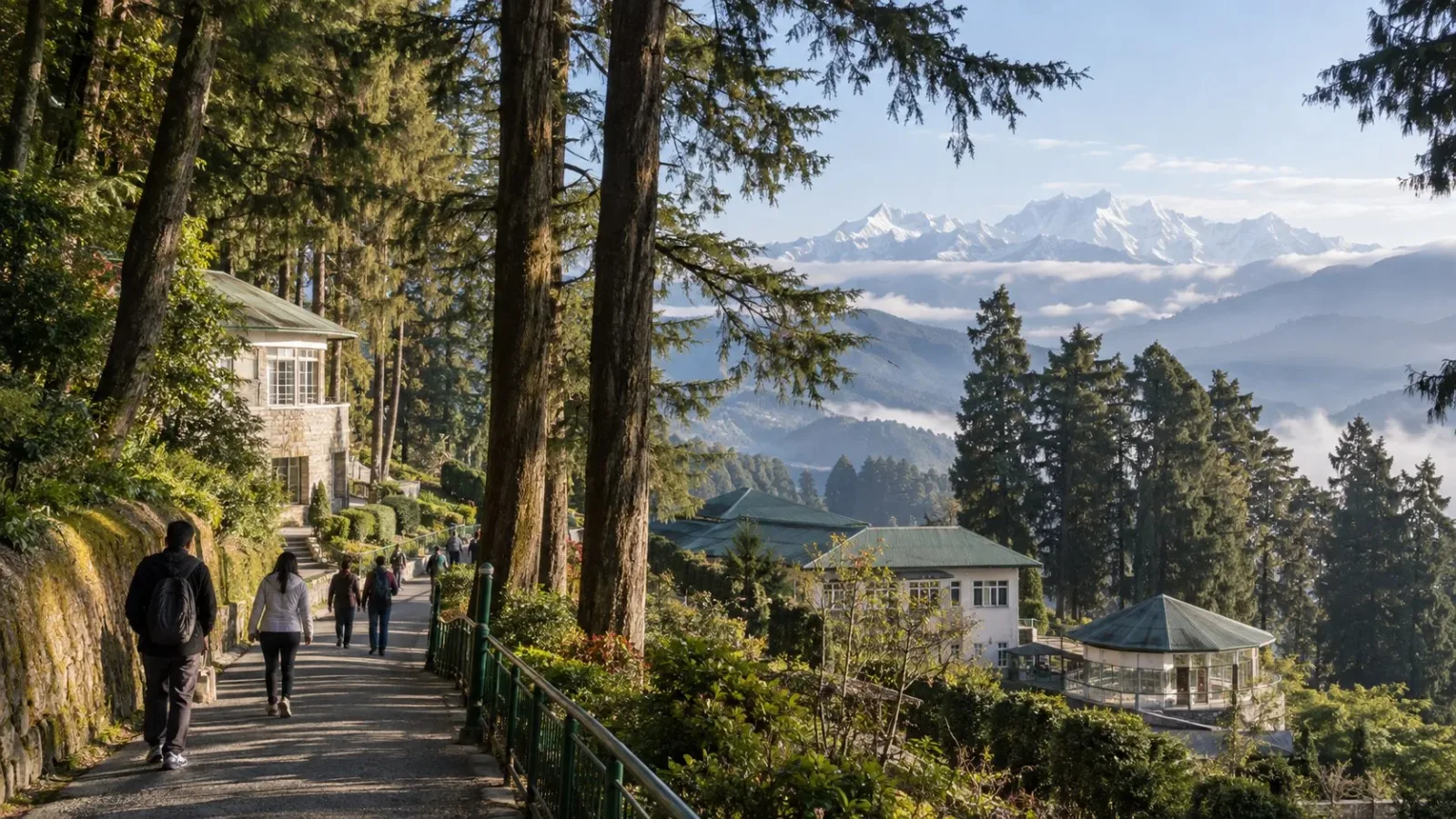
AI illustration: a fictional wooded hillside scene inspired by Darjeeling, with travellers and institutional buildings. Not an actual location, person, animal sighting or service.
Choose what you want to learn
Darjeeling's Padmaja Naidu Himalayan Zoological Park and Himalayan Mountaineering Institute offer different subjects: Himalayan wildlife and the history of climbing.
Choose the main interest before making a list of everything nearby. Give that subject a useful part of the day, with food, rest and the return. Check current official visitor information for your choice.
Zoo: conservation before a checklist
The zoo's account describes conservation breeding involving red pandas and snow leopards. Read that work as part of the institution's purpose, not simply a list of animals to collect in photographs.
Our suggestion is to spend patient time observing a few animals rather than rushing between names. A species description is not a report that a particular animal will be visible when you arrive.
Watch without making an animal perform
Let the animal's own activity set the moment. A quiet or hidden animal does not make the outing unsuccessful, and a photograph does not need to be the measure of the visit.
Follow staff directions and respect barriers. Avoid noise or attempts to attract an animal for the camera. Keep observation separate from expectations of contact or performance.
HMI: read equipment as evidence
HMI's museum description includes the evolution of mountaineering equipment and equipment associated with the first successful Everest ascent in 1953. It also describes models, photographs and other expedition material.
Choose a question: what changed in equipment, what a model explains, or how an expedition is remembered. A few carefully read objects can be more useful than trying to finish every display.
Mountains are more than a summit
The institute describes a relief of the Himalayan range, with peaks, glaciers and river systems, as well as material about Himalayan environments, art and culture.
This gives a second way into the museum for someone less interested in summit achievements. Compare landscape, people and exploration while remembering that a display is a selected interpretation. Check current official visitor information for HMI.
Keep the shorter outing complete
Make the other subject optional rather than promising a full zoo-and-museum circuit. Let the group's interest and remaining energy decide whether more still feels worthwhile.
Keep a proper meal, sitting-down time and a clear return. Ask the actual food provider about ingredients when dietary needs matter, and use the full place name when arranging the journey.
Sources
Questions people ask at the gate
Which main interest should we choose?
Choose Himalayan wildlife and conservation at the zoo, or climbing history and mountain environments at HMI.
Does a species list guarantee a sighting?
No. It is not a report that a particular animal will be visible at your visit.
What conservation work does the zoo describe?
Its account includes conservation breeding involving red pandas and snow leopards.
What does HMI describe about equipment?
The evolution of mountaineering equipment and material associated with the 1953 Everest ascent.
Is HMI only about summit achievements?
No. Its museum description also includes Himalayan environments, art and culture.
Must we complete both institutions?
No. Keep one main interest, check current official visitor information and leave food, rest and the return in the plan.
Next walk starts at a new gate.
Was this helpful?
one tap, no sign-up

A Miranda House graduate and lawyer who traded courtrooms for slow travel. Cheshta travels with the batches we host ourselves, with a soft spot for travelling alongside elders.