




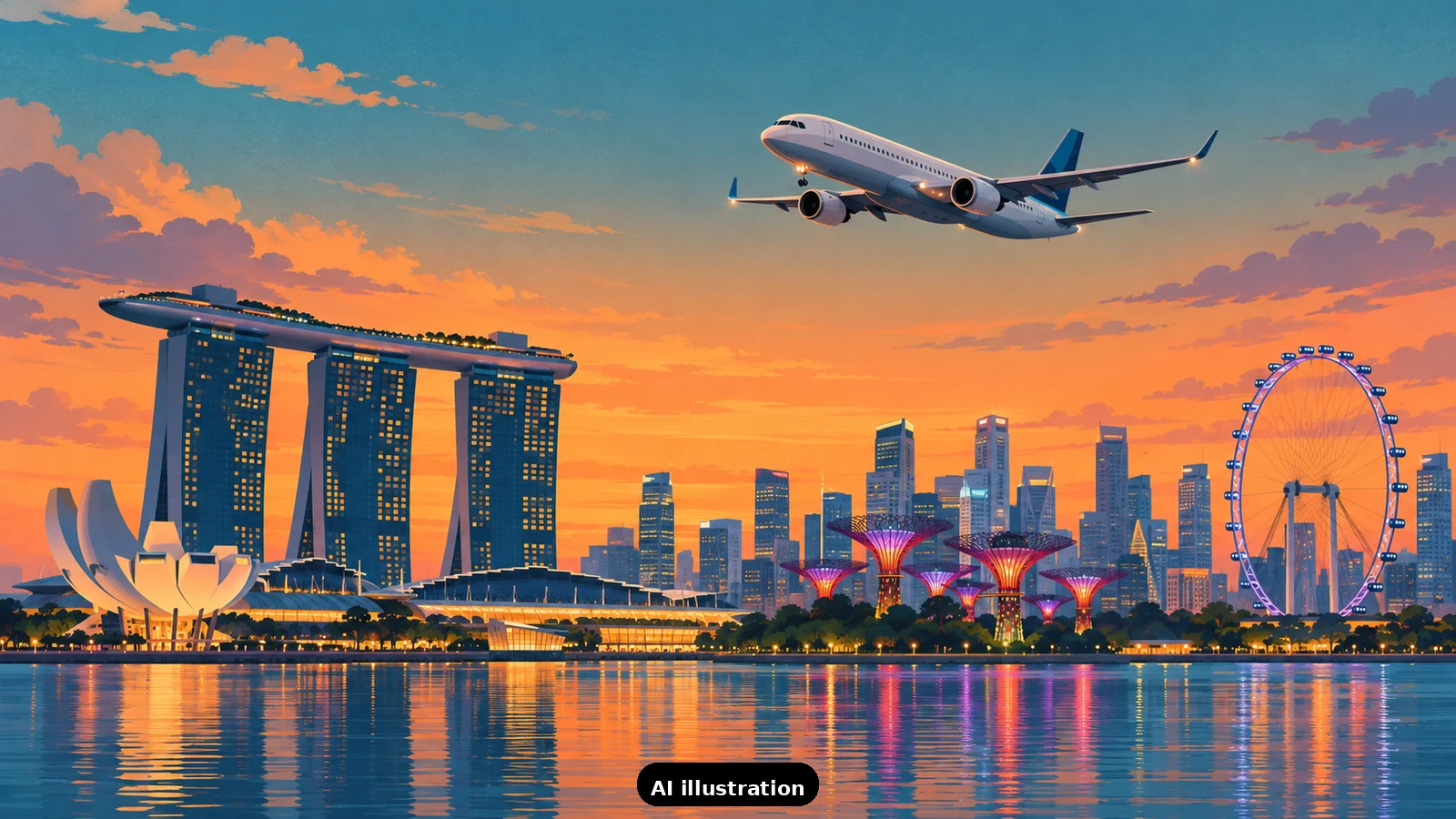
Delhi to Singapore looks simple on a map: a straight line southeast across the Bay of Bengal, 4,157 kilometres. In practice there is exactly one sensible way to travel it for a holiday, and two adventurous ways that technically exist. This guide compares all three honestly, with 2026 fares, timings and the paperwork the road route quietly demands.
The short version
Fly. About nine non-stop flights run daily between Delhi (DEL) and Singapore Changi (SIN) on three airlines: IndiGo, Air India and Singapore Airlines. The block time is 5 hours 40 minutes to about 6 hours, and a one-way ticket booked a few weeks out costs roughly Rs 12,000 to 15,000 on the budget carriers. There is no train, and the road route is a two-to-three-week expedition through Myanmar, Thailand and Malaysia, not an alternative for a normal trip.
Flying: the option that makes sense
Non-stop flights
Three airlines fly non-stop between the two cities:
- IndiGo runs a morning departure (6E 1203, around 9:20 AM, landing about 5:45 PM Singapore time). It is consistently the cheapest seat on the route, from about Rs 11,500 to 13,500 one way when booked early.
- Air India flies several daily rotations, including an early-afternoon departure (around 1:25 PM, landing 9:55 PM) and a late-night 10:35 PM departure that lands at dawn. Fares from about Rs 13,000 one way.
- Singapore Airlines flies the evening SQ 403 (around 9:45 PM) plus codeshares operated with Air India. The premium option, from about Rs 29,000 one way, worth it when a full-service night flight and proper rest on arrival matter.
Schedules shuffle seasonally, so treat these timings as the late-2026 pattern and confirm for your dates.
What fares actually look like
On current 2026 fare calendars, a non-stop one-way runs about Rs 12,000 to 18,500 in ordinary weeks, rising past Rs 20,000 to 25,000 around the December holidays and long weekends. The cheapest months to fly are May to June and September, when fares dip toward Rs 12,000 and below. Booking four to eight weeks ahead makes the biggest difference; inside ten days, budget-carrier fares converge with full-service ones.
Are one-stop flights worth it?
Occasionally. One-stop routings via Kuala Lumpur, Bangkok or Colombo sometimes undercut the non-stops by Rs 2,000 to 4,000, but add four to six hours of travel time and a second takeoff. For a family of four, that saving can top Rs 12,000, which is real money; for a solo traveller on a short trip, the non-stop wins almost every time. Check both before booking.
By train: the honest answer
There is no train from India to Singapore, and no cross-border passenger rail from India into Southeast Asia at all. India's rail network effectively ends before the Myanmar border, where tracks do not connect through. The famous Eastern and Oriental Express, the wood-panelled luxury train between Singapore and Bangkok, is a holiday in itself with fares in the lakhs, not a way to travel from Delhi. If an itinerary sells you "Delhi to Singapore by train", it is a stitched-together fantasy.
By road: an expedition, not a commute
Driving from India to Singapore is legal and has been done, mostly by organised adventure groups. The route runs roughly 5,000 km from Delhi: across Uttar Pradesh and the Northeast to the Moreh border in Manipur, through Myanmar from Tamu, across Thailand from Mae Sot down past Bangkok, the length of peninsular Malaysia, and over the causeway at Johor Bahru into Singapore. Budget two to three weeks of driving. What the route demands on paper:
- Myanmar is the gatekeeper. Individual self-drive entry is not permitted. You need a pre-planned itinerary, hotel bookings and a government-approved local guide travelling with you, arranged through a Myanmar-registered tour company, with vehicle and driver documents submitted about a month in advance. A lead car for the convoy is mandatory even for a single vehicle.
- Carnet de Passages. Your vehicle needs a carnet to cross these borders, issued in India against a deposit of up to 200 per cent of the vehicle's value.
- Visas and permits for five countries. Beyond your Singapore visa, the drive needs Myanmar, Thailand and Malaysia visas or entry permits, an International Driving Permit, and fresh vehicle insurance at each border.
- Singapore's own layer. Foreign vehicles entering Singapore need a Vehicle Entry Permit and an Autopass card for tolls and entry charges, and the city-state's traffic rules are enforced precisely.
Add up the guide fees, carnet deposit, permits, fuel and three weeks of hotels, and the drive costs more than business-class flights for the whole family. Do it because the journey is the point, not to reach Singapore.
The combination that actually makes sense
For a Singapore holiday from Delhi, the arithmetic is simple: a non-stop flight out and back, booked six to eight weeks ahead on IndiGo or Air India for the fare, or Singapore Airlines' night flight if sleep quality matters more. Use the money and the week you save on the trip itself. And if the overland idea genuinely excites you, plan it as its own expedition with a specialist operator, not as the way to reach Gardens by the Bay.
Bottom line
Delhi to Singapore is a flight route. Nine daily non-stops, under six hours in the air, from about Rs 12,000 one way: that is the combination that makes sense for a holiday. The train does not exist, and the road is a magnificent, paperwork-heavy adventure for a different kind of trip entirely.

A Miranda House graduate and lawyer who traded courtrooms for slow travel. Cheshta travels with the batches we host ourselves, with a soft spot for travelling alongside elders.
Planning your next trip?
We'll handle insurance, hotels, airport assistance and the itinerary — the same way we do it for every trip.
Questions on this article
asked by readers, answered by us
Was this helpful?
one tap, no sign-up