




Last checked: 11 November 2026. A baby visit to Designmuseum Danmark starts with leaving your own stroller out of the exhibitions, not choosing the smallest model. Confirm the loan’s age and fit, plan the actual workshop route and separate a ticket-free café stop from the paid galleries.
Your own stroller cannot follow you into the exhibitions
The practical information bars personal baby carriages, prams, strollers and pushchairs from exhibition areas. This is not just a ban on large carrycots or a request to fold a wide model. Folding strollers can be borrowed at the ticket counter, but no stock count, reservation system or equipment dimensions were established. Do not arrive with a compact own stroller expecting its small size to create an exception. Ask where it can be left, what loan equipment is actually available and how the family will move through the chosen route. The sources do not promise pram parking, a carrier loan or a stroller suitable for every child. If the visit depends on one particular setup, settle that question before buying a ticket rather than turn a general baby-welcome message into an equipment guarantee.
At exactly one year, the wording needs a check
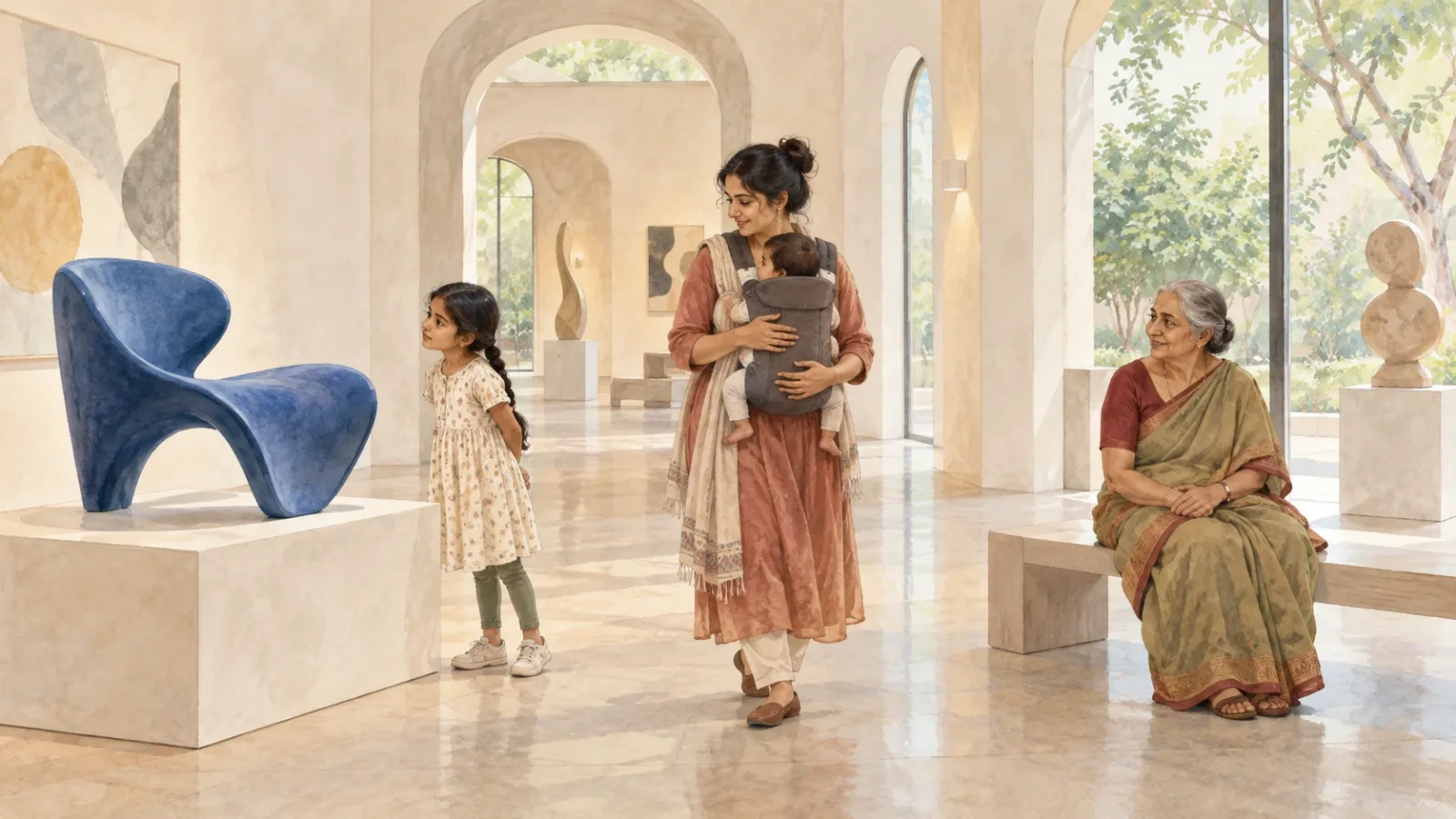
The practical page calls loan strollers suitable for children one year or older. The English family page says over one year, as does the Danish family guidance. A child at exactly twelve months sits at that wording boundary, so ask about the current equipment and suitability rather than silently choose the more permissive phrase. For babies too young to sit upright, the operator recommends bringing a baby carrier; this is the museum’s practical suggestion, not this guide’s assessment of a baby’s development or a medical fit recommendation. Use equipment that the caregiver already knows how to use and confirm the museum’s rules. The fictional illustration shows a family scene, not an instructional demonstration. It establishes neither a carrier’s safety nor a loan stroller’s fit, recline or support.
All exhibitions accessible does not settle an upstairs workshop route
The dedicated accessibility page says wheelchair users can access all exhibitions, the shop, library and café. It describes a ramp from the entrance hall to the garden, from which the café can also be reached. The practical page separately says there is no elevator to the first-floor conference facilities, assembly hall and temporarily closed porcelain collection. These statements need to be read by destination, not flattened into either no museum access or every room in the building accessible. The family page places workshops in the banquet hall, so ask about the current workshop venue and actual step-free route before depending on a session. A dedicated exhibitions-access statement does not prove access to an event room. Accessible toilets are listed on the ground floor near the entrance hall, and a lightweight wheelchair can be borrowed on arrival, subject to actual availability. The dedicated page grants free entry to a companion of a visitor with a disability; confirm any practical requirements directly.
A family workshop happens on selected days, not every Saturday
The family pages describe creative work with shapes, colours and materials on selected Saturdays and during school holidays. That is not a daily staffed playroom, every-weekend guarantee or a reserved seat bundled with every ticket. Check the dated programme for the actual audience, language, duration, cost, booking requirement and route. The garden includes Anne Brandhøj’s Playmates figures, where the operator specifically permits touching and climbing at the visitor’s responsibility. That invitation is for the named play figures, not the whole sculpture collection, display chairs or gallery objects. Outdoor play depends on the weather and current access; it is not a sheltered winter activity. Choose a small number of exhibits the family wants to see, and treat a confirmed workshop or garden stop as an addition, rather than the unverified centre of the day.
Changing and breastfeeding are confirmed; a family picnic is not
Changing facilities are listed by the entrance-hall toilets, and breastfeeding is allowed throughout the museum. FORMAT’s children’s menu and highchairs are also described on the family pages. No microwave, bottle-warming facility, private feeding room or highchair reservation was established. The Danish family page asks visitors to put loose items, including bags and water bottles, in cloakroom lockers, so ask staff how to keep essential baby supplies with you. The practical food rule directs refreshments to the café and allows schools and kindergartens to bring food to the garden in warm months. It does not grant every family an indoor packed-lunch room or a winter picnic exception. Ask before relying on brought meals. A permission to breastfeed is not the same thing as permission for a whole family to eat a picnic among the exhibits.
FORMAT is ticket-free, not an included meal or a reserved table
The FORMAT café page confirms that museum admission is not required. The practical page also makes the shop, library and garden ticket-free, while exhibitions require admission. The café advertises Tuesday-Sunday 10:00-18:00, Thursday until 20:00, but a separate kitchen last-order time was not established. Its table-booking contact is for a minimum of ten guests; do not promise a normal small family can reserve through that arrangement. The menu changes seasonally, so confirm the current child meal and any dietary needs instead of treating a menu photograph as guaranteed stock or an allergy assurance. Lille Format at the entrance is described as a separate outward-facing coffee-and-pastry option, not automatically the same seating or full menu. Ask about the actual café route if your equipment or access needs make it important.
Age seventeen is included in the actual child-ticket product
As checked on 11 November 2026, the current admission page and Danish prices page list adult DKK 140, under-18s free, and under-27s/students DKK 90 with valid ID and student evidence as required. The operator’s child-ticket product explicitly says ages 0-17, free. This resolves the English family page’s narrower under-17 wording for an ordinary child ticket, but does not make every adult, workshop or meal free. Verify the actual visitor categories and extras at purchase. Ticket sales close one hour before museum closing and exhibition admission closes thirty minutes before closing; arriving with a purchased ticket does not override the exhibition-entry cutoff. The normal hours are Tuesday-Sunday 10:00-18:00 and Thursday 10:00-20:00. The holiday-closure sections include date rows that also display time ranges: do not read a time printed under a closure heading as proof the museum is open that holiday. Confirm the actual date directly. The address is Bredgade 68, 1260 Copenhagen K. To build a wider plan, share dates, ages and access needs with The Trip Keeper. Nothing here reserves a ticket, stroller, workshop, meal or transport, or states that one is included in a package.
Illustration and primary sources
The hero is a fictional AI watercolour of a family viewing an invented blue chair in an imagined gallery, with a baby in a carrier. It is not Designmuseum Danmark, an actual chair or proof of equipment fit, access or facilities. Eight operator pages were read; no personal visit is claimed. Loan availability and exact twelve-month suitability, the current workshop route, food exceptions and holiday opening remain questions to confirm.
- Practical information: own-stroller ban, lockers and older first-floor limits
- English family page: loan age, workshop venue and baby facilities
- Danish family page: loan age, loose items and selected workshops
- Dedicated access guidance: exhibitions, garden ramp and café
- FORMAT café: ticket-free access and group booking threshold
- Current opening hours, ticket-sale and entry cutoffs
- Danish current prices and date exceptions
- Actual free child-ticket product, ages 0-17

A Miranda House graduate and lawyer who traded courtrooms for slow travel. Cheshta travels with the batches we host ourselves, with a soft spot for travelling alongside elders.
Planning your next trip?
We'll handle insurance, hotels, airport assistance and the itinerary — the same way we do it for every trip.
Questions on this article
asked by readers, answered by us
Was this helpful?
one tap, no sign-up