




Reviewed 18 November 2026. An architecture-interest guide using national and Rajasthan tourism sources. Check current official visitor information.
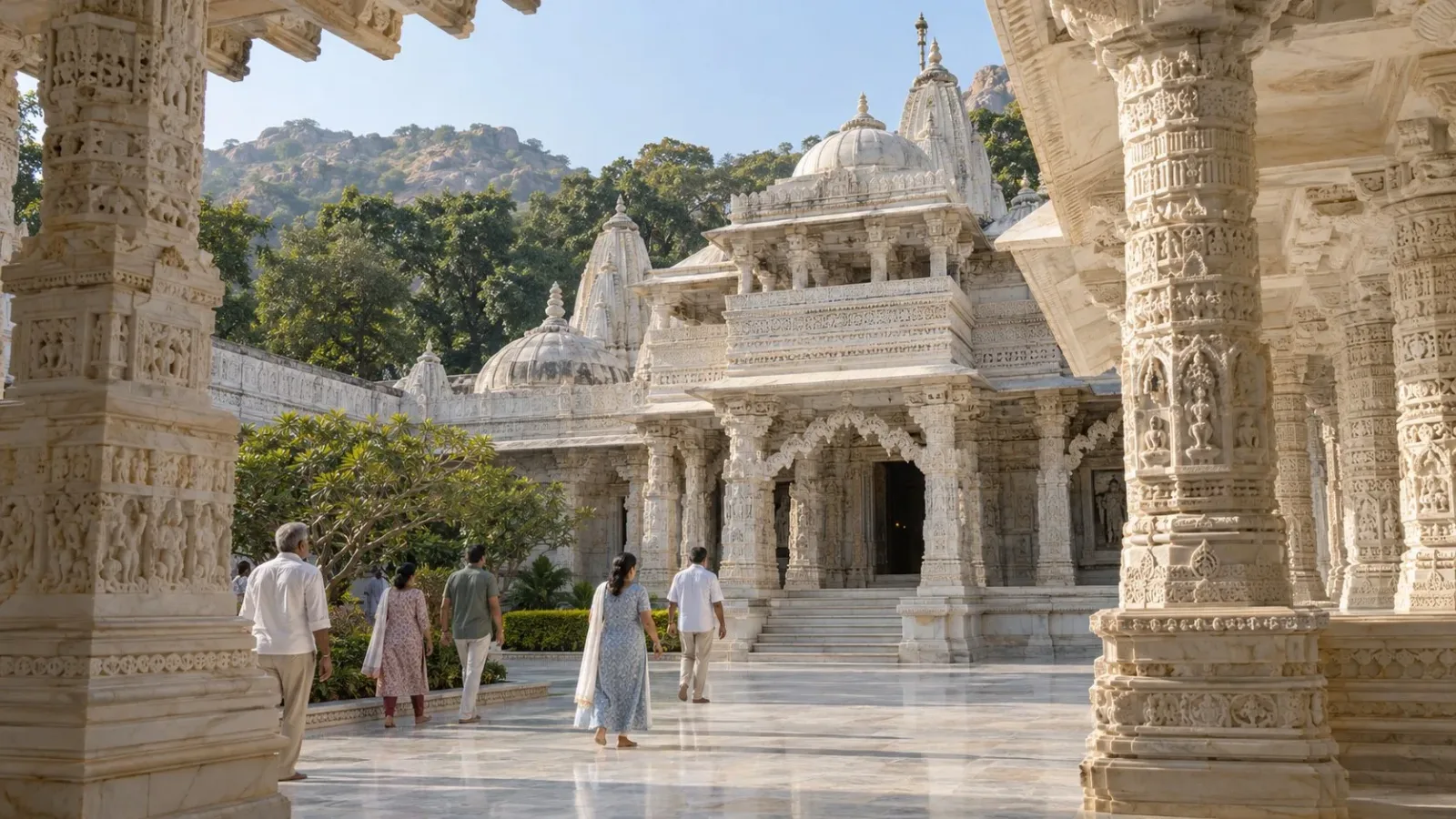
AI illustration: a fictional Jain temple scene inspired by Mount Abu. Not an actual location, person, route inspection or service.
Choose looking closely as the purpose
Dilwara can be the main architectural interest of a Mount Abu outing, rather than a brief name between a lake and a hilltop. Choose it when the group wants to look at Jain temple design and carved marble.
Our recommendation is a small number of details understood together. Give the outing room for a meal, rest and the return, and check current official visitor information.
Start with ceiling, pillar and light
Incredible India describes intricately carved marble pillars, lotus ceilings and delicate work, while Rajasthan Tourism also identifies the temples with marble carving. Those details offer a clear starting point.
Notice how depth and shadow change the appearance of a carved surface. Compare one ceiling detail with one pillar instead of trying to attach a story to every figure.
Learn the temple names before joining them up
The national tourism account identifies five temples: Vimal Vasahi, Luna Vasahi, Pittalhara, Parshvanath and Mahavir Swami. The complex has distinct temple identities, not one undifferentiated hall.
Use those names as a way to ask better questions, not as a completion checklist. The account associates Vimal Vasahi and Pittalhara with Adinath, and Luna Vasahi with Neminath.
Give Luna Vasahi its own subject
National tourism draws particular attention to Luna Vasahi’s carved ceilings and central hall. That makes it a useful subject for people who enjoy how a building is shaped as well as how it is decorated.
Ask which detail an explanation refers to and what its identification rests on. A guide to architecture should help you understand what you are looking at, rather than supply a guessed story for every carving.
Keep the religious setting in the picture
These are Jain temples, not simply a collection of marble objects. The national tourism account links the temples to different Tirthankaras and describes scenes associated with Jain teachings.
Let the religious identity remain part of the explanation. Respect worshippers and the setting; check current official visitor information rather than treating a sightseeing description as the whole story.
Leave other Mount Abu interests separate
Dilwara can be enough of a subject for one outing. A hilltop, lake or another building should be a separate choice, not the measure of whether the temple visit was worthwhile.
Our choice is to finish with a few details understood and time for food, a useful break and the real return. There is no need to make every companion enjoy the same amount of architecture.
Sources
Questions people ask at the gate
Why choose Dilwara in Mount Abu?
For a focused look at Jain temple architecture, especially carved marble pillars and ceilings.
How many temples does national tourism identify?
Five distinct temples: Vimal Vasahi, Luna Vasahi, Pittalhara, Parshvanath and Mahavir Swami.
What does the national account highlight at Luna Vasahi?
Its carved ceilings and central hall.
Should every figure be given an improvised story?
No. Use reliable interpretation for a specific identification rather than guessing from its appearance.
Must we add a lake or hilltop to the outing?
No. Our recommendation is a few architectural details understood, with other interests kept separate.
What should we check before fixing the plan?
Check current official visitor information and arrange the practical day around the people travelling.
Next walk starts at a new gate.
Was this helpful?
one tap, no sign-up

A Miranda House graduate and lawyer who traded courtrooms for slow travel. Cheshta travels with the batches we host ourselves, with a soft spot for travelling alongside elders.