



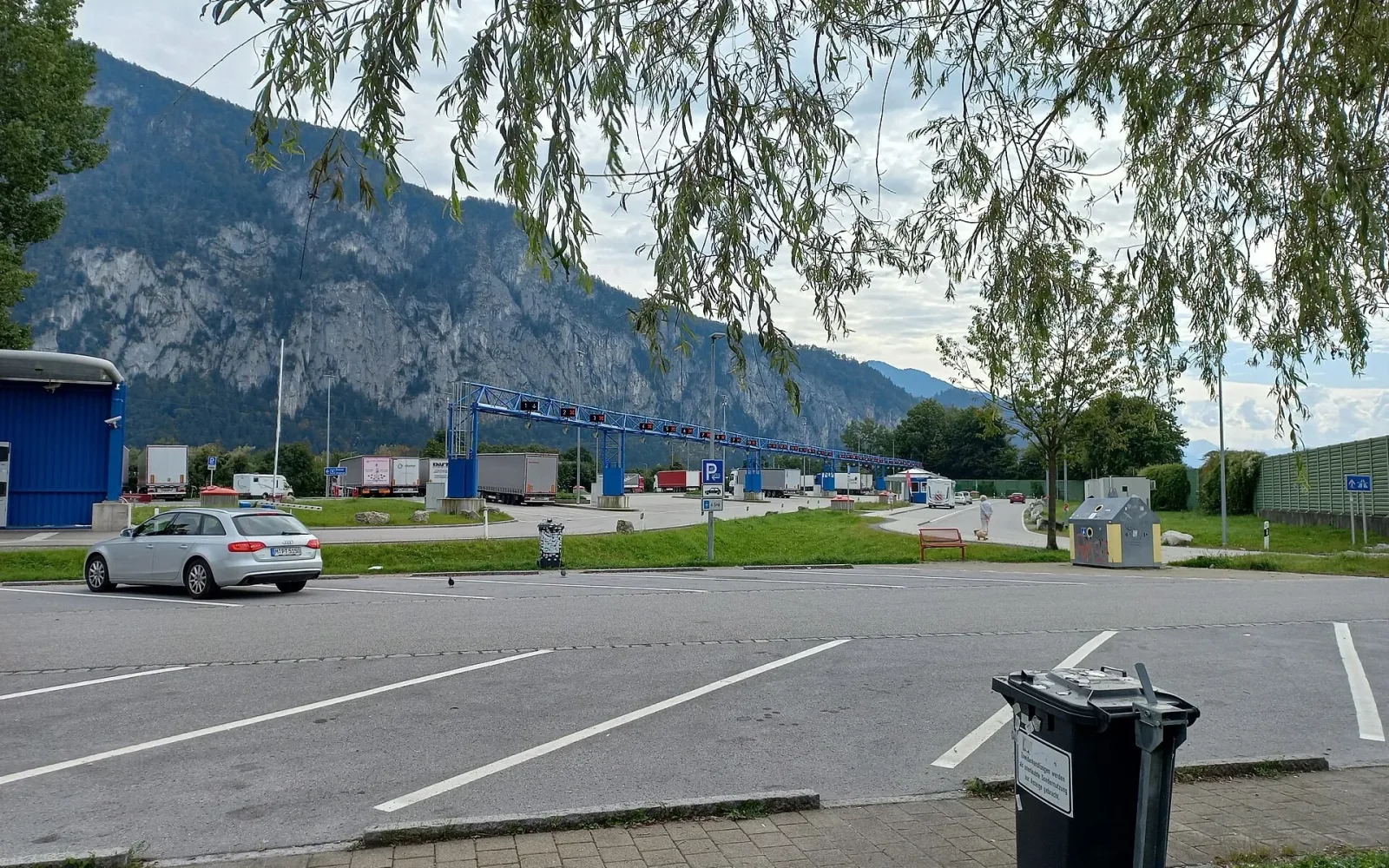

Toll gantry at the Inntal West rest area near Kiefersfelden, on the German-Austrian border route. Photo: Asurnipal, CC BY-SA 4.0, via Wikimedia Commons.

The charge sits on the road, not on the rental contract
The rental counter settles who may drive, the deposit and the insurance. It does not settle what the road itself charges. European countries split into two charging styles: many motorways are tolled per distance at booths or electronically, while several countries sell a time-based vignette - a flat pass for a day, ten days or a year - and a growing set of cities restricts entry by emissions, demanding a sticker tied to the vehicle. Who carries the charge when the car is rented is each country's own rule; Czechia states its rule explicitly - the official vignette e-shop's 24 June 2026 notice says that if you rent a car on holiday, remember that the driver of the vehicle is responsible for a valid vignette. Ask at pickup what the car already carries, and assume nothing crosses a border: a vignette is country-specific, and an emission sticker bought for France does nothing in Germany. This article covers the five systems we read on official sources: Austria, Czechia and Switzerland (vignettes) and France and Germany (emission stickers). Other countries run their own schemes, so check each route country's official portal rather than assuming these rules.
Austria: ASFINAG's vignette, with a digital-only future
Every car, motorcycle and camper van up to 3.5 tonnes needs a vignette on Austrian motorways and expressways. ASFINAG's current price list (valid from 1 December 2025, i.e. the 2026 season) charges a car EUR 12.80 for 10 days, EUR 32.00 for 2 months and EUR 106.80 for a year, and adds a purely digital 1-day vignette at EUR 9.60, sold only in the ASFINAG toll shop or app. Motorcycles pay EUR 5.10 for 10 days. Two mechanics matter: for the 1-day and 10-day products you can choose immediate validity, but the 2-month and annual digital vignettes start no earlier than the 18th day after online purchase (a consumer-protection rule) - buy ahead; and the digital vignette is bound to the number plate. ASFINAG also confirms the adhesive sticker is sold for the last time in 2026 - from 2027, only the digital vignette remains. A few border sections are exempt (for example parts of the A1, A12, A14 and A26), listed on the same page.
Czechia: the official e-shop, 2026 prices, and real enforcement
Czechia's electronic vignette is sold by the state e-shop, which moved to edalnice.gov.cz on 24 June 2026 (edalnice.cz redirects; the ministry warns against lookalike intermediary sites that add service fees). The price list valid from 1 January 2026 for a standard-fuel car: 1 day CZK 230, 10 days CZK 300, 30 days CZK 480, 1 year CZK 2,570. Natural-gas (CNG/LNG, not LPG) and biomethane vehicles pay half, plug-in hybrids a quarter, and electric or hydrogen vehicles use motorways free - vehicles registered abroad must file an exemption notice for the free rate. You can buy up to 30 days before the validity start. Enforcement is automated: the Police of the Czech Republic and the Customs Administration scan number plates on the road, at control gates and at rest stops, and a driver found on a toll road without a valid vignette faces a fine of up to CZK 20,000.
Switzerland: one annual vignette, no short version - by law
Switzerland charges every motor vehicle and trailer using its motorways, in the form of a vignette - and only an annual one. The Federal Office for Customs and Border Security (BAZG) prices it at CHF 40, valid 14 months, from 1 December of the previous year to 31 January of the year after the printed year; the FAQ confirms the Vignette Act makes no provision for short-term vignettes, so even a single visit means the annual charge. Two forms exist at the same price: the adhesive sticker and the e-vignette, which is valid immediately after purchase and is linked to the number plate (it cannot be transferred to a different vehicle and plate). BAZG says to buy before entering Switzerland - online at www.e-vignette.ch or through automobile clubs - and warns that third-party distributors charge surcharges while the official webshop charges exactly CHF 40.
France: the Crit'Air sticker decides whether you may enter the low-emission zones
France's air-quality certificate - the round Crit'Air sticker - comes in six classes (E, then 1 to 5) based on the vehicle type and its Euro emissions norm; the oldest, highest-emission vehicles get no sticker at all. It is mandatory only where it matters: to drive or park in a ZFE-m (low-emission mobility zone) and during prefect-ordered differentiated traffic on pollution episodes. Since 1 January 2025, every metropolitan French urban area over 150,000 inhabitants that meets the regulatory air-quality thresholds but exceeds WHO guideline values must set up a ZFE-m. The sticker costs EUR 3.11 plus postage from the official service, stays valid for the vehicle's life while legible, and the ministry explicitly warns against intermediary sites charging well above the real price. Fines for driving or parking in an active ZFE-m without the right sticker: EUR 68 for light vehicles, EUR 135 for heavy vehicles.
Germany: green-plakette-only zones, shrinking but still fining
Germany's Umweltzonen admit only vehicles bearing the green Umweltplakette (the emissions sticker), a rule in force since 2012 and valid in every German zone, not per city. The sticker class follows the emission key in the vehicle's papers; motorcycles, E-plated electric vehicles, vintage cars and several special categories are exempt. The Umweltbundesamt (page updated 1 October 2026) notes that many cities have abolished their zones as air quality improved - about 35 remain - but the standing rule is unchanged: driving into a zone without the plakette is an offence fined at EUR 100. Because the sticker is tied to the vehicle's documents, arrange it before you reach the zone, and if you are in a rental, confirm with the company that the car carries a green plakette before entering any German low-emission zone.
The pre-departure checklist
1. Map your route countries and check each one's official road-charge portal - vignette country, per-distance tolls, or both; charges never cross borders. 2. Rental car? Ask the company what vignettes and emission stickers the vehicle already has; in Czechia the official e-shop puts the responsibility on the driver in plain terms, and in other countries confirm the rule at pickup. 3. Austria: buy the digital vignette in the ASFINAG toll shop or app; 10-day car vignette EUR 12.80 (2026 prices); remember 2-month and annual online purchases start no earlier than day 18. 4. Czechia: buy only at edalnice.gov.cz, up to 30 days ahead; 10 days CZK 300 (2026 prices); number-plate cameras enforce, fines up to CZK 20,000. 5. Switzerland: CHF 40 annual vignette (14-month validity) from www.e-vignette.ch - no short-term option exists. 6. City driving in France or Germany: France's ZFE-m zones need a Crit'Air sticker (EUR 3.11 plus postage, official site only); Germany's remaining Umweltzonen need the green plakette - both are vehicle-bound, so for rentals confirm with the company rather than buying for a car you do not own.
Last verified: 25 November 2026 against the ASFINAG vignette page, the eDalnice price list, the 24 June 2026 e-shop release, the supervision and fines page, the Swiss BAZG vignette page and FAQ, the French ministry's Crit'Air page, and the Umweltbundesamt Umweltzonen page.
Questions people ask at the gate
Do I need a vignette if my rental already crossed Europe?
Vignettes are country-specific and vehicle-bound. A car with a Czech vignette has no Austrian or Swiss cover. Ask the rental company what the car carries, and buy what is missing from the official portal of each country on your route.
What does a European motorway vignette cost in 2026?
From the official sources read for this article: Austria EUR 12.80 for 10 days (car; EUR 9.60 for 1 day, digital-only); Czechia CZK 300 for 10 days (CZK 230 for 1 day); Switzerland CHF 40 for the annual vignette only - no short-term version exists under the Vignette Act.
Who is responsible for the vignette in a rental car - me or the company?
In Czechia, the official e-shop states it explicitly: the driver of a rented vehicle is responsible for a valid vignette. Other countries write their own rules, so confirm responsibility with the rental company at pickup wherever you drive.
What is France's Crit'Air and when is it mandatory?
A six-class emissions sticker based on the vehicle's Euro norm, mandatory to drive or park in a ZFE-m low-emission zone and during pollution-episode traffic restrictions. It costs EUR 3.11 plus postage on the official service, lasts the vehicle's life while legible, and the fine for ignoring an active zone is EUR 68 for cars.
Are German low-emission zones still active?
Yes, fewer of them. The Umweltbundesamt (updated 1 October 2026) counts about 35 remaining Umweltzonen; only green-plakette vehicles may enter, and the fine for driving in without one is EUR 100. Check whether your route crosses a zone.
Can I buy these at the border or from a reseller?
Official channels are safer and cheaper: Switzerland's BAZG and France's ministry both warn that third-party sellers add surcharges, and Czechia's ministry warns about lookalike vignette sites. Austria's and Switzerland's digital products are valid immediately; Czechia lets you buy up to 30 days ahead - there is no reason to pay an intermediary.
Next walk starts at a new gate.
Was this helpful?
one tap, no sign-up

A Miranda House graduate and lawyer who traded courtrooms for slow travel. Cheshta travels with the batches we host ourselves, with a soft spot for travelling alongside elders.