



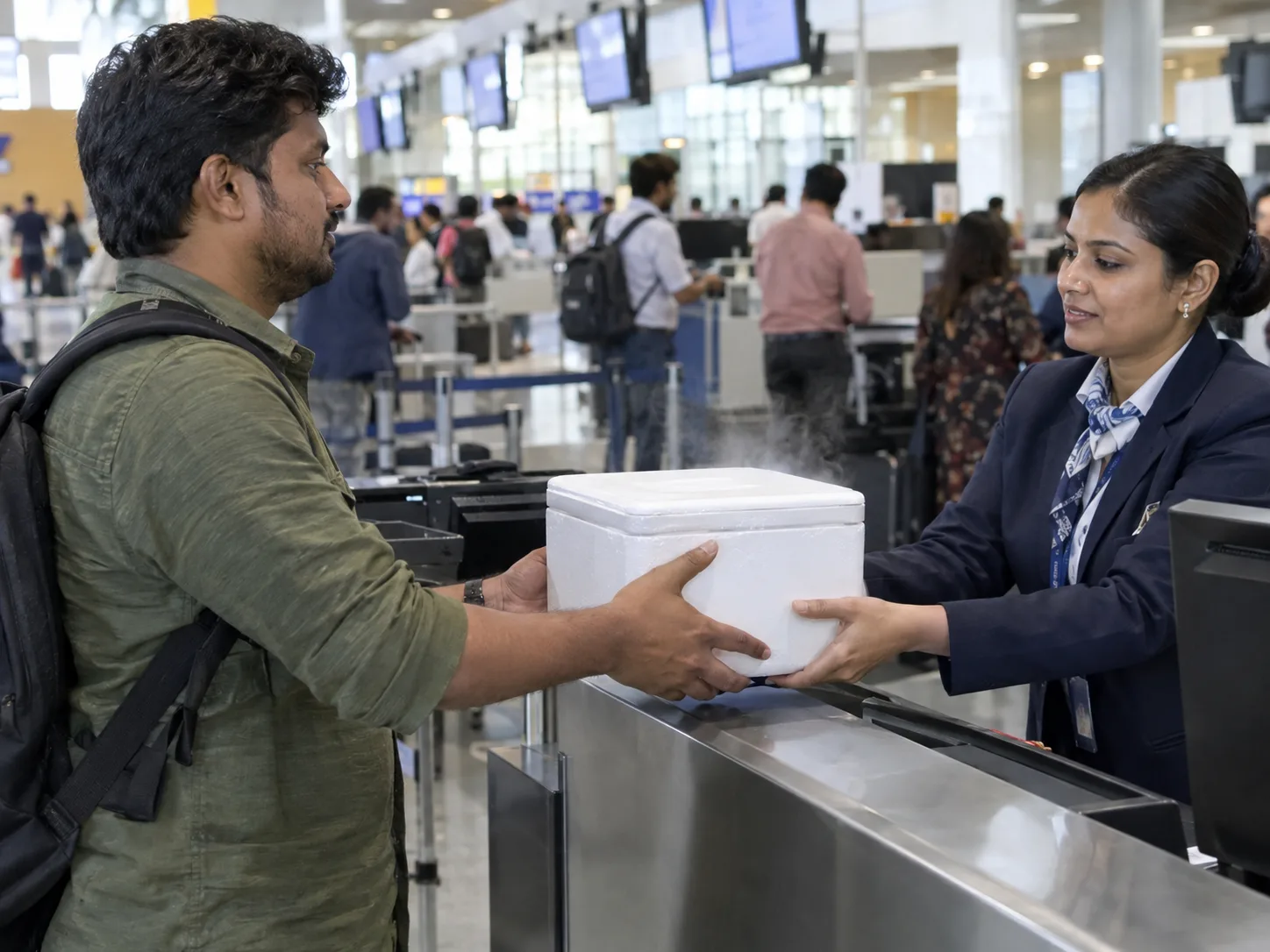

An AI-generated image of a traveller handing an insulated cool box to airline staff at an airport check-in counter in India. It is not an airline photo, and it says nothing about what any airline allows.
Where these statements come from, and their date
This guide answers one packing question: for a flight from India, what do Air India and IndiGo each say on their own pages about carrying dry ice to keep perishables cold? Air India's restricted baggage page was read on 26 November 2026 and carries no date. IndiGo's dangerous goods table is a PDF whose footer reads "Effective 28 Apr 2026 and valid until 31 Dec 2026". IndiGo's baggage policy was also searched and does not mention dry ice. No government listing is used. Read everything below as "as published on those pages", and confirm with your airline for your flight.
Air India: 2.5 kg per person, allowed on both, with a venting package
Air India's page lists "Dry ice (carbon dioxide, solid)" under "Chemical substances" with an "Allowed on both" marker, which covers checked-in and carry-on baggage. The condition: "A quantity not exceeding 2.5 kg/5.5 lb per person is allowed when used to pack perishables which are not subject to DG Regulations in checked-in or carry-on baggage, provided the baggage (package) permits the release of carbon dioxide gas." A note adds that checked-in baggage must be marked "dry ice" or "carbon dioxide, solid" and with the net weight of dry ice or an indication that there is 2.5 kg/5.5 lb or less dry ice.
The page states no approval step for dry ice. That is what the page says, not a promise that no approval will be asked for at the airport; the page is undated and the airline decides on the day.
IndiGo: the same 2.5 kg, but the operator's approval is required
IndiGo's table has a row for "Dry ice (carbon dioxide, solid)" with the same quantity and conditions: up to 2.5 kg per person when used to pack perishables not subject to the regulations, in checked or carry-on baggage, in a package that lets carbon dioxide escape, with checked baggage marked "dry ice" or "carbon dioxide, solid" and the net weight or an indication of 2.5 kg or less. The row's cells read: approval of the operator required - yes; permitted in or as checked baggage - yes; permitted in or as carry-on baggage - yes; the pilot-in-command must be informed - no; allowed to be transported in IndiGo aircraft - yes.
Two limits sit on top of that. The row requires the operator's approval, which in practice means asking IndiGo before you fly rather than turning up with dry ice. And the row notes that the maximum dry ice in passengers' baggage on an ATR aircraft is 10 kg per flight. IndiGo's baggage policy page does not mention dry ice; its list of unacceptable items says it is not intended to be all inclusive. The table is valid only until 31 December 2026.
What the 2.5 kg and 10 kg figures mean in practice
The 2.5 kg is per person; the 10 kg is per flight, across all passengers' baggage on an ATR aircraft, so it is not extra capacity you can plan on. Both allowances exist to keep perishables cold, and both pages limit them to perishables that are not themselves subject to dangerous-goods regulations. Neither page promises space, and IndiGo's row makes carriage conditional on the airline's approval, so the practical step is to ask the airline before you pack, especially on a smaller aircraft.
What this guide leaves out
It covers the dry ice only. Whether a particular food may be carried at all, and whether it can enter your destination country, are separate questions these pages do not answer. Gel packs and ice packs are a different case; for cooling medicines in flight, see our guide on keeping injectable medicine cold on a long flight. For carrying food itself on a domestic flight, see homemade food on an Indian domestic flight. For another airline-by-airline packing list, see pepper spray, mace and stun guns.
Last verified: 26 November 2026 against the airline pages. IndiGo's table is valid until 31 December 2026.
Questions people ask at the gate
Can I carry dry ice in my cabin bag on Air India?
Air India's page marks dry ice "Allowed on both", which covers checked-in and carry-on baggage: up to 2.5 kg (5.5 lb) per person when it packs perishables not subject to dangerous-goods regulations, in a package that lets carbon dioxide escape.
Can I carry dry ice in my cabin bag on IndiGo?
IndiGo's table permits it in carry-on and checked baggage under the same 2.5 kg condition, but the table also requires the operator's approval, so confirm with IndiGo before you pack.
How much dry ice can one person carry?
2.5 kg per person on both airlines' pages. Air India also gives the figure as 5.5 lb.
Does the 10 kg ATR figure mean I can carry 10 kg?
No. The 10 kg is the maximum dry ice in all passengers' baggage on an ATR aircraft per flight. The per-person limit stays 2.5 kg.
How do I mark a checked bag that has dry ice?
Both pages ask for the bag to be marked "dry ice" or "carbon dioxide, solid" with the net weight of dry ice or an indication that there is 2.5 kg or less.
If the airline accepts the dry ice, is my food allowed at the destination?
That is a separate question. These pages cover carriage on the airline only, not which foods may be carried, imported or cleared at your destination.
Next walk starts at a new gate.
Was this helpful?
one tap, no sign-up

A Miranda House graduate and lawyer who traded courtrooms for slow travel. Cheshta travels with the batches we host ourselves, with a soft spot for travelling alongside elders.