




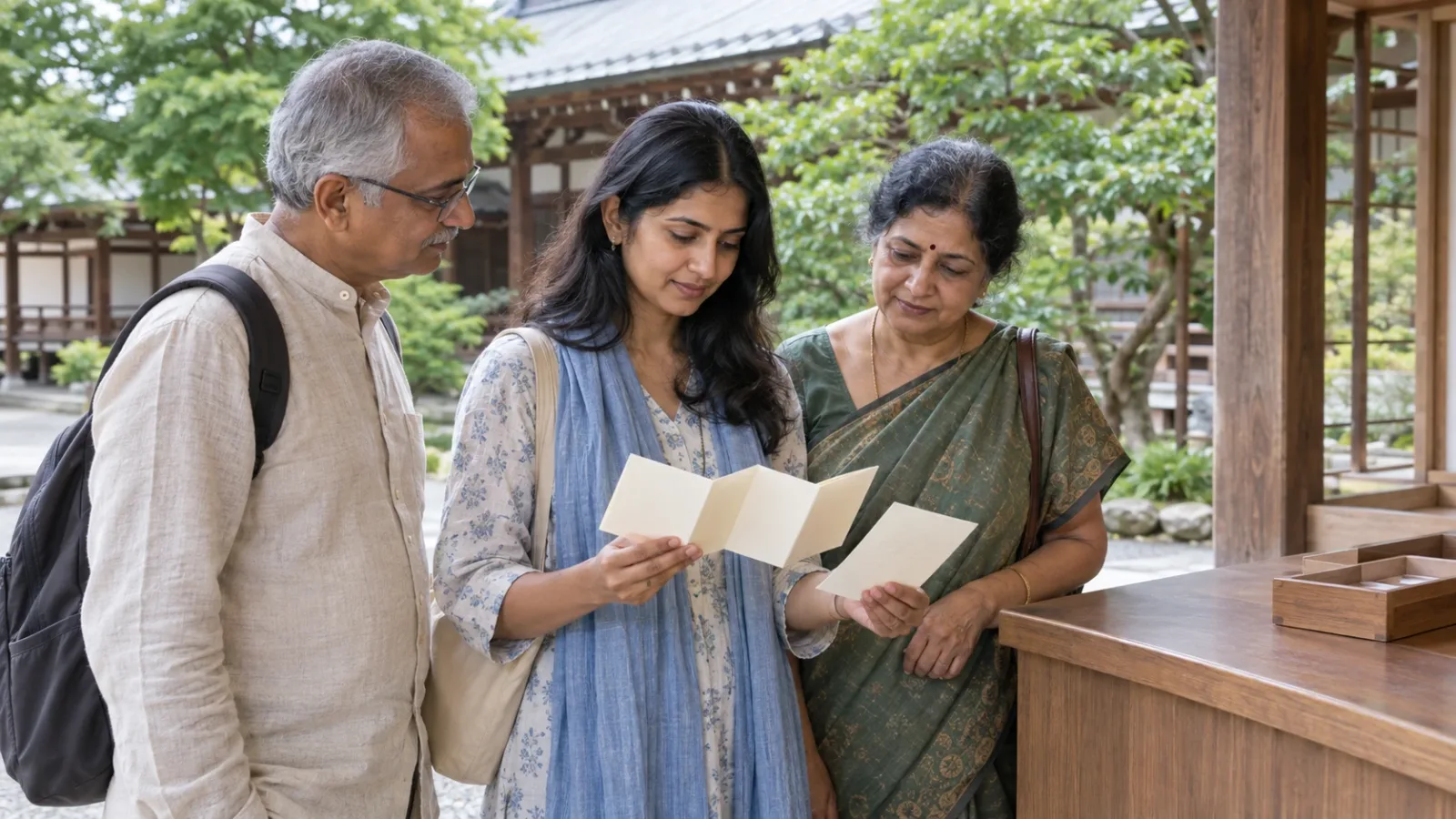
Parents may enjoy keeping a record of a shrine or temple visit in a goshuincho, the dedicated book for goshuin. But carrying that book does not promise that someone will write directly onto its pages. A separate sheet can be the format the institution provides, and accepting it should not become an argument at the counter.
Understand what the record means before joining the line
Himeji Jinja's official guidance describes a goshuin as a record of a visit to pay respects. It asks visitors to pay respects before receiving one and says goshuin are not suitable as gifts because they record that visit. This is not the same activity as ordering a personalised name stamp in a craft shop.
Chion-in's official visitor guide likewise places the goshuin request after worship at the main hall. If parents are unfamiliar with the practice, explain its religious context and let them decide whether to participate. Follow that site's instructions rather than apply a remembered ritual to every temple and shrine.
For the family day, our suggestion is to choose a site you genuinely want to visit. Do not turn the outing into a race to fill blank pages or treat the counter as a souvenir checkout.
The book and a separate sheet are different formats
On 9 November 2026, Himeji Jinja's page said that when the office is staffed, visitors may ask for an entry in a dedicated book. When it is not staffed, goshuin are available on separate sheets with the offering left in the box. The page lists JPY 500 for each goshuin. Those are this shrine's stated arrangements, not a promise that its office will be staffed when you arrive.
Meiji Jingu's official page also says a sheet-type goshuin is available if you do not have a book. Do not generalise the book-entry procedure at one location into an entitlement to direct calligraphy somewhere else.
A firsthand Kanda Myojin account of an October 2026 visit describes receiving a prepared sheet rather than writing in the visitor's book. It is evidence of that person's visit, not a current guarantee of Kanda Myojin's counter format, amount or hours.
Check the offering for the selected site, not an old average
JNTO's December 2020 overview mentioned a usual JPY 300–500 contribution. Treat that as dated general background. Current individual pages show why it is not a fixed national price: Chion-in's page lists JPY 500 per stamp, while Meiji Jingu's page displays JPY 1,500 for its goshuin.
The book itself is another item to ask about. Confirm whether a displayed amount is for an entry, a book or a particular set; do not assume the cover photograph and goshuin are included together. Check the currently displayed offering and accepted payment method at your chosen counter. We have not established a universal card or cash-only rule.
Ask about that day's reception hours before building the route around the counter. An open precinct does not establish that every service is operating. No live queue, named design stock, same-day entry or maximum waiting time was verified for this article.
If staff keep the book, agree how it comes back
JNTO explains that busy sites may ask visitors to leave the book and return later. Before stepping away, understand the collection point, any token and the return instruction. Do not take the family onward to the next stop while the book is still at reception.
For parents who do not read Japanese, one family member can help keep the instructions and identify the correct book. This does not establish permission to collect goshuin for absent relatives. Ask the institution about its own process rather than assume one person may request every family member's entry.
Keep any site-name reminder separately if the calligraphy is unfamiliar. The memory should lead back to a place the family visited, not just an attractive page whose origin has been forgotten.
Protect the sheet without rushing to fold it
TORII's October 2026 book guide suggests checking the actual sheet dimensions and the book's usable space, rather than relying only on the cover's outer size. A plain protective folder is our practical suggestion for carrying a loose sheet until you can store it properly.
JNTO says separate sheets can be pasted into a book later and advises keeping other kinds of stamps out of a goshuincho because goshuin are considered sacred. Use another notebook for ordinary sightseeing stamps. Ask about the paper's handling before closing, mounting or pressing a fresh entry; this article does not promise that all ink dries in a set number of minutes.
For a wider Japan day with enough time for a respectful visit, see our Japan trip-planning page. A planning enquiry does not reserve a goshuin, a writer, a particular design or priority at a religious site.
Questions families ask
Will staff always write in the goshuincho we bring?
No such promise is established. The site may issue a separate sheet; follow its current format and counter instructions.
Is a separate goshuin sheet an unofficial substitute?
Not when the institution itself issues it. Himeji Jinja and Meiji Jingu explicitly describe sheet arrangements on their official pages.
Does every goshuin cost JPY 500?
No. Old general ranges are not a fixed price. Check the current offering for the exact site and item, including any book.
Can one person collect entries for relatives who are not there?
That permission is not established. Goshuin record a visit and respects; ask the institution about its own process.
Sources and review
Reviewed 9 November 2026 using six linked sources across shrine and temple pages, JNTO background, an independent book guide and a firsthand visit account. Current counter staffing, hours, queue, design availability, language and access remain site-specific and unconfirmed for a particular visit. No entry was requested or tested. The AI image uses blank paper in a fictional setting, not a reproduction of sacred calligraphy or a photograph of a named counter.

A Miranda House graduate and lawyer who traded courtrooms for slow travel. Cheshta travels with the batches we host ourselves, with a soft spot for travelling alongside elders.
Planning your next trip?
We'll handle insurance, hotels, airport assistance and the itinerary — the same way we do it for every trip.
Questions on this article
asked by readers, answered by us
Was this helpful?
one tap, no sign-up