




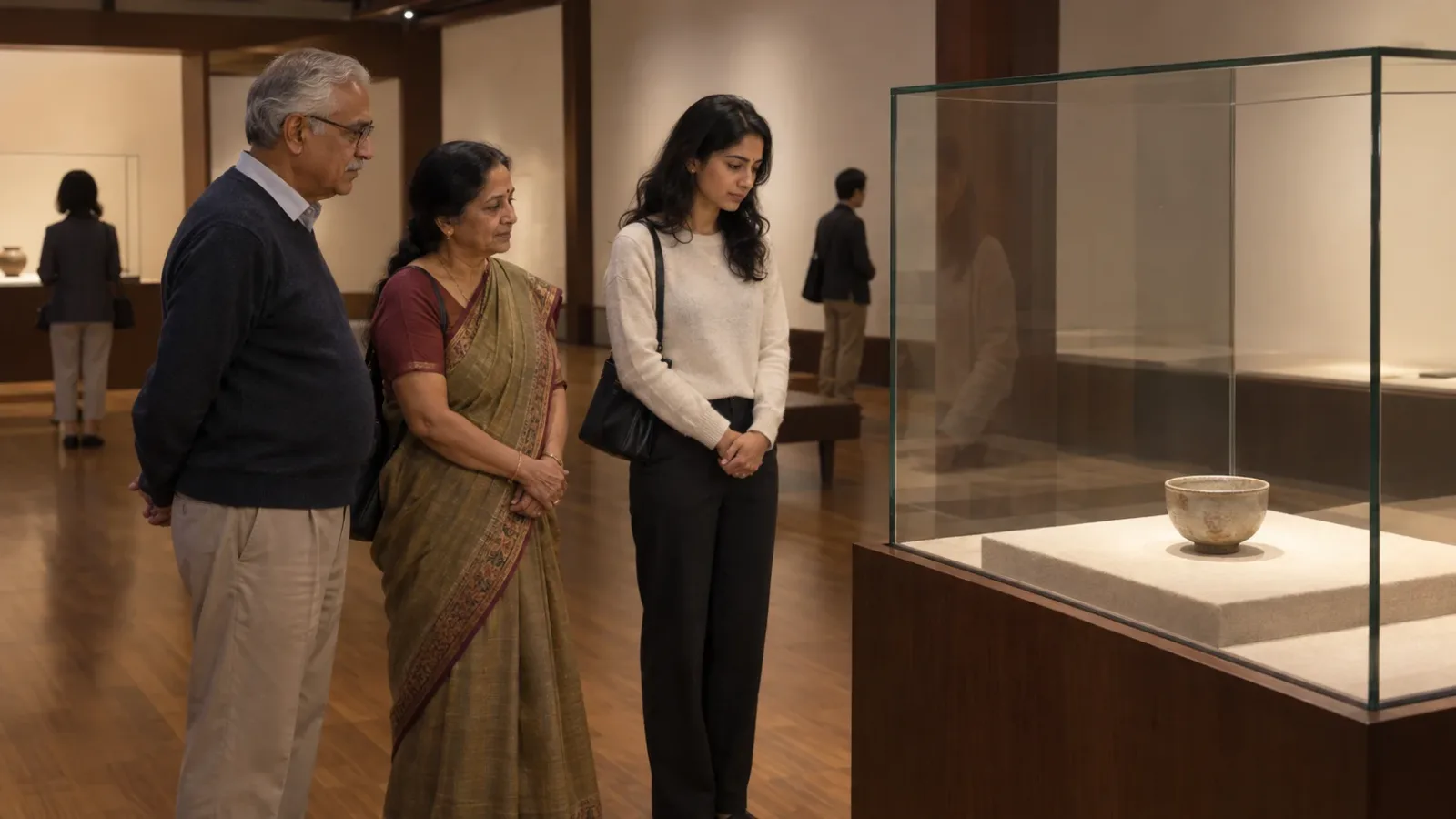
At Ebara Hatakeyama Museum of Art, parents can see tea utensils, pause over a bowl of tea at the cafe and admire a garden shaped by tea culture. Those are three different experiences. Museum admission does not by itself reserve a historic tearoom, a tea ceremony, a cafe table or a guided explanation. Decide which part matters before building a Tokyo outing around it.
The tea bowl behind glass is for looking, not drinking
GO TOKYO describes the museum as a collection of historical tea utensils and art, with seasonal exhibitions and a new building added for the 2024 reopening. A collection is not a guarantee that one famous bowl, painting or National Treasure will be on display on the family's date.
The museum's facility guide says not to touch exhibits or cases and not to take photographs or make calls in the exhibition rooms. A display that appears unusually close or has very clear glass still needs the same distance and care. Cafe tea is not permission to handle collection objects.
Sarumachi Cafe is the ordinary tea break to investigate
The museum's shop and cafe page places Sarumachi Cafe on the first floor of the new building. It describes coffee, black tea and a tea service where visitors choose a bowl and combine the tea with sweets. This is a practical place to investigate if parents want a drink and a seated break after looking at art, rather than a formal ceremony.
The 12 April 2025 opening notice says the cafe is for visitors who have viewed the exhibition. Do not plan it as a confirmed independent street cafe or assume tea is included in museum admission. The checked page does not establish a reserved table, immediate seating, a fixed food package or current price for the family's chosen drink.
The cafe page currently lists 10:30-16:45, with last orders 16:20, on museum opening days. Its last order is a different limit from the museum's last entry. Check both on the actual date and leave time for any wait, rather than entering at the museum deadline expecting tea afterwards.
A historic tearoom opening is a separate event
The museum's archived spring 2025 exhibition and events page describes special openings of normally closed historic tearooms, with a separate timed event ticket. It explicitly says that the described event did not include an otemae tea-making demonstration. Even an event serving matcha in a historic room is not automatically a complete ceremony or lesson.
That archived programme also mentions tatami, steps, socks, limited sitting aids and no air conditioning for that event. Those are reasons to ask about the room and current format before choosing a future event, not permanent conditions for every cafe or exhibition visit. Do not assume ordinary museum admission opens those rooms daily.
If the historic room matters, find a current event with its actual date, availability, included admission, seating and access terms. If none is confirmed, present a museum visit and possible cafe tea honestly. Do not sell the past programme as an upcoming booking or use its old price as a current quote.
The ramp to reception does not certify the whole garden
The facility guide confirms a ramp from the main gate to the main building, a step-free corridor connecting the main and new buildings, an accessible toilet on the main building's first floor and permission to view with a wheelchair or stroller. It also lists one loan wheelchair. These are specific facilities, not a promise that a wheelchair is free at the moment the family arrives.
Ask staff for the route to the actual exhibition floors, cafe and toilet, and for the garden sections suitable for the person using the chair. We did not establish a fully accessible route through every garden path or into every historic tearoom. Do not substitute a beautiful garden photograph for that route check.
A personal visit account from April 2025 describes changes in level and awkward rocky footing in parts of the garden. That is one visitor's experience, not a survey of every route, but it is enough reason not to label the whole garden flat. A shorter route or a view from the building can be a valid family choice.
A rest area is not an always-empty cafe seat
The facility guide says to ask reception to use its rest area. It is also used for needs such as changing or nursing. Ask for help when needed rather than assuming a private lounge, bed or seat reserved for the family throughout the visit.
For the cafe, confirm chair and back support, table space and any waiting arrangement if those determine whether parents can enjoy the stop. The April 2025 visitor account found the cafe busy. That is not a forecast of your date, but neither is a calm promotional image a guarantee of immediate seating.
Cashless purchases and coin lockers are separate
The shop/cafe page says payment throughout the museum, including the shop and cafe, is cashless. The facility guide separately lists refundable 100-yen coin-deposit lockers. Carrying a coin for storage does not mean the ticket or tea can be paid for in cash.
The museum's current linked ticket seller lists adult online admission at 1,300yen and same-day admission at 1,500yen for the listed paired autumn exhibitions. That does not establish a senior discount, tea inclusion or the price of a future exhibition. Read the actual admission category and checkout terms before buying; do not add a separate event merely because its title mentions tea.
For the currently listed admission product, the seller permits cancellation until 9:00am Japan time on the visit day and applies cancellation to the whole order, not one person from a shared order. Check the rules for the specific product again if parents may change plans. A cafe visit and an event ticket should not inherit admission-ticket terms without verification.
Use the current calendar rather than an old seasonal timetable
Older visitor material gives an earlier autumn/winter closing time. At this check, the museum homepage and current ticket page both give 10:00-17:00, last entry 16:30, for the current programme. Do not average the two timetables or treat an old seasonal rule as today's closing time. Recheck the actual exhibition calendar for the visit date.
The museum homepage also lists exhibition changes and individual events. A curator talk is not a daily guided tour, and yesterday's listing is not tomorrow's programme. The current ticket page includes extra closure days, so "not Monday" alone is not an opening check.
Tea culture does not guarantee a Hindi explanation
An English visitor page helps with planning, but it does not establish a Hindi-speaking guide, translated curator talk or staff member for every room. Ask about the language of a particular event and available written explanations. If parents mainly want the bowls, spaces and garden, it is fine to choose a quiet self-paced visit without pretending a guide is included.
The official rules say exhibition lighting and temperature are controlled for conservation. Bring an adjustable layer and allow time to look closely, but do not promise large-print Hindi labels or bright lighting. Photography restrictions also mean the companion should not plan to photograph all labels and explain them later.
Keep drinks in the cafe, and lunch separate
The shop/cafe page explicitly says cafe drinks must be consumed inside the cafe and food or drinks cannot be carried into exhibition rooms or the garden. The English facility guide likewise prohibits food and drinks. Buying tea does not turn the garden into a picnic stop.
Sweets and drinks are not a confirmed full lunch, vegetarian or Jain meal, or allergy arrangement. Ask about the actual ingredients and options if needed. A personal tea-focused account published in February 2026 describes enjoying matcha and sweets, but its earlier exhibition visit is not a current menu or dietary guarantee.
Do not turn one museum into a compulsory multi-stop day
The facility guide distinguishes no ordinary visitor parking from one accessible parking space that needs staff coordination. Ask about the actual drop-off and walking route rather than assuming a taxi can wait inside or that a short map distance is a step-free entrance. No station-exit accessibility claim is being made here.
Keep the exhibition as the anchor, cafe tea as a separately checked option and garden walking optional. For the wider holiday, The Trip Keeper's Japan trip page can help start a conversation about pace. Admission, historic tearoom events, cafe seats, translation, transport and a fully accessible garden circuit are not implied package inclusions. Last checked9 November 2026. Hero: AI-generated fictional family viewing a generic tea-bowl display, not the actual museum, current exhibition or a confirmed accessible route.

A Miranda House graduate and lawyer who traded courtrooms for slow travel. Cheshta travels with the batches we host ourselves, with a soft spot for travelling alongside elders.
Planning your next trip?
We'll handle insurance, hotels, airport assistance and the itinerary — the same way we do it for every trip.
Questions on this article
asked by readers, answered by us
Was this helpful?
one tap, no sign-up