



- Answer
- Shared rules first, else usually MSC
- MSC
- First area-crossing carrier
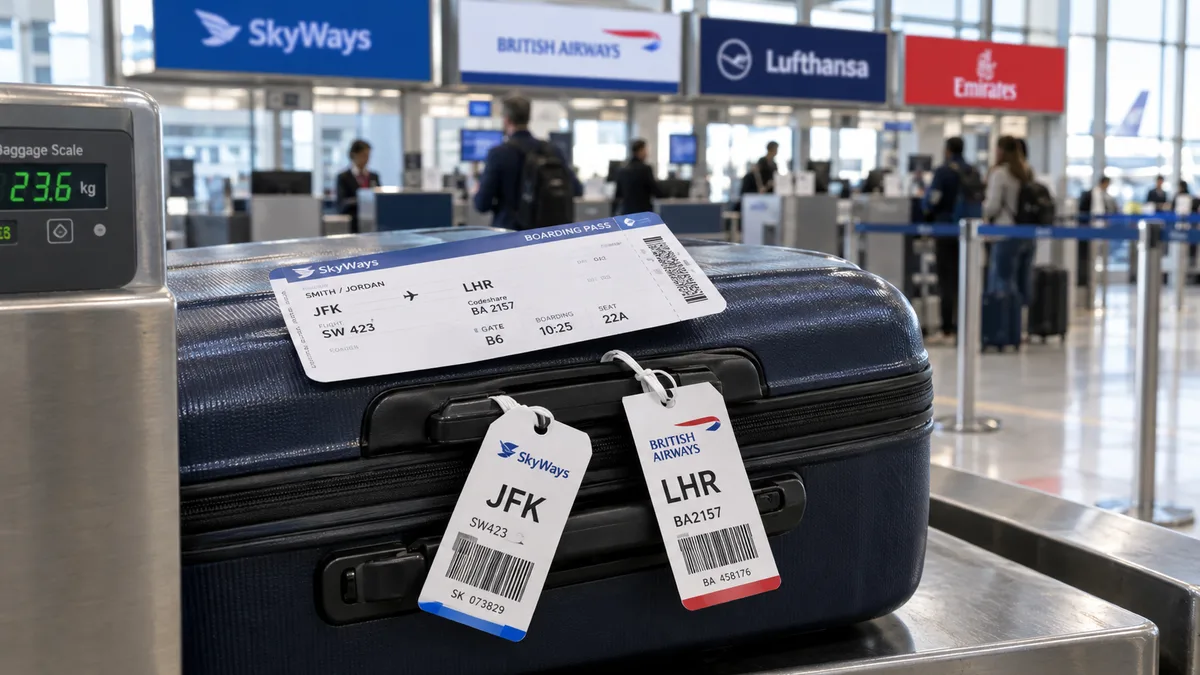
- Codeshare
- Flight number (marketing carrier) counts
- Separate tickets
- Each airline's own allowance
When one ticket carries flights from two or more airlines with different baggage limits, you do not get to pick the most generous one - and the strictest leg does not automatically win either. A shared industry rule, IATA Resolution 302, sets the hierarchy that decides which carrier's allowance applies to your checked baggage journey. The short version: on a single through-ticket, shared provisions apply first and, where the airlines' rules differ, usually the Most Significant Carrier's published rules; on separate tickets, each airline's own allowance applies separately.
One ticket or two? Check this first
Everything depends on whether your flights sit on one ticket. A single ticket - one e-ticket with one booking reference covering all sectors - means the airlines treat it as one checked baggage journey, and IATA Resolution 302 selects the applicable rules. Separate tickets are separate contracts: each airline applies its own allowance and fees to its own sector, and you will usually collect and re-check your bag at the connection point. Air India makes one limited exception: passengers holding separate tickets for Air India domestic and connecting international flights get the international free baggage allowance if the connection is within 24 hours and both flights are operated by Air India.
The IATA rule that picks the airline whose limits apply
Air India and ANA both publish the same four-step selection process from IATA Resolution 302 for interline journeys - journeys involving more than one carrier:
- Step 1: If every participating carrier's published baggage provisions are the same, those provisions apply.
- Step 2: Where provisions differ, apply any common provisions - and where they differ, the published provisions of the Most Significant Carrier (MSC).
- Step 3: If the MSC does not publish baggage provisions for that journey, the rules of the carrier accepting your baggage at check-in apply.
- Step 4: If that carrier also publishes nothing for the journey, each operating airline's provisions apply sector by sector.
So the outcome follows that hierarchy: shared provisions where they exist, the MSC's published rules where provisions differ, and the check-in carrier's or sector-by-sector rules as fallbacks. These provisions cover checked baggage - Air New Zealand describes the rules as based on a checked-baggage concept - so confirm cabin baggage allowance separately with each operating carrier.
Which airline is the Most Significant Carrier
The MSC is chosen by geography, not by which airline you booked with. Per the Resolution 302 text published by ANA and repeated by Air India:
- For travel between two or more IATA areas, the MSC is the carrier flying the first sector that crosses from one area to another. India sits in IATA Area 3; Europe, Africa and the Middle East are Area 2; the Americas are Area 1. On a Delhi-Dubai-London ticket with two different airlines, the carrier flying Delhi-Dubai - the first area-crossing sector - is the MSC for the journey.
- For travel between sub-areas within one area, the carrier on the first sector crossing between sub-areas.
- For travel within one sub-area, the carrier on the first international sector.
Air New Zealand's Most Significant Carrier guide walks through worked examples of this determination, including return journeys where the MSC can differ between the outbound and the return.
Codeshares: the flight number matters more than the plane
On a codeshare - you bought an airline's flight number but a partner operates the aircraft - the marketing carrier, the one whose code is on your ticket, generally counts as the MSC for tickets issued on or after 1 April 2015, per Air New Zealand's summary. Airline pages do not all phrase this identically: ANA's published text says the marketing carrier applies unless it publishes a rule naming the operating carrier, while Air India's page currently states the reverse default. Because the summaries conflict, treat the flight number on your ticket as the starting point and confirm the applicable allowance with the ticketing airline before you fly.
Two exceptions worth knowing
- Trips starting or ending in the US or Canada: for a single-ticketed journey that starts or ends in the USA or Canada, the first marketing carrier decides which baggage allowance and charges apply to the entire journey - its own rules or the MSC's - per Air New Zealand's MSC guide. Merely passing through the USA or Canada does not trigger this.
- Stopovers: choosing a stopover at the connection point can end the through-checked journey there, subject to how your itinerary is ticketed and the applicable rules. Air India notes that when a passenger chooses to take a stopover at a connecting point, a new baggage assessment - and new charges - may apply from the point of departure after the stopover. The US/Canada first-marketing-carrier choice above applies to the entire journey and is not automatically reset by a stopover.
One same-airline simplification: Air India states that passengers flying its domestic and international sectors on the same ticket receive the international sector's baggage allowance for the journey.
Quick questions
How do baggage rules work when airlines on one ticket have different limits? For checked baggage, a shared rule - IATA Resolution 302 - picks whose published allowance applies to the through-checked journey: first any provisions all carriers share, then the Most Significant Carrier's published rules where they differ. Two qualifications: journeys starting or ending in the US or Canada follow the first marketing carrier's choice instead, and cabin allowance is each operating carrier's own - check it per airline. You do not get to combine the best parts of each airline's checked limits.
Which airline is the Most Significant Carrier on my trip? For the checked-baggage journey, usually the airline flying the first sector that crosses from one IATA area to another - so on a Delhi-Dubai-London routing, the Delhi-Dubai carrier - but codeshare flight numbers and route-specific exceptions like the US/Canada rule can change that, so confirm against your ticket with the airline. Air New Zealand's MSC guide has worked examples.
What if my flights are on separate tickets? Then each airline's own allowance and fees apply to its own sector, and you will usually need to collect and re-check your bag at the connection. Air India grants a limited exception when separate Air India-operated domestic and international tickets connect within 24 hours.
Does a codeshare change whose rules apply? It can. Air New Zealand's guide says that for tickets issued on or after 1 April 2015, the marketing carrier - the airline whose code is on your ticket - is generally the Most Significant Carrier; but airline pages phrase the codeshare default differently (Air India's page currently states the operating carrier), so confirm the applicable allowance with the ticketing airline.
Does any of this change for trips involving the US or Canada? Yes: if your single-ticketed journey starts or ends in the USA or Canada, the first marketing carrier decides whether its own rules or the MSC's rules apply to the whole journey, per Air New Zealand's summary. Transiting the US alone does not trigger this.

A Miranda House graduate and lawyer who traded courtrooms for slow travel. Cheshta travels with the batches we host ourselves, with a soft spot for travelling alongside elders.
Planning your next trip?
We'll handle insurance, hotels, airport assistance and the itinerary — the same way we do it for every trip.