




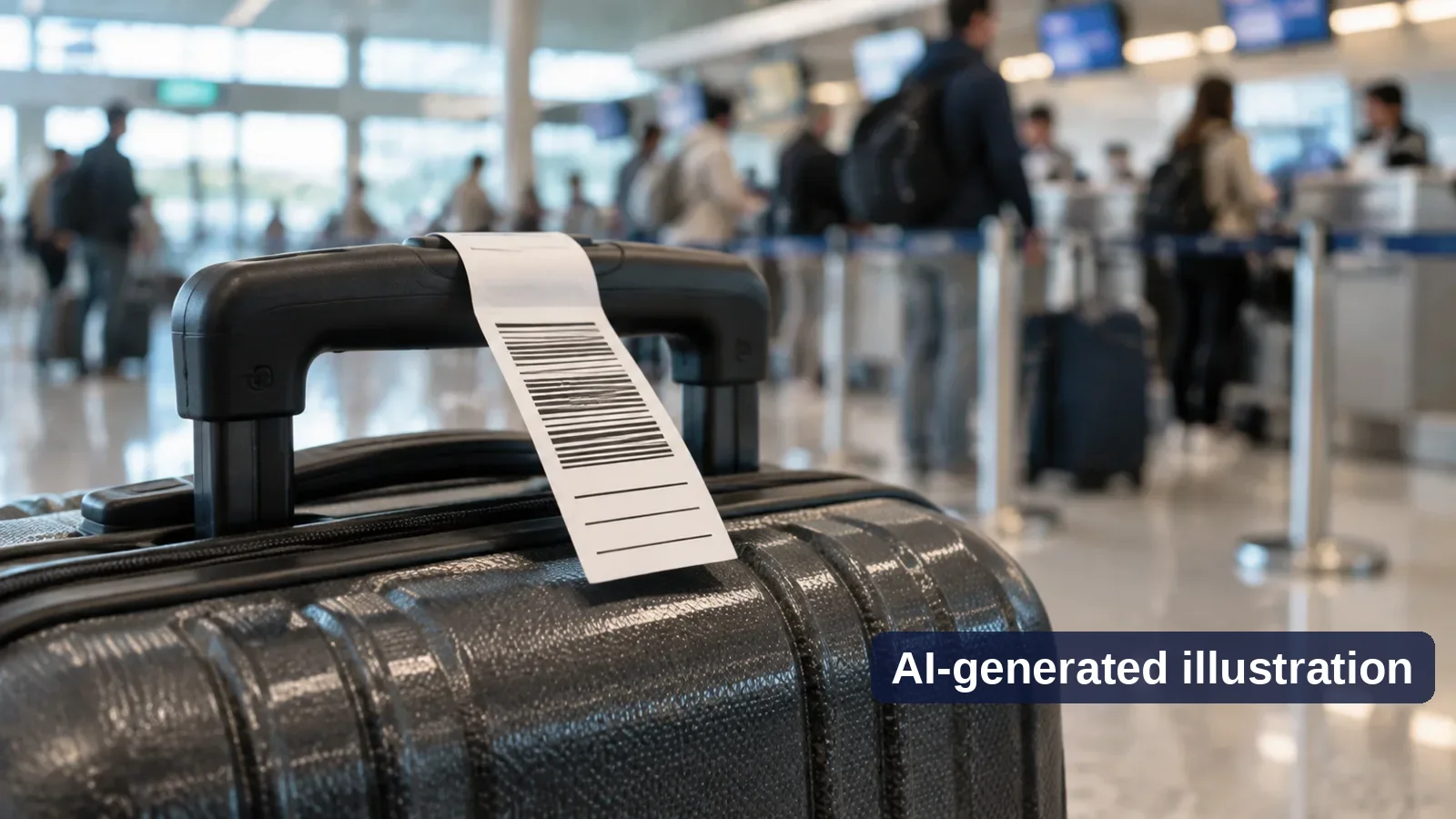
- Destination shown
- 3-letter IATA code
- Also on the tag
- Flight no. + time
- Long barcode no.
- routes the bag
- Green-edged tag
- started in the EU
The long sticker looped around your suitcase handle at check-in is not decoration. It tells the baggage system - and you - where the bag is going. Reading two items on it takes seconds: the big three-letter code and the flight details.
Start with the big three-letter code
Amsterdam Airport Schiphol explains that every baggage label carries an IATA airport code, such as AMS for Schiphol, alongside the destination itself. IATA's location codes exist to identify destinations on travel documents, and the three-letter code printed on your tag is the airport your bag is checked to.
The destination is also written out in words on the label, so read the code and the name together. If the code on the tag does not match the arrival airport on your booking, ask the check-in agent to confirm before you walk away. If the code is unfamiliar, check it against your itinerary or the airline's site rather than assuming.
Match the flight number and date
Schiphol lists the airline's code and flight number and the time of departure among the details always printed on the label. Compare the flight number with your boarding pass. A bag tagged for a different flight can travel without you; point out a mismatch to staff at the counter, not at arrivals.
Leave the long number to the system
The barcode and the ten-character code beside it - the "license plate" - exist so automated baggage systems can route and track the suitcase from check-in to arrival. Schiphol notes that passengers usually cannot decipher it, and you do not need to. Keep the small tag receipt the agent hands you until your bag is in your hand; it carries the tracking reference if you need to report a missing bag.
Special marks you may notice
Some labels have green edges. Schiphol explains this means the bag started its journey within the European Union, so at an EU arrival it signals the nothing-to-declare channel - though customs can still check any bag. Tags issued outside the EU look ordinary; the absence of green edges is normal, not a problem.
Sources
Schiphol: what is all that information on your baggage label? | IATA airline and location codes | British Airways: do I need to collect my bags?
Quick questions
Which part of the tag shows the destination? The destination written out and the large three-letter IATA airport code; Schiphol lists both among the details always printed on the label.
The code on my tag is not my final stop. Is that wrong? Not necessarily. British Airways explains that bags can be checked through to your final destination when all your flights are on one booking reference with the same ticket number, and advises asking staff at check-in if you are unsure.
Do I need to read the barcode number? No. Schiphol says that ten-character code serves baggage handlers and the automated system. Keep your tag receipt for reference instead.
What does a green-edged tag mean? Per Schiphol, the bag began its journey inside the EU; at EU arrivals it points to the nothing-to-declare channel, but checks remain possible.

A Miranda House graduate and lawyer who traded courtrooms for slow travel. Cheshta travels with the batches we host ourselves, with a soft spot for travelling alongside elders.
Planning your next trip?
We'll handle insurance, hotels, airport assistance and the itinerary — the same way we do it for every trip.
Was this helpful?
one tap, no sign-up