




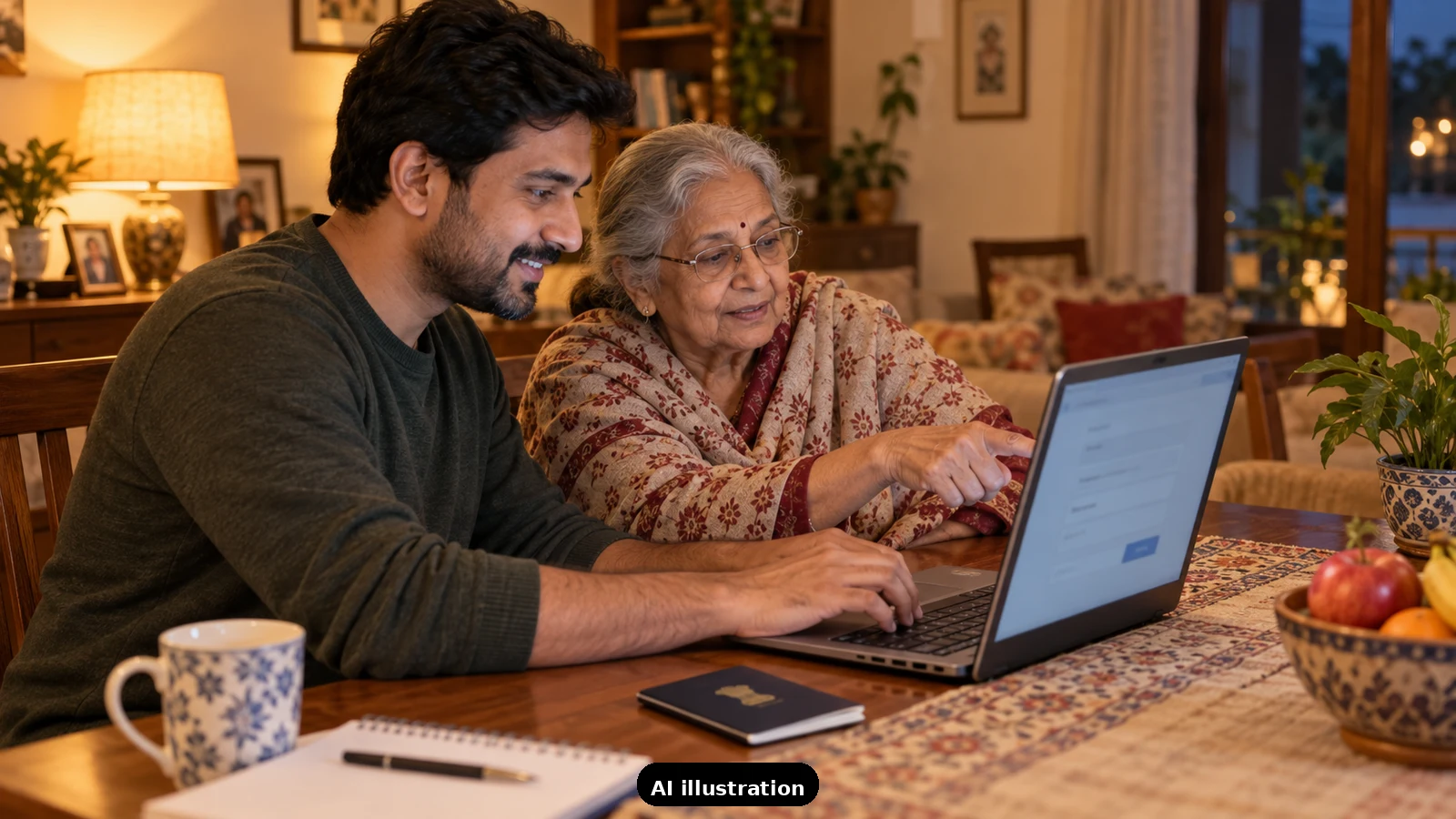
Short answer: fill the form yourself and put your own email address in it. On these forms the email field is a delivery channel for the confirmation, not an identity check - Singapore's ICA says outright that a proxy may submit the SG Arrival Card for someone else, and Thailand's TDAC lets one family submission cover up to ten travellers. The only thing that matters is that the confirmation or QR code physically reaches your parent before the immigration counter. Here is how to do it country by country, and the one habit that makes it foolproof.
First, what the email field actually does. Digital arrival forms ask for an email so the system can send back the acknowledgment or QR code. Nobody at the border checks that the email belongs to the traveller. ICA's own answer says a valid email is needed to receive the acknowledgment - and a family member's email receives it just as well. So your address, your phone number, your inbox: all fine.
Singapore: submit as a proxy. ICA explicitly allows you to submit the SG Arrival Card on behalf of another traveller, as long as the information is true and accurate. Fill it within three days before arrival, use your own email, and the acknowledgment lands in your inbox. Forward it, print it, and pack the printout with your parent's passport.
Thailand: one family submission. The TDAC - which replaced the paper arrival card - accepts a group submission of up to ten entries at once, so your parents can be on your submission. The QR code goes to the submitting email only, so use yours, then print it or save a photo of it on your parent's phone. Timing: submit within 72 hours before arrival. If technology fails entirely, Thailand runs TDAC kiosks at five airports - Suvarnabhumi, Don Mueang, Phuket, Chiang Mai and Hat Yai - where the card can be completed on landing, and staff can help.
Japan: one account, family members inside. Visit Japan Web is account-based rather than email-per-traveller: you create your own account and register accompanying family members - like a parent - under it, completing their immigration and customs sections yourself. The QR codes then live in your account; carry them on your phone and keep printed copies in your parent's documents.
Everywhere else: the same pattern. South Korea's Q-Code or e-arrival options, Malaysia's MDAC, Indonesia's forms - they all follow the same logic: an adult child can prepare the form, the email is for delivery, and the printout is what the officer wants to see. Where a paper card still exists on board or at the counter, it remains a valid fallback - cabin crew distribute them where digital is not mandatory.
Make it reach the counter. The chain only breaks if the confirmation stays in your inbox. So: print the acknowledgment or QR, slide it into the passport cover, and also save it as a photo on your parent's phone if they carry one. Write your name and number on the printout in case the officer wants to confirm details with you.
The lasting fix. A free email account takes five minutes to create and is worth having for your parent long-term - hospitals, banks and airlines all ask for one now. Set it up on their phone with the password written down at home, and future forms can carry their own address. Until then, yours works everywhere.
How TripKeeper helps here. Families who plan a parent's trip with us get the arrival-form step handled as part of the preparation - which form, which timing, what to print - inside the same itinerary work. Send a trip-planning inquiry and we will take it off your list.

A Miranda House graduate and lawyer who traded courtrooms for slow travel. Cheshta travels with the batches we host ourselves, with a soft spot for travelling alongside elders.
Planning your next trip?
We'll handle insurance, hotels, airport assistance and the itinerary — the same way we do it for every trip.
Questions on this article
asked by readers, answered by us
Was this helpful?
one tap, no sign-up