




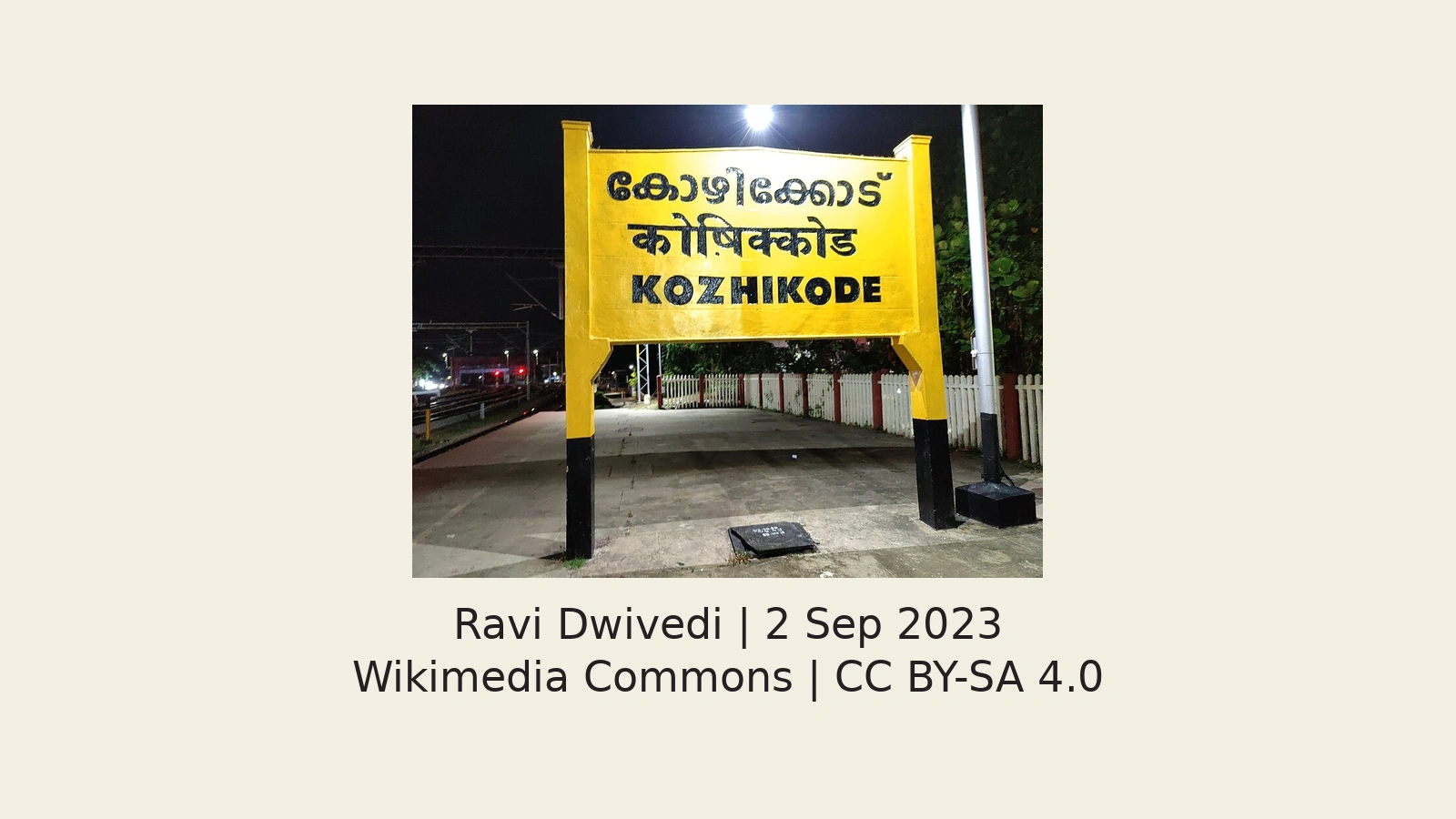
Photo: Ravi Dwivedi, 2 September 2023, Wikimedia Commons. Source: https://commons.wikimedia.org/wiki/File:Kozhikode_Railway_Station_board.jpg. License: https://creativecommons.org/licenses/by-sa/4.0/ (CC BY-SA 4.0). Adaptation: the whole photograph was resized, set on a cream canvas and given an attribution strip. This composite is also licensed CC BY-SA 4.0. A dated name-reading example, not current station-layout or accessibility evidence.
Identify your stop by matching the destination on your booking with current train information and the station you have actually reached. Do not get off simply because the train has stopped, other passengers are leaving or a familiar city name appears. Our suggested sequence is: establish the booked station, follow the journey's progress, then confirm the station before leaving the coach.
At boarding: settle which station is yours
Keep the destination in your actual booking available offline. Read the full station name and code, train number and journey date. Ask railway staff to clarify an unfamiliar name before you settle in. A city can have more than one railway station; a city name alone is not a sufficiently precise arrival plan.
Do not assume the train's final destination is your stop. IRCTC's terms allow bookings between intermediate halting stations as well as between a train's origin and terminus. Your booked journey can end while the train continues. This distinction matters when a train-name board or a fellow passenger refers to the end of the full route.
During the journey: read the schedule and running status separately
CRIS describes NTES's Train Schedule as the complete route with public stops, scheduled arrival and departure, distance and day count. Its Spot Your Train service gives current running status and expected arrival or departure at the queried station. The timetable tells you the planned sequence; the running information helps you check progress. Neither is a promise that the next update will arrive on your phone immediately.
Our practical method is to find your destination in the correct train's schedule and note the public stop before it. Keep the journey day with the time, particularly across midnight. As you approach that part of the route, check the current information for the correct train instance, not merely a clock alarm set from the original timetable. Delays, diversions and changed stopping arrangements need current railway confirmation.
The official NTES mobile website warns that dynamic data may change. If the page will not load or the information is unclear, ask railway staff on the train. CRIS also lists station enquiry counters and IVRS-based 139 call centres as enquiry channels. This guide does not promise mobile coverage, an automatic destination call or a working announcement in every coach.
At the station: compare the actual name, not the colour of the board
The photograph above is a dated reading example: KOZHIKODE is written on the same sign in Malayalam, Hindi and English. The English station name is visible in full. It illustrates checking the actual wording rather than identifying a stop from a yellow board or one familiar-looking word. It does not show a station code, so the photograph cannot verify that code.
Compare the name you can read with your booking. If the sign is hidden, too far away, unclear in the dark or written in a script you cannot read, ask railway staff to confirm: "Is this the station on my ticket?" Show the actual destination privately. A train stopping beside a platform does not by itself establish that it is your booked station. Do not lean out or open a moving train's door to look for a board.
A boarding-to-destination timeline, without a fixed minute count
- After boarding: keep your booked destination and travel date available; resolve an unfamiliar station name with railway staff.
- Before the destination section: check the correct train's public-stop sequence and journey day. Keep running information separate from scheduled time.
- As arrival approaches: confirm the stop with current information and staff if anything conflicts. Arrange any needed assistance early; this article does not guarantee it.
- Once stopped: confirm the actual station before getting off. If unsure, ask staff rather than following the crowd or taking a risky look outside.
For packing bags and leaving safely at a short halt, use our separate two-minute-halt guide. If reading or communication is the difficulty, our show-to-staff journey card addresses that handoff. If you realise you have already passed your stop, tell railway staff; do not jump from a moving train. The missed-station guide covers the separate ticket-law question.
Sources checked 29 October 2026. CRIS and IRCTC pages are undated; they describe services and booking scope, not guaranteed facilities on a particular train. The photograph was taken 2 September 2023 and is not evidence of the station's current layout, exit or accessibility.


A Miranda House graduate and lawyer who traded courtrooms for slow travel. Cheshta travels with the batches we host ourselves, with a soft spot for travelling alongside elders.
Planning your next trip?
We'll handle insurance, hotels, airport assistance and the itinerary — the same way we do it for every trip.
Questions on this article
asked by readers, answered by us
Was this helpful?
one tap, no sign-up