




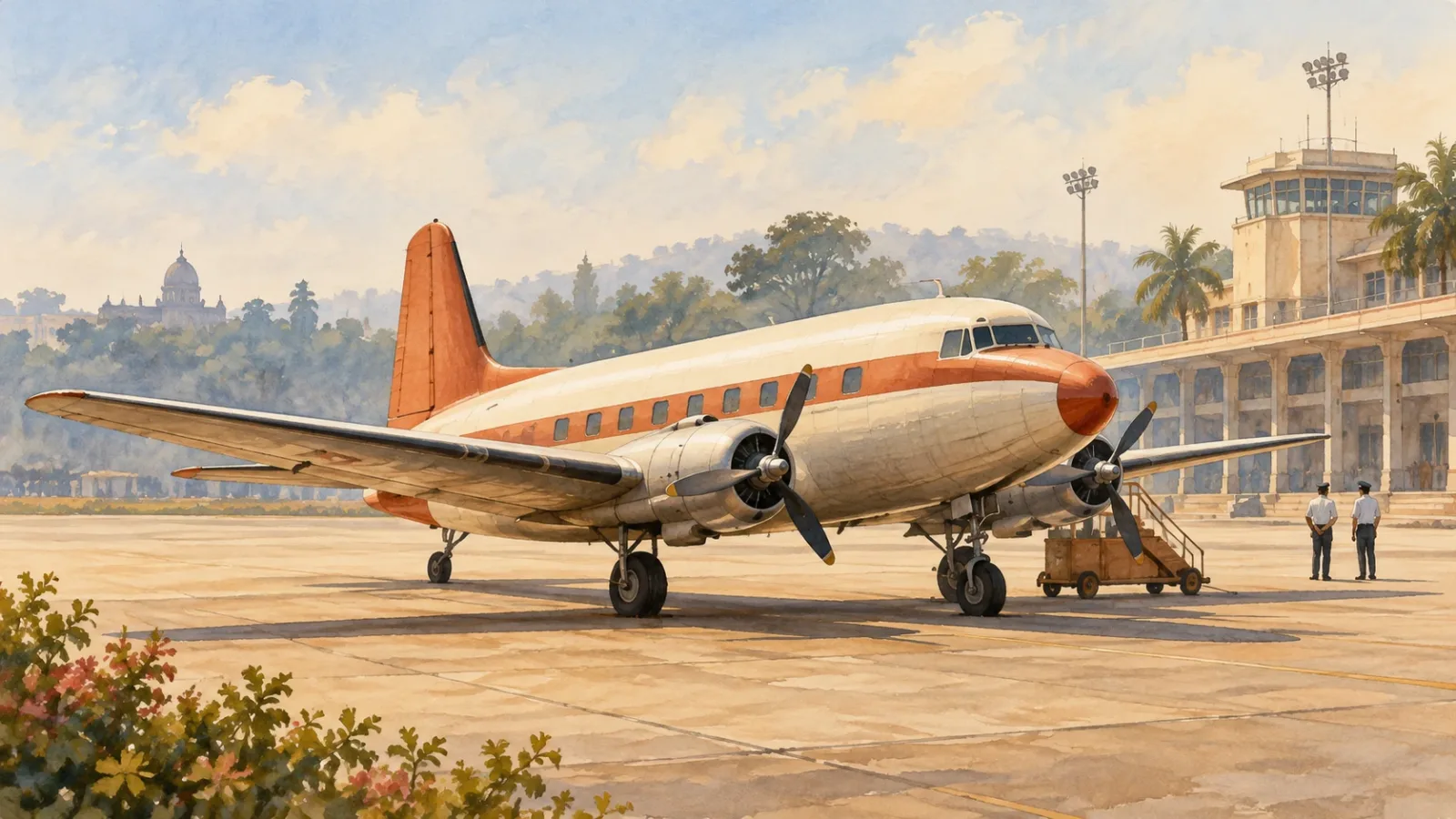
Historical records checked 12 November 2026. Indian Airlines belongs in an airline-history series for a different reason from an airline that suddenly grounded its fleet: its identity became part of a merged carrier. The useful story is the sequence from 1953 to Indian in 2005, the legal merger in 2007 and later integration work.
Those dates answer different questions. The creation of a corporation, a change in its public name, legal amalgamation and the joining of reservation systems should not be collapsed into one last-flight date.
1953: a domestic corporation, not the start of all Indian aviation
The Comptroller and Auditor General's 2011 introduction records two corporations coming into existence under the 1953 framework: Indian Airlines Corporation as the national domestic carrier and Air India as the international carrier. The PIB aviation timeline published on 25 January 2011 also places Indian Airlines' formation in the nationalisation period.
That is not the same as saying Indian aviation began in 1953. The audit traces earlier scheduled services to the Aviation Department of Tata Sons in October 1932, followed by Tata Airlines and the later Air India names. Nor should the domestic role assigned in 1953 be read as a claim that Indian Airlines never had international links later.
An airline that changed before it merged
The 2011 PIB timeline records Indian Airlines inducting A320 aircraft in 1989. It also records the 2005 rebranding of Indian Airlines as Indian. These are separate milestones: a fleet development and a public-facing name change, neither of which by itself created the later merged company.
The CAG introduction records the repeal of the Air Corporations Act in 1994 and the incorporation of Air India Ltd. and Indian Airlines Ltd. under the Companies Act. A corporate history needs this distinction between the earlier corporation and the later company, even when passengers remember one familiar airline name.
Cooperation was already happening before 2007
A Civil Aviation Ministry release dated 14 November 2002 said Air India and Indian Airlines had finalised a hub-and-spoke arrangement. It described using Indian Airlines aircraft to connect domestic stations with Air India's international flights from Delhi and Mumbai.
This is evidence of planned cooperation at that time, not proof of a completed merger or a statement of today's connection rules. It helps explain why an integrated domestic and international network later appeared among the merger's stated aims.
2007: distinguish the appointed date from the legal-process announcement
The CAG merger chapter records Cabinet approval on 1 March 2007 and incorporation of National Aviation Company of India Ltd. (NACIL) on 30 March. Its chronology says the two airlines stood dissolved and merged into NACIL on 22 August 2007, while the approved scheme set an appointed merger date of 1 April 2007.
A separate Ministry release on 24 August 2007 announced the legal-process completion through filing the approval with the Registrar of Companies that day. It said the merged airline would fly under the Air India brand domestically and internationally. The appointed date, the audit's legal chronology and the filing announcement describe different parts of the process; they are not three competing dates for one last passenger flight.
2010 and 2011: a company name and a reservation-system milestone
The CAG introduction records NACIL being renamed Air India Ltd. in November 2010. Chapter4 then makes clear why a 2007 legal merger did not mean every operational system was already combined: the two earlier airlines had separate reservation systems and codes, IC for Indian Airlines and AI for Air India.
The audit says the single-code passenger reservation system was activated in February 2011, after the integration contract was awarded in April 2010. It also reports that other integration work remained incomplete at the time of the audit. We use the month established by that primary record, not an unverified exact last-flight day.
Why the merger was still being discussed later
The audit tabled on 8 September 2011 criticised delays in actual integration. The Ministry's 28 December 2012 review later described the integration process under the Justice Dharmadhikari Committee recommendations as almost completed. A 2 December 2014 parliamentary reply also listed the Passenger Service System for a single code among Air India's cost-cutting measures.
These documents have different dates and scopes. The later statement does not erase the earlier audit findings, and the earlier finding is not a claim about the airline's present systems. This is a merger history, not a bankruptcy or liquidation account. No exact final flight, final repainting date or current passenger entitlement is established here.
Keep nostalgia separate from today's booking
For a private family trip, an old airline name may begin a conversation about journeys your parents remember. It should not decide today's operator, allowance or connection plan. Share the current itinerary and family needs through the trip-planning page; the historical releases above are not current travel instructions or package-inclusion promises.
Sources and illustration
Official dated records checked on12November2026. The hero is a fictional AI watercolor, not an archival photograph, a verified livery or evidence of a particular aircraft in Indian Airlines service. The article separates legal milestones, brand changes and system integration rather than inventing one shutdown date.
- PIB aviation timeline, 25 January 2011: 1953 formation, 1989 A320 induction and 2005 Indian rebrand
- Civil Aviation Ministry, 14 November 2002: pre-merger hub-and-spoke arrangement
- Civil Aviation Ministry, 24 August 2007: legal merger process and intended Air India brand
- CAG Report18 of2011, tabled8September2011: audit overview
- CAG2011 Chapter1: corporations,1994 companies, merger and2010 NACIL name change
- CAG2011 Chapter4: appointed/legal milestones, February2011 reservation integration and delays
- Civil Aviation Ministry review,28December2012: integration under Dharmadhikari recommendations described as almost complete
- Parliament reply,2December2014: PSS single-code measure recorded

A Miranda House graduate and lawyer who traded courtrooms for slow travel. Cheshta travels with the batches we host ourselves, with a soft spot for travelling alongside elders.
Planning your next trip?
We'll handle insurance, hotels, airport assistance and the itinerary — the same way we do it for every trip.
Questions on this article
asked by readers, answered by us
Was this helpful?
one tap, no sign-up