




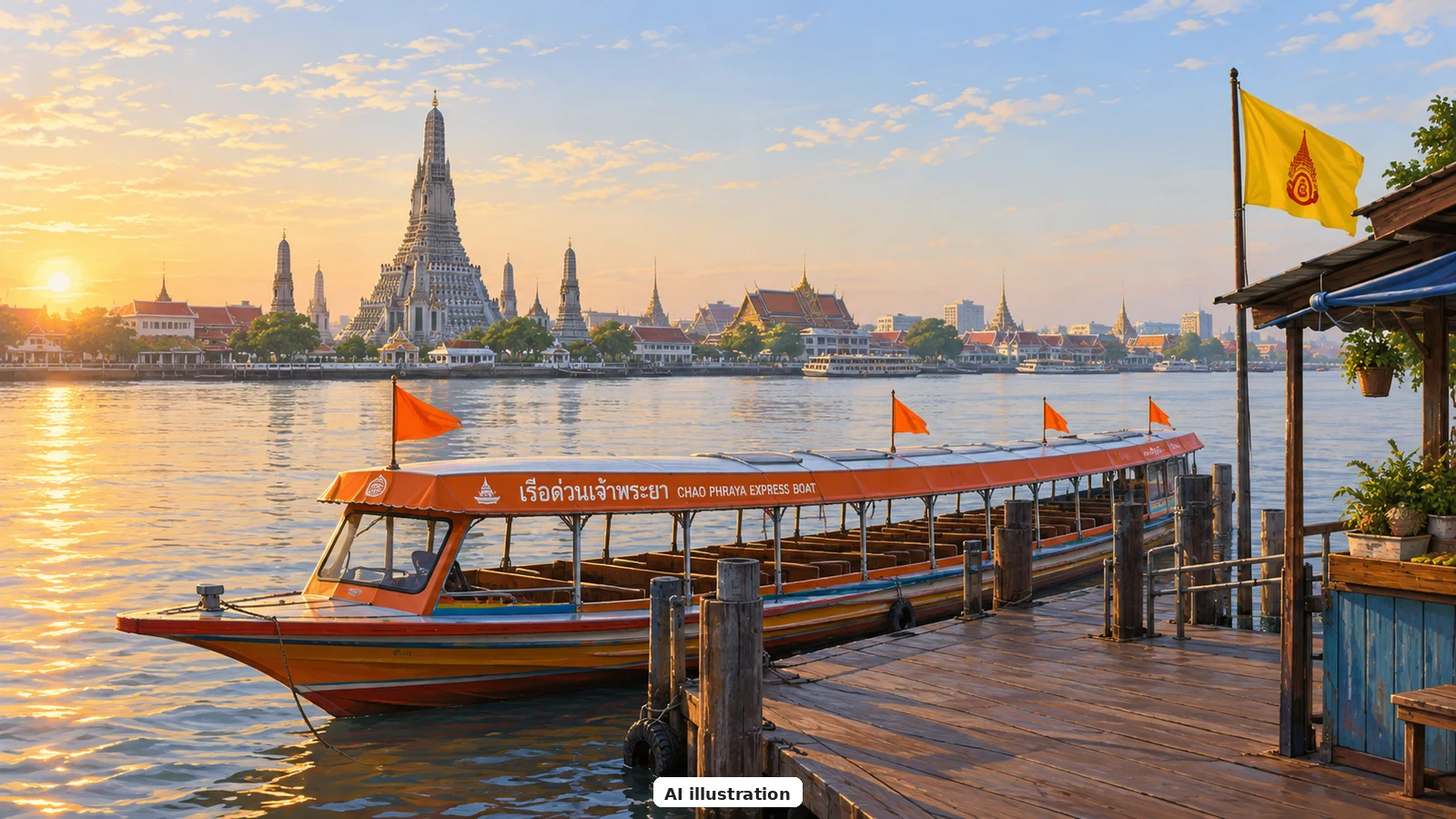
The Chao Phraya express boat is the cheapest and most scenic way to reach Bangkok's great temples - and it is also a floating pontoon, a narrow gangway and a crowd of hurrying commuters. For a senior traveller or anyone with limited mobility, the honest answer is: yes, the river is manageable, but not the way younger travellers do it. Here is where the steps are, where the lifts are not, and the alternatives that keep the boat ride and lose the obstacles.
1. The short answer
A senior who can manage one flight of steps slowly, with a railing and a free hand, can ride the river boats and should - they bypass Bangkok's road traffic completely and land you at the Grand Palace, Wat Pho, Wat Arun and the flower market. The two pinch points are Sathorn (Central) Pier, reached by about 15 steps down to a floating pontoon, and Saphan Taksin BTS above it, the one Skytrain station in Bangkok still without an elevator. A senior who cannot do stairs should skip the BTS-to-boat connection entirely and take a taxi to a smaller pier instead - more on that below.
2. Where the steps actually are
The river itself is not the problem; the access is. Almost every visitor's boat journey starts at Sathorn Pier beneath Saphan Taksin BTS station. Getting from train to boat means leaving the elevated station - stairs only, since Saphan Taksin (S6) is the single BTS station without a lift as of the operator's own FAQ - then descending roughly 15 steps to a pontoon that physically rises and falls with the tide. The gangway onto the boat is narrow, deckhands whistle departures, and at busy hours the queue moves at commuter speed. Smaller upriver piers like Tha Tien (for Wat Pho) and Tha Chang (for the Grand Palace) are simpler, but still floating pontoons with a step or two and a gap to the boat. The boats themselves have an outdoor section with room to stand or sit close to the deck edge.
3. Which boat to pick (and what it costs)
Boats are distinguished by flag colour. The orange-flag express is the workhorse: about 19 baht flat, stops at most piers including the Old City temples, and is the best value - but it is a commuter service, crowded at rush hours with no commentary. The blue-flag tourist boat costs more (about 30-50 baht single, or a hop-on-hop-off day pass around 150-200 baht) and is the easier choice for seniors: English announcements, staff used to visitors, and a slower boarding rhythm. The tourist boat runs from Sathorn Pier roughly 08:30 to 19:15 daily. Whichever you pick, read the flag before you queue - the hulls look nearly identical, and the wrong flag either skips your pier or costs more than it should.
4. Timing tricks that remove the crowd
Boarding difficulty is mostly crowding, and crowding is mostly timing. Go before 9am: the boats are full of commuters but the tourist queue is short, the light is beautiful on the temples, and the heat is kind to older legs. Avoid 5-7pm when commuters and sunset sightseers stack up and gates grow congested well before the final sailings. Keep one hand free for the railing - no bags in both hands on the gangway - and let a deckhand see an older parent boarding; they hold the boat and offer an arm more readily than you might expect. Sit toward the covered middle in the heat; the open rear deck has the views but also the spray and the engine noise.
5. The stair-free alternative: taxi straight to a small pier
If stairs are a real problem, skip Saphan Taksin entirely. Take a taxi directly to Tha Tien pier (beside Wat Pho) or Tha Chang (beside the Grand Palace) - ask for the temple name, since drivers know those better than pier numbers - and board the orange-flag boat there for a one-way river ride when the queue is short. You get the river experience without the 15 steps, and a taxi back from wherever you finish. Cross-river ferries (Sathorn to Khlong San in under three minutes, Tha Tien to Wat Arun) are another low-commitment taste of the river, though they have the same floating-pontoon boarding. Wheelchair users should know the pontoons move with the tide, so the step gap varies - help from staff is available but not formalised.
6. Getting there without the BTS stairs
The rest of Bangkok's rail network is friendlier than Saphan Taksin: every metro (MRT) station is wheelchair accessible, and every BTS station except Saphan Taksin has an elevator. A comfortable pattern for seniors is MRT or taxi to the riverside area, boat one way for the scenery, taxi back. If you do use the BTS, Silom line trains are frequent and staff stand at the boarding area to make sure everyone is on before doors close - but at peak hours the crowds themselves are the hazard, so off-peak only.
7. A senior-friendly half-day on the river
Here is the plan we give families. Taxi to Tha Chang at 8:30am, see the Grand Palace while it is cool, walk the flat ten minutes to Tha Tien for Wat Pho, cross to Wat Arun on the little ferry if energy allows, then board an orange-flag boat downriver from Tha Tien toward Sathorn around 11:30 - seats available, temples behind you, breeze on deck. Lunch near the river, taxi home for the afternoon rest. Total steps: the pontoon steps at two piers, taken slowly. Total cost per person: well under 100 baht in boat fares.
Before you go
Check five things: whether Saphan Taksin's lift has opened yet (the BTS FAQ lists stations with elevators); the day's first and last tourist-boat times at Sathorn; the tide-sensitive gangway angle if anyone uses a walking aid; that everyone boards with one hand free; and the temple dress code for the day. This article reflects guides checked on 30 October 2026 - fares and hours change, so confirm with the operator's site before travelling.

A Miranda House graduate and lawyer who traded courtrooms for slow travel. Cheshta travels with the batches we host ourselves, with a soft spot for travelling alongside elders.
Planning your next trip?
We'll handle insurance, hotels, airport assistance and the itinerary — the same way we do it for every trip.
Questions on this article
asked by readers, answered by us
Was this helpful?
one tap, no sign-up