




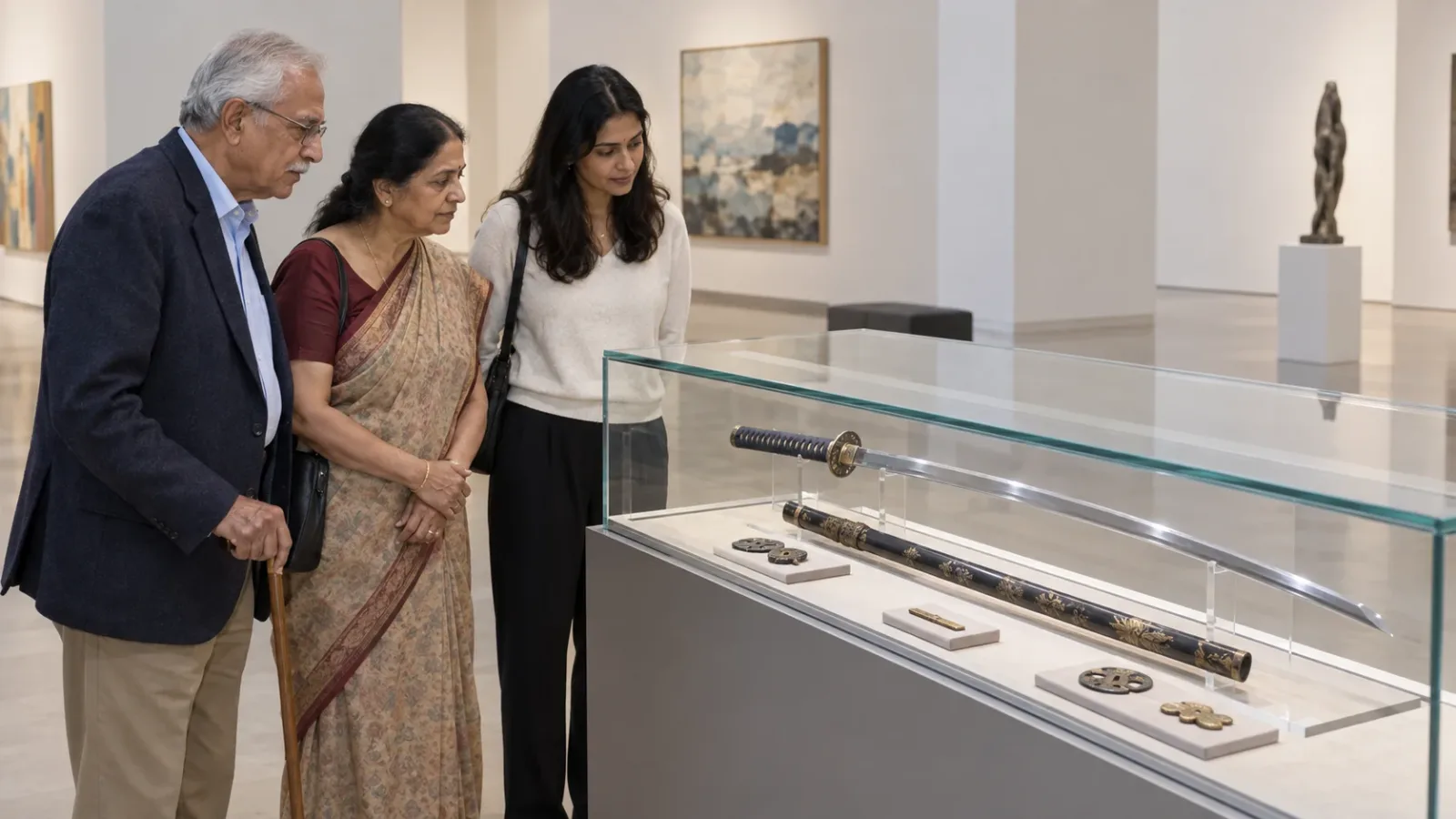
The Japanese Sword Museum in Ryogoku suits parents who want to look at Japanese swords as art: their shape, surface and fittings. Museum admission is not a place in a sword-handling session. The association does run separate appreciation events, but their own application and first-time conditions matter. Choose the ordinary gallery visit unless the actual event arrangement has been confirmed.
An exhibition ticket and an appreciation event are different
The museum's English page maps the first-floor information corner and lecture hall separately from the third-floor exhibition hall. A lecture hall on the map does not put an activity into the admission ticket. Nor does the existence of a museum shop make this a sword rental, costume photo session or martial-arts demonstration.
The operator's regular appreciation-event page describes an event at which participants actually hold swords for appreciation. It requires advance reservation and, for first-time participation, completion of the Japanese-sword appreciation manners course. If attending both on the same day, the page calls for a reservation for each, not just one of them.
That page lists its own fee, age category, capacity and instructions. Those event terms should not be replaced by museum admission prices or an old account saying no reservation was needed. No event place, course completion, language assistance or permission to handle an object has been secured by this article.
First-time conditions are part of choosing the outing
If an adult parent specifically wants the event rather than a display visit, ask the association whether they meet the current requirements and can understand the instructions in the language provided. Do not assume a companion can translate throughout or that gallery staff can waive the course condition because the family has travelled a long way.
This is not a how-to guide for handling swords. Follow only the organiser's instructions in a properly accepted event. The ordinary museum plan here is viewing objects in cases, with no handling, forging, polishing, purchase or export arrangement included.
Start with the information corner before the paid gallery
The museum's own introduction describes conserving and presenting Japanese swords as cultural and artistic objects. A first-person museum account published in March 2025 recommends the first-floor information panels and videos about sword making before going to the paid third-floor exhibition.
That is a useful way to give parents some context before comparing objects in cases. Pick one or two questions: what changes in the blade's outline, how the surface catches light or how a fitting is decorated. These are viewing ideas, not a claim that a particular famous sword or a demonstration is always present.
The English headline price is not every exhibition price
The English page shows a normal adult admission figure of ¥1,000 but explicitly warns that fees vary by exhibition. The Japanese admission page separates ordinary and special-exhibition rates, and the current exhibition page gives the relevant show's actual categories. Read those together instead of promising every family the English headline figure.
The bracketed adult rates on the Japanese fee table are for groups of 20 or more, not senior discounts for two parents. Students, members, children and disability-category visitors have separate categories and evidence requirements. Do not choose a lower category just because a parent is older or uses a walking stick.
The Japanese page asks for original documentation, while the English disability note says its provision is based on the Japanese system. Acceptance of a particular overseas disability document has not been confirmed here. Ask before relying on a concession for the visitor or companion.
The fee page also distinguishes ordinary invitation tickets from special-exhibition invitation tickets. Having an invitation is not enough unless it is valid for the show you want. Check the exact exhibition and ticket before paying or treating a family budget as settled. No ticket or event has been purchased here.
English material is not a confirmed Hindi guide
The current exhibition page includes an English-list link, while the English museum page gives basic practical information. Those are useful preparation, not proof of Hindi narration, a live Hindi interpreter or every explanation being available in English.
Accessible Japan's on-site access account says many labels were not in English and describes QR-based guidance using the museum's Wi-Fi. Treat that as an account of available support on that visit, not a guarantee about the current show's full translation. Ask what reading or audio support is actually available before planning around a phone.
Do not promise gallery photography from an old photo online
The March 2025 first-person account reports that exhibition photography was prohibited on its visit. This article has not established a current blanket permission for every display. Read the current room and object signs and ask staff before taking a photograph or using camera translation.
The separate appreciation-event page prohibits photography for that event. Do not merge event and gallery rules, and do not treat a museum's publicity photographs as permission for visitors to make their own images. A family souvenir photo or a video plan is not included in admission by assumption.
A good indoor access report still has a date
Accessible Japan describes an elevator to the third-floor hall, loan wheelchairs, rest places and accessible toilets on the first and third floors. A Japanese wheelchair-visit report based on October 2019 fieldwork also describes flat interiors and displays it could view from a wheelchair.
Those are helpful specific observations, but not a reservation or a current access audit. Ask the museum about the entry route, lift operation, wheelchair availability and the actual visitor's needs. Do not turn “fully accessible” in a review headline into a promise that every part of the outing is effortless.
The 2019 report separately notes two manual doors to the roof garden and a barrier height that limited its view from a wheelchair. That is a reason to ask about the terrace and sightline, not to promise the same view for everyone. It is also not advice to stand up or change mobility support for a photograph.
The ground-floor café label is not a restaurant booking
The floor map includes a café and the on-site accounts describe a rest area with vending machines and tables. A space called café on a map does not establish a staffed lunch restaurant, a vegetarian meal or seats for the whole family. Arrange lunch separately if it must happen at a particular time.
The second-floor reading room is another separate service. The operator's library guide requires a telephone reservation, asks which materials you want and says there are no open shelves. It is not a walk-in reading break automatically covered by an exhibition ticket.
The garden next door does not follow the museum ticket
The official Tokyo listing for Kyu-Yasuda Gardens describes a separate free garden nearby. The Sword Museum itself normally closes Mondays, moving to Tuesday when Monday is a holiday, plus exhibition-change and New Year closures. Do not use a garden's open gate as proof that the museum hall is open.
The museum publishes 9:30–17:00 with last admission 16:30. Choose the day and exhibition first, then decide whether parents want a short garden pause as well. No particular outdoor route, opening exception or weather condition has been verified for a future family date.
Let the gallery visit be a complete plan
Ask parents whether comparing art objects with a little background would be worthwhile without touching a sword or seeing a live performance. If yes, the museum fits on its own terms. If not, resolve the actual event and language needs before paying rather than promising an activity that the ticket does not contain.
Use The Trip Keeper's Japan trip page for the wider holiday conversation. Museum admission, an appreciation event, manners course, interpreter, lunch, wheelchair or transport is not implied to be included in a package. Last checked 9 November 2026. Hero: AI-generated fictional family and a generic museum case, not actual museum rooms, current exhibition objects or a booked event.

A Miranda House graduate and lawyer who traded courtrooms for slow travel. Cheshta travels with the batches we host ourselves, with a soft spot for travelling alongside elders.
Planning your next trip?
We'll handle insurance, hotels, airport assistance and the itinerary — the same way we do it for every trip.
Questions on this article
asked by readers, answered by us
Was this helpful?
one tap, no sign-up