




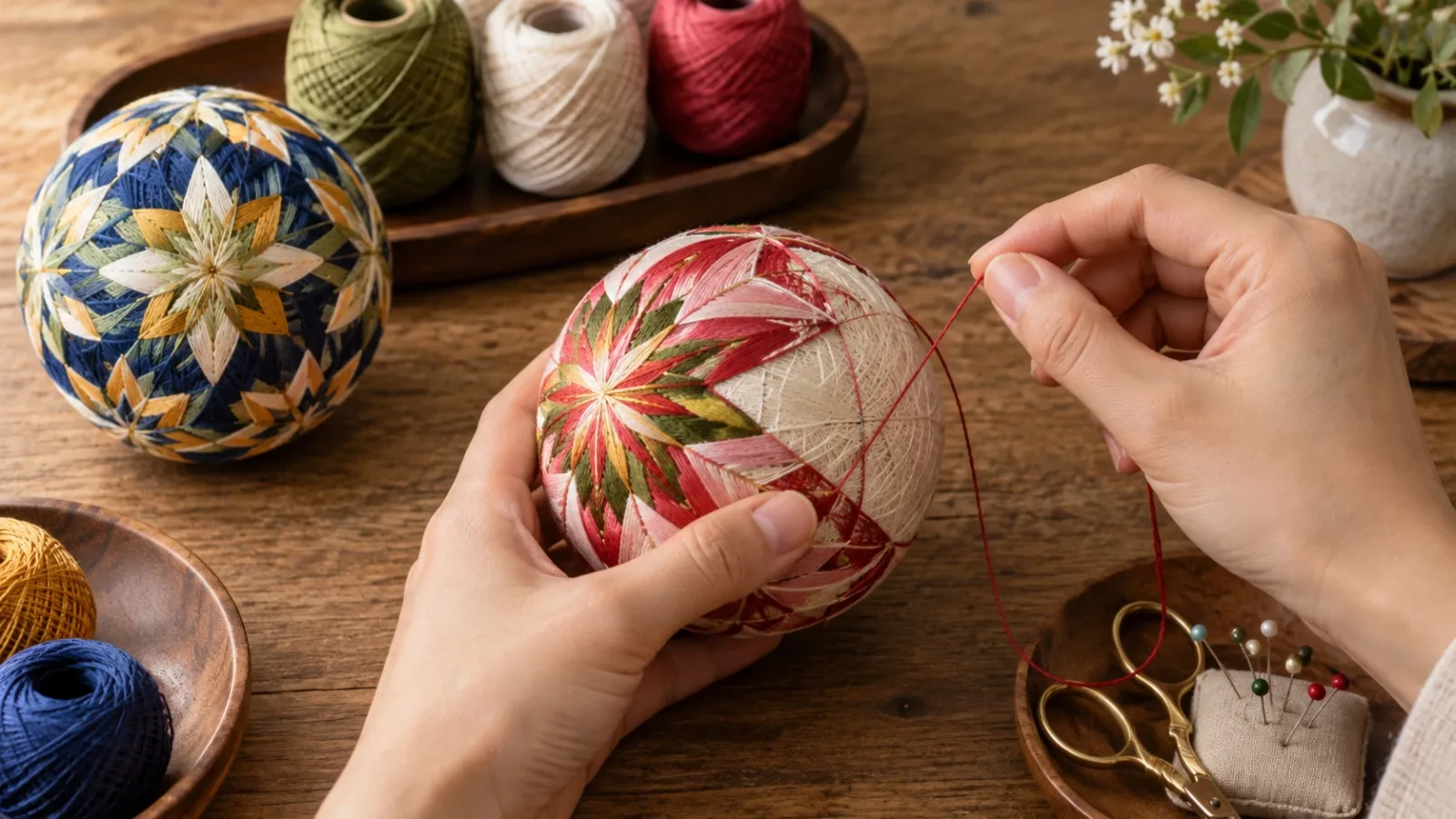
Checked 9 November 2026. AI illustration shows hands guiding thread around a partly stitched geometric temari ball at a fictional craft table, not the actual Mariya venue, equipment or confirmed activity. Confirm the selected date, activity, language and access directly.
Choose learning now and finishing later, not a quick craft stop
The operator’s one-day experience page says the class lasts about two hours and the work cannot be finished together in that time. The aim is to teach visitors to continue on their own at home. The Ishikawa tourism listing explicitly makes the same unfinished-work point for the temari kit.
For the temari lesson, the operator names a two-chrysanthemum design and says participants start from stitching the coloured threads. That is not a promise of building every layer of the ball from scratch during the visit, nor a choice of every finished-shop design.
Ask what comes home, which steps remain, whether you receive instructions you can understand and what tools you must have later. Do not choose this solely because the calendar has a spare two-hour gap. Leave room for arrival, explanation and packing up too.
Use the operator’s ¥8,000 quote, not the lower tourism listing
The operator currently lists the temari experience at ¥8,000. The prefectural tourism page still lists ¥6,500 per person including tax. These prices disagree. Use the operator’s higher current published figure for initial planning, then ask for the final per-person total, tax and kit/material inclusions before payment.
Two participants at the listed ¥8,000 would be ¥16,000 by simple addition, not a checked family checkout total. An accompanying parent who does not stitch is not automatically a free observer or a paid participant; ask about the place and charge.
The same operator page advertises yubinuki thimble classes at ¥4,000 or ¥4,400 depending on design. Those are a different item and lesson. Do not treat the cheaper thimble price as the cost of making a temari ball.
A request is not a confirmed weekend lesson
The operator says the visitor temari class can be held on Saturdays or Sundays, while the one-day yubinuki class is Sunday-only. Both depend on arranging an instructor. Ordinary shop opening does not make every weekday a visitor-workshop day.
The published capacity is one to four people. The tourism listing asks for reservations at least a week ahead. Send the desired date and time, names/contact details and actual maker count, then wait for the operator’s reply after the instructor is arranged. The operator specifically says that reply completes the reservation.
Its notice also warns that email may not arrive reliably and advises phone or fax if there is no reply. Silence is not acceptance. For five family members or a mix of makers and observers, ask what is possible rather than splitting bookings to bypass the stated capacity.
Regular local classes are a separate timetable
The regular-class page lists temari sessions on Mondays and Thursdays, with two-hour morning and afternoon periods, a ticket system and materials charged separately. Those sessions are not evidence that a short-stay visitor can book the one-day weekend product on a Monday.
This distinction matters if a parent sees an appealing date in a search result. Ask for the visitor experience by name and get the date, time, item and price together in one confirmation. Do not mix the regular course timetable, one-day lesson fee and shop opening hours into a new product.
The pages do not establish an English or Hindi teaching guarantee, a translated step-by-step booklet or a private family class. An English shop-description page is not proof that the instructor can teach in English on your date.
Fine silk-thread work needs its own fit check
The tourism page describes detailed needlework with silk thread and says to bring glasses or a magnifier if needed. Tools and materials are described as provided there; the operator separately says tools are loaned. Ask exactly what is included and what must be returned.
A parent may love watching the patterns emerge but not want two hours of close stitching. Ask about the size of the work, lighting, seating, breaks and whether the instructor can demonstrate a small section before you commit. This is a practical activity check, not a medical assessment.
The operator’s English shop description and Kanazawa craft directory distinguish decorative temari balls from silk thimbles. Choose the object first. A thimble-shaped accessory is not the same exercise as embroidering a ball, even when both are displayed in the same shop.
Check the actual route to the lesson, not an old staircase photo
The regular-course page names the second floor. The current one-day listing says the experience is in the shop’s activity space, without confirming a continuous step-free route. Ask which floor your lesson uses, whether there are stairs or a lift and where a companion can wait.
A December 2011 maker’s visit account describes climbing stairs to the shop and seeing a classroom. It is useful as a reason to ask a precise route question, not proof of today’s access arrangements, stair count or lift availability.
A local tour group’s craft profile shows the shop’s temari and thimble displays. It does not confirm a walk-in lesson or a guaranteed live demonstration. If parents prefer looking at finished work, ask about a shop visit instead, without assuming they must book a workshop or buy something.
Keep the Kanazawa day flexible until the reply arrives
The published address is 5-7 Minamicho, Kanazawa. The tourism listing gives shop hours of 09:30–18:00, Tuesday/Wednesday closure and no parking. Check your chosen date and the exact entrance with the shop; do not use those hours as a confirmed lesson start time.
If the class is unavailable, a shop visit or another part of the day can still work. Do not promise the exact displayed design will be in stock, that a finished ball costs the lesson price or that a parent can join just to watch without asking. Cancellation, deposit and date-change terms remain unconfirmed here.
For the wider itinerary, use The Trip Keeper Japan planning page to share the maker count, preferred weekend, language and access needs. This workshop, materials, interpreter and transfers are not promised package inclusions. Checked 9 November 2026. The reused AI hero shows a fictional Indian family planning in a generic lounge, not Mariya, its classroom or a finished temari.

A Miranda House graduate and lawyer who traded courtrooms for slow travel. Cheshta travels with the batches we host ourselves, with a soft spot for travelling alongside elders.
Planning your next trip?
We'll handle insurance, hotels, airport assistance and the itinerary — the same way we do it for every trip.
Questions on this article
asked by readers, answered by us
Was this helpful?
one tap, no sign-up