




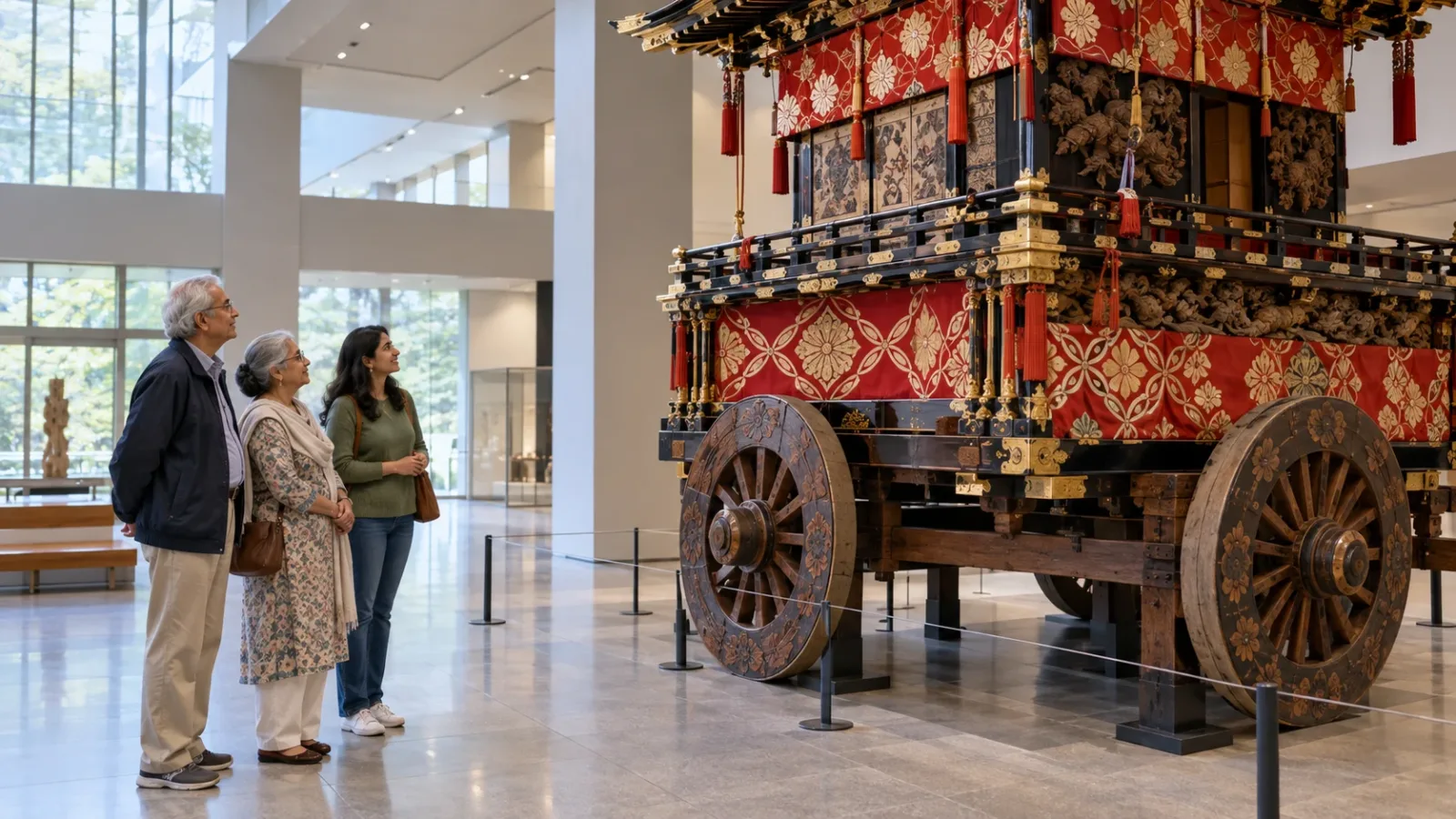
Kawagoe Festival Museum can work for parents who want to see the carved floats without planning their entire trip around the street festival. But “experience the festival at any time” does not mean a live music performance every day. Choose whether the family mainly wants the objects and films or would only make the stop for a live hayashi performance.
The float display and the live programme are separate
The Japanese museum page describes two real festival floats, changed periodically, and films about the festival. It lists live hayashi demonstrations on Sundays and public holidays, lasting about twenty minutes. The Saitama prefecture’s June 2024 performance page gives the same broad performance-day pattern and directs visitors to the museum’s timetable.
The official exhibition and performance page lists afternoon performance times, but an operating museum day is not proof that a particular performance will run. Check the current date-specific programme and any notices if music is the reason for the visit. A time printed on a general timetable is not a reserved seat.
There is a real language-page conflict: the English museum page still says musical accompaniment will be suspended for a while, while the Japanese page and a March 2026 notice refer visitors to a performance schedule. Do not silently choose whichever page suits the plan. Ask the museum to confirm the intended performance before making a special journey.
A film is not a substitute for a promised live show
The Japanese page describes a roughly eight-minute presentation on a three-sided screen, every twenty minutes. The English page describes an older-looking six-minute, single-screen presentation. Treat that as inconsistent published detail, not two performances to add together. Check the actual programme if the length, format or sound matters to parents.
The museum also describes recorded conversations, other video displays and an immersive festival scene. Indoors is not the same as quiet. If a parent prefers less sound or moving imagery, ask whether they can see the floats while skipping or stepping out of the film. A quiet room, volume adjustment and guaranteed seat were not confirmed from the checked pages.
Two floats does not mean the same two forever
The museum’s current Japanese description and timetable make clear that floats rotate. A 2018 Muza-chan photo essay explains the timber base, sculpted decoration and upper structure visible in a museum float. It is useful for deciding whether those details interest the family, not for identifying the float on display during a future trip.
The official English festival feature also mentions a float under construction, while the main museum page centres on two displayed floats. Do not promise a building demonstration, handling session or a particular doll from that older descriptive feature. Ask what visitors can actually see and do on the day.
Viewing a real float does not mean riding on it, pulling it through town or watching a parade outside. Keep the museum visit and any separate festival activity distinct. A museum ticket alone does not establish participation in another event.
An elevator listing is not a live equipment check
The official Saitama tourism listing identifies a shared elevator, handrails, wheelchair parking and a nursing room. These are useful facility leads. They do not confirm current elevator operation, the route to every exhibit, toilet dimensions or whether a particular wheelchair fits.
The museum’s 27 February 2026 elevator notice concerns a short inspection-related closure on a specified March morning. It is an old, time-limited notice, not evidence that the elevator remains out of service today. Equally, a facility icon is not proof that it will work on a future date. Ask about the route and equipment if the family depends on it.
Do not confuse this museum with Kawagoe City Museum. Accessible Japan’s Kawagoe area guide describes City Museum facilities and warns that linking many sights covers a fair distance. Its City Museum benches, cafe and toilet description cannot be transferred to the Festival Museum.
Multilingual does not automatically include Hindi
The Japanese museum page says multilingual audio guides can be borrowed at reception, and the English feature mentions English explanations. Neither establishes Hindi narration, a Hindi-speaking guide, the full available language list or availability of a particular device on your visit. Confirm what the family can actually use.
If a daughter or son will translate, allow time to pause rather than expecting the whole family to follow a fast film. Check subtitles, device terms and any fee before relying on them. An English website is not a booked private English tour either.
The advertised half-hour is not the family’s whole stop
The operator describes a museum visit of about thirty minutes in its parking information. That is a broad estimate, not a promise including arrival, toilets, waiting for a film or live music, translation and rest. Leave enough room that parents can choose one activity without racing to another.
The checked Japanese page lists general admission at 300 yen and elementary/junior-high admission at 100 yen. It lists different seasonal closing and last-entry times, plus regular and temporary closures. Check the current page for the intended date rather than treating a general “year-round” description as open every day.
The certificate-based admission exemption on the operator’s page does not say that any overseas disability document or age alone qualifies. Ask what proof is accepted if relevant; do not budget on an assumed exemption. A ticket does not promise a performance, a seat or interpretation.
Museum parking is not an all-day town parking plan
The operator lists a small free parking area for museum visitors, with a maximum two-hour use and separate bus-reservation requirements. That does not reserve a car or wheelchair space for your family. Confirm the actual vehicle arrangement and do not build a longer town walk around unlimited museum parking.
For the surrounding walk, the area access guide notes distance, narrow or uneven approaches and traffic close to the warehouse district. Those are the guide’s observations, not a measured route for your date. Choose the actual drop-off and return point, and keep a separately checked seated meal or rest option instead of assuming the museum provides one.
Make a small choice before you go
If floats and films are enough, choose an open day after checking the family’s route and language needs. If live music is essential, confirm that specific performance first. If a low-sound visit is essential, confirm a workable alternative before treating the museum as the solution.
For the wider holiday, The Trip Keeper’s Japan trip page can start a conversation about pace and interests. This museum, performance, Hindi assistance, admission, transport and meals are not implied inclusions. Last checked 9 November 2026. Hero: AI-generated fictional family beside a generic festival float, not the museum’s actual interior, present float or confirmed access layout.

A Miranda House graduate and lawyer who traded courtrooms for slow travel. Cheshta travels with the batches we host ourselves, with a soft spot for travelling alongside elders.
Planning your next trip?
We'll handle insurance, hotels, airport assistance and the itinerary — the same way we do it for every trip.
Questions on this article
asked by readers, answered by us
Was this helpful?
one tap, no sign-up