




Checked 12 November 2026. The Kon-Tiki Museum can work well as a focused family stop in Oslo, but its children's play area should not be sold as a gentle room you reach immediately on arrival. The museum locates it downstairs, after the caves and a large whale shark. Start with the vessels and interactive stations, then decide whether that lower-level route suits your child.
Start with a raft, not a checklist of every room
The museum's current visit page says a new exhibition around and beneath the Kon-Tiki raft opened in summer 2026. Its homepage confirms that the new exhibition is open, with stories, interactive stations and animations.
The original Kon-Tiki raft and the Ra II reed boat are the headline objects. The museum describes the former as the raft used for the 1947 Pacific voyage and the latter as the boat used for the 1970 Atlantic voyage. They are not interchangeable names for one vessel.
For a mixed-age family, choose one vessel as the anchor and let children try a few activities nearby. That is a planning suggestion, not a museum rule or a promise that every station will be working on the day. Leave room to pause rather than treating the visit as an expedition-themed endurance test.
The lower-level play area has a more dramatic approach
The museum background page places the activity corner downstairs, after the caves and the large whale shark. It describes a raft children can slide from, navigation play and a cabin where they can imagine a voyage.
The current children's activity page still includes Kid-Tiki. It also lists a cave, a skull-like lava rock and a small surprise on the left passage where the cave divides. These are useful practical details for a child who dislikes dark, enclosed or startling spaces.
The cave is described as a 30-metre replica of one from Easter Island. The whale shark is part of the museum experience, not a live animal encounter. Ask staff about the route before taking a nervous child downstairs. A play area at the end does not mean the approach is comfortable for every child.
No inspected source established a guaranteed cave bypass, a sensory-friendly session or a minimum age for the surprise passage. Do not promise any of these. Explain what is ahead and be willing to keep the visit to the raft and other exhibits.
Hands-on activities need not mean touching the historic vessels
The children's page lists a raft-steering wall game, a game about finding balsa logs, and levers explaining how wooden guara boards helped steer a raft. It also lists interactive marine-life displays, an Easter Island map and the children's own raft.
These are designated activities. They are not permission to climb onto the original Kon-Tiki raft or handle every historic object. Let the station's instructions and staff guidance determine what can be touched.
The homepage also mentions separate children's storylines involving Johannes the crab and Safi the monkey. Those can help younger visitors find a thread without reading every panel. Whether a particular station, storyline or audio track is available in the language your family needs should be checked rather than assumed.
Ramps are confirmed; every narrow route is not
The museum's accessibility FAQ answers the question about wheelchair users and pushchairs by saying it has ramps to help visitors move around. That is useful positive evidence of access provision.
It does not publish, in the inspected answer, ramp gradients, doorway widths, turning spaces inside the replica cave, or the accessibility of each element of the children's raft. Ramps somewhere in the museum do not prove every play structure or optional passage can be used by every visitor.
If access is essential, ask for the step-free route to the main vessels, lower galleries, cinema and toilets, and specifically whether the cave or play area can be approached another way. Give the actual width and needs of your wheelchair or pushchair. A confirmed route for your equipment is more useful than a general accessible label.
The noon film is a separate time commitment
The museum's English and Norwegian background pages list the original 1950 Kon-Tiki documentary daily at noon in the downstairs cinema. The English account describes an approximately one-hour documentary and says it continues to be shown through the day.
This is documentary material from the expedition, not a promise of the same experience as a modern dramatic feature film. The inspected pages do not establish a full repeat timetable, reserved seats or a guaranteed language and subtitle combination for a particular screening.
For a child who mainly wants hands-on activity, an hour in the cinema may be a different visit from an hour spent exploring galleries. Choose it because your family wants the film, not because the daily noon listing makes it feel compulsory. Check the day's screening and language before building a timed lunch or onward museum visit around it.
Check age boundaries before buying for the whole family
The current visit page lists adult admission at NOK 180 and a family ticket at NOK 400 for two adults and up to five children. It also lists children at NOK 70 and students at NOK 70. These are prices read on 12 November 2026, not a held quote or completed booking.
The page has a small age-boundary mismatch: its headline wording says children over six and under 18, while the detailed price section says ages 6–17. If your child is exactly six, confirm which rate applies. Do not infer a free-entry rule for younger children from a missing line.
The senior rate is listed as NOK 140 for people over 67. If someone is exactly 67, confirm eligibility rather than silently changing the wording to 67 and above. No inspected statement here settles every proof-of-age or concession-document requirement.
Combination tickets with neighbouring museums are advertised, but the visit page's detailed options differ by category. Do not assume every family, child or student has the same two- or three-museum offer. Compare the actual tickets only after deciding whether everyone wants and has energy for the second museum.
A November visit is not a summer transport plan
The museum publishes September–April hours of 10:00–17:00. VisitOSLO's dated 2026 listing supports 10:00–17:00 from 1 September through 23 December. Both sources indicate reduced hours on Christmas Eve and New Year's Eve, so a holiday visit needs its own check.
The address is Bygdøynesveien 36, Oslo. The museum's directions page and the transport block on its visit page describe the Bygdøy ferry as seasonal, while another FAQ on the visit page calls it year-round. Those descriptions conflict.
We have not treated either wording as proof of a November sailing. Check the ferry operator's dated timetable or a current journey planner for your actual date. Likewise, use the journey planner for current bus departures rather than treating a general frequency on a museum page as a guaranteed connection.
Keep language, comfort and the next stop flexible
VisitOSLO lists children's quizzes in Norwegian, English and German. The museum advertises a free audio guide and explanatory texts in several languages, but the inspected pages do not confirm Hindi interpretation or that every audio track and station shares the same language choices.
Bring the family language question to the desk and use a few objects as shared talking points. If the cave, the film or an interactive station does not suit someone, a shorter visit can still be worthwhile. No fixed visit duration is promised here.
The Trip Keeper's trip-planning page can collect the family's dates, access needs and museum interests. Its private-tour page explains planning around the group. Neither link implies admission, guiding, transport or a particular accessible route is included in a package.
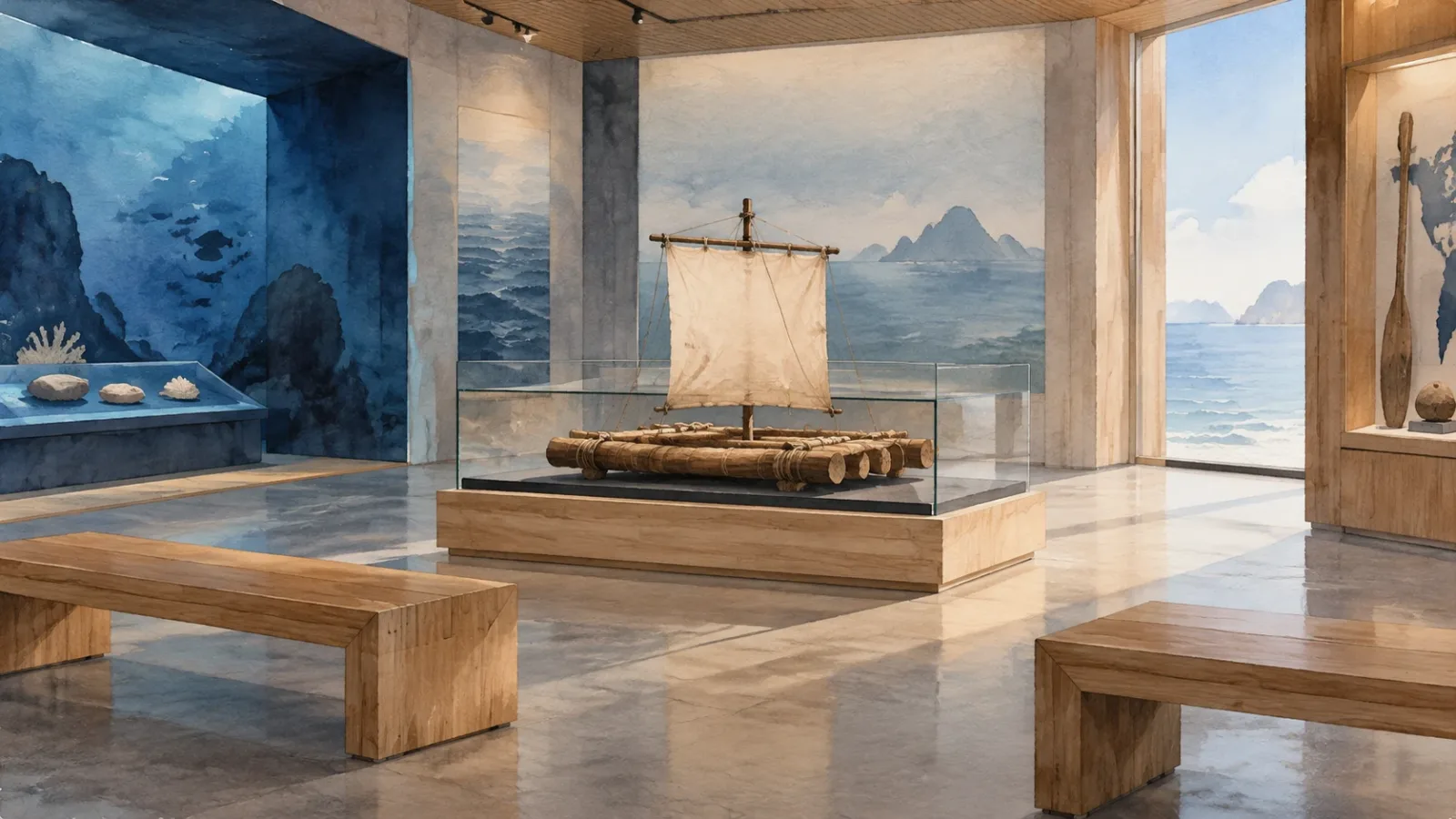
The hero is a fictional AI watercolor of an invented maritime gallery and model raft. It does not depict the actual Kon-Tiki Museum, a real vessel, a play structure or an accessible route.
Sources checked on 12 November 2026 include six museum pages and the official city visitor listing. The current children's page supports the play activities; an older dated playground event is not being used as proof of a bookable session today. Ask the museum directly about any essential route or age boundary before paying.
- Museum visit page: current exhibitions, prices, accessibility FAQ and conflicting transport descriptions
- Museum background: vessels, cave, children’s area and documentary
- Current museum children’s activities: interactive stations and cave surprise
- Museum homepage: new exhibition open, vessels and children’s storylines
- Museum directions page: location and seasonal transport description
- Museum Norwegian background page: noon documentary and children’s exhibits
- VisitOSLO: dated 2026 opening-hour blocks and quiz languages

A Miranda House graduate and lawyer who traded courtrooms for slow travel. Cheshta travels with the batches we host ourselves, with a soft spot for travelling alongside elders.
Planning your next trip?
We'll handle insurance, hotels, airport assistance and the itinerary — the same way we do it for every trip.
Questions on this article
asked by readers, answered by us
Was this helpful?
one tap, no sign-up