




Reviewed 18 November 2026. A focused heritage guide using Kushinagar district and the Uttar Pradesh government museum directory. Check current official visitor information.
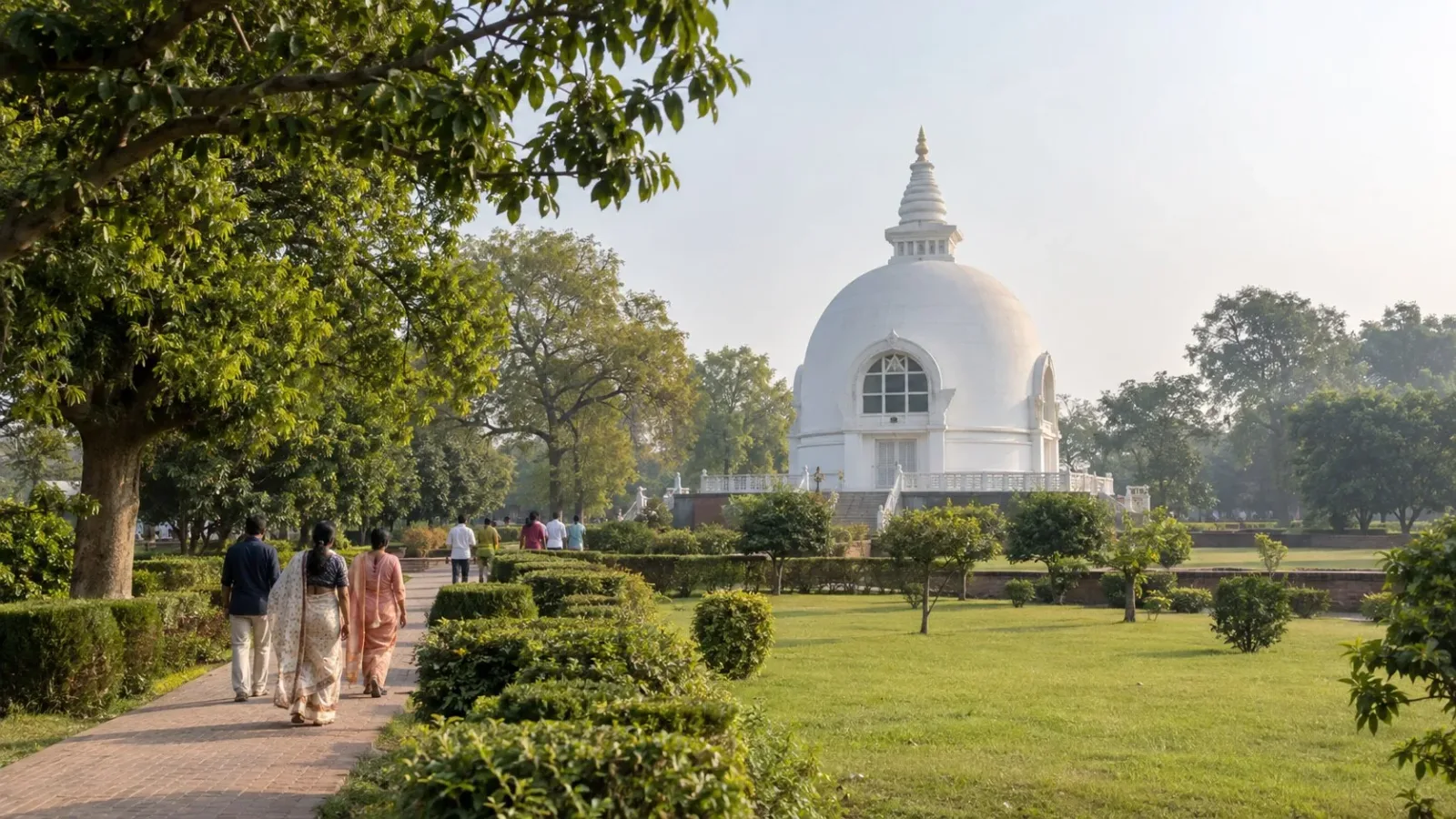
AI illustration: a fictional Buddhist monument scene inspired by Kushinagar. Not an actual location, person, route inspection or service.
Begin by separating the names
The district places the reclining Buddha inside the Mahanirvana Temple, with the main stupa next to it. Image, temple and stupa are related, but they are not interchangeable names for one object.
Our suggestion is focused attention to that main group, then a separate choice about Ramabhar or a museum. Check current official visitor information and keep food, a break and the return.
Read the reclining image carefully
The district describes an image 6.1 metres long, carved from a single block of sandstone, reclining on its right side with the face towards the west. Length is the measurement here, not the height of a standing statue.
The account records three human figures on the pedestal and an inscription attributing the image as a religious gift from Haribal. Keep that attribution with its source rather than inventing an identity for every figure.
Distinguish recovery from the present form
The district describes nineteenth-century excavation of the main stupa remains and the reclining image. It says the temple and stupa assumed their present form in 1956.
That history is a reason not to describe every visible part as untouched ancient work. Consider the image, the building that houses it and the neighbouring stupa as separate subjects with a connected history.
Give Ramabhar its own association
The district’s Ramabhar page links the stupa with the Buddha’s cremation in Buddhist tradition and names Mukutabandhana Chaitya. Its longer description uses cautious language about identifying the cremation site.
Keep the traditional association attributed rather than claiming archaeology proves every detail of the narrative. The district describes a circular drum and plinth with subsidiary remains, a different subject from the reclining image in the temple.
Choose a named museum for objects
The UP government directory lists Government Baudha Museum in Kushinagar, with stone, terracotta and metal sculpture, thangkas, seals, coins and decorated bricks among its collections. Those are reasons to consider material context as another interest.
The directory separately lists a private Baudh Sangrahalaya associated with Rahul Sanskritayan Sansthan. Do not treat the two institutions as one, or assume every collection item is displayed on a particular visit.
Leave space for pilgrimage as well as looking
A source-based heritage outline need not become a compulsory pilgrimage sequence. Let the group choose whether the image, Ramabhar’s association or museum objects are the main reason for further attention.
Leave room for worshippers and quiet. No ceremony, blessing, teaching or private meeting is arranged by this article. Check current official visitor information and keep food, rest and the return.
Sources
Questions people ask at the gate
What should be distinguished in the main group?
The reclining Buddha image, the Mahanirvana Temple housing it and the adjacent main stupa.
What does the district say about the image’s size?
It is 6.1 metres long and carved from one block of sandstone.
Which way is the Buddha reclining?
The district describes the right side, with the face towards the west.
What is Ramabhar’s association?
The Buddha’s cremation in Buddhist tradition, with the district’s longer account qualifying the site identification.
Which museum does the state directory name?
Government Baudha Museum, separately from a private Baudh Sangrahalaya associated with Rahul Sanskritayan Sansthan.
Is a fixed pilgrimage programme supplied?
No. Choose the interests that matter, check current official visitor information and keep food, rest and the return.
Next walk starts at a new gate.
Was this helpful?
one tap, no sign-up

A Miranda House graduate and lawyer who traded courtrooms for slow travel. Cheshta travels with the batches we host ourselves, with a soft spot for travelling alongside elders.