




- Place
- Lepakshi
- Focus
- Natya-mandapa art
- Look together
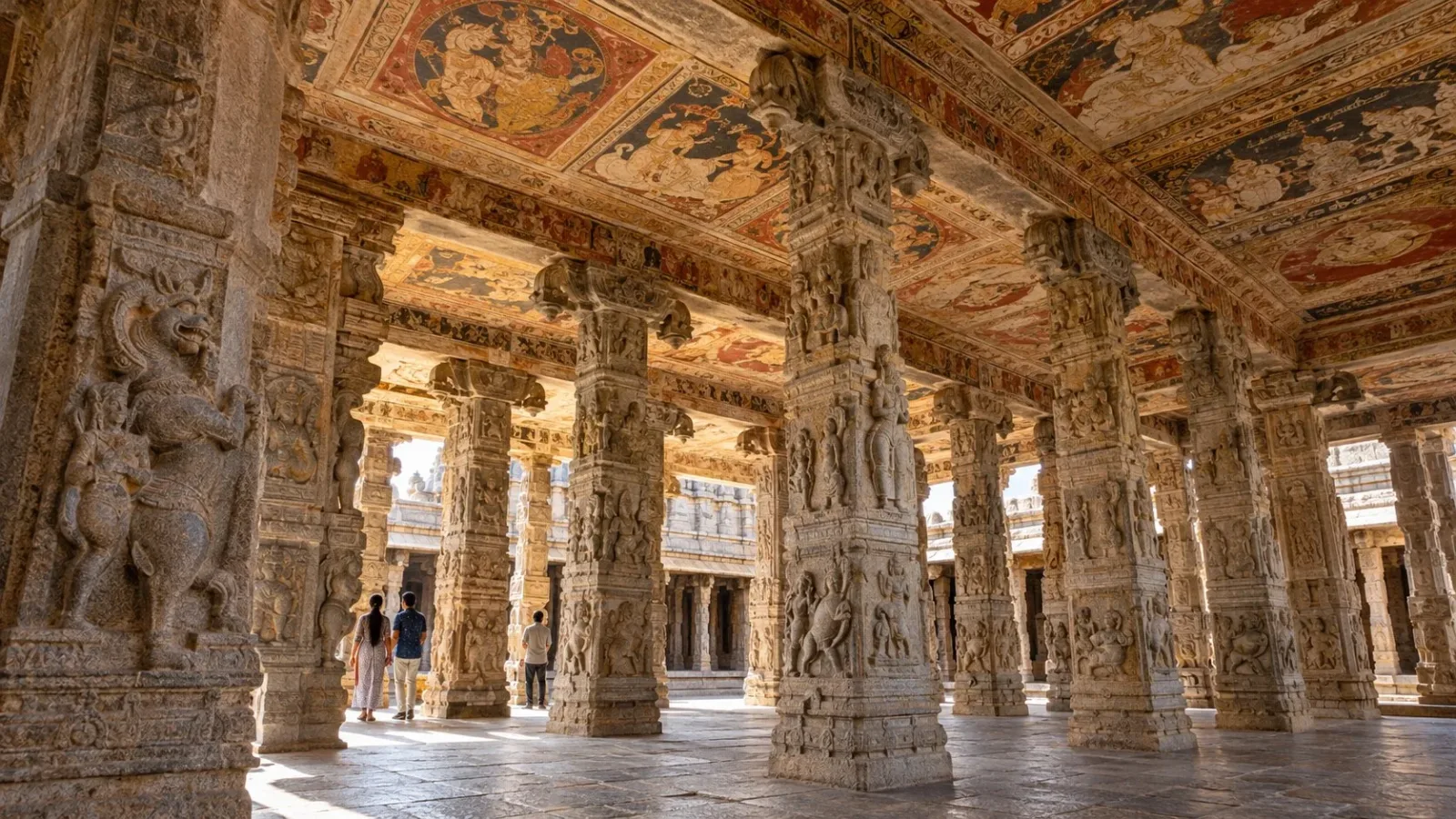
- Ceiling murals and carved pillars
- Source status
- India tentative-list submission
- Reviewed
- 17 November 2026
Reviewed: 17 November 2026. Selective heritage outline, not a ticket or access guarantee.
AI-generated fictional Lepakshi temple hall-inspired scene, not an exact monument layout, current visitor route or access record.
At Lepakshi, a useful way to understand the Natya-mandapa is to connect what is above you with what supports the hall. India's tentative-list submission describes painted roof panels and pillars carved with musicians, dancers and divine figures. Treat those as related parts of a space, rather than two unrelated photo stops.
Begin with the hall
The submission describes the Natya-mandapa as attached to the Maha-mandapa within the Veerabhadra temple complex. That relationship gives the art a setting: painted panels occupy the roof, while carved figures appear on the hall's supports. This article focuses on that relationship, not a complete inventory of shrines and sculptures.
This is a tentative-list submission made by India and hosted by UNESCO. It is not an inscription on the World Heritage List. The page explicitly leaves responsibility for its contents with the submitting State Party. Its description is useful evidence for this narrow art question, not a certification of today's visitor arrangements.
Look between painting and carving
The source describes roof paintings with narratives from the Ramayana, Mahabharata and other religious traditions, alongside carved musicians, dancers and deities on pillars. Notice the difference in medium and position: a painted scene above and a carved figure on a support do different work within the same hall. Do not assume every painted scene has a matching pillar figure.
Use a current site explanation or a suitably informed guide for a particular identification. This article does not identify every panel, promise that every painting is visible, or infer a fixed viewing sequence. Lighting, conservation and the areas actually open may affect what you can see.
Keep interpretation separate from demonstrations
This visit does not need a paper-under-pillar test or a demonstration about a supposedly hanging support. The sources used here do not establish the mechanics, safety or permission for such an activity. Do not touch or test painted or carved surfaces to make the visit feel complete.
The submission uses different technical labels for the paintings in different sections. This guide therefore calls them murals rather than choosing one technique label without further evidence. It also leaves out claims about unique survival, exact construction dates and the origin of the place name. Those questions are not needed to understand paint and carving together.
Check what can actually be visited
Before relying on the hall as your main stop, confirm whether it is open, which parts visitors may enter and whether the paintings can currently be seen. Check worship arrangements, eligibility, clothing, phones and photography with the site. A heritage description does not settle these rules.
Confirm the actual gate, tickets if required, walking, steps, surfaces and assistance for your group. This guide has not verified a step-free route, lighting conditions, guide availability or a fixed visit duration. Choose what the current permitted visit allows, rather than force a demonstration or a complete sculpture checklist.
Frequently asked questions
Is Lepakshi described here as an inscribed World Heritage Site?
No. The cited page is India's tentative-list submission, with State Party responsibility for its contents.
What is the main art question?
How ceiling murals and carved supports relate within the Natya-mandapa, not how many objects can be collected in one visit.
Does every painting match a carved figure?
This article establishes no such one-to-one mapping. Check individual identifications rather than invent a connection.
Is a pillar demonstration part of the plan?
No. Permission, safety and mechanics for a test have not been established here.
Does this article reserve a guide or transport?
No. Confirm the actual provider, language, meeting point, fee and return separately. A heritage description does not book a service.
Is there a fixed visit duration for every traveller?
No. This is a selective editorial outline. Check your group and actual route before adding further stops.
Official sources and limits
Official heritage descriptions support the named structures and architectural features, not current opening, final fees, combined ticket scope, services or continuous accessible routes. Verify the actual visit separately.

A Miranda House graduate and lawyer who traded courtrooms for slow travel. Cheshta travels with the batches we host ourselves, with a soft spot for travelling alongside elders.
Planning your next trip?
We'll handle insurance, hotels, airport assistance and the itinerary — the same way we do it for every trip.
Questions on this article
asked by readers, answered by us
Was this helpful?
one tap, no sign-up