




- Place
- Martand, Anantnag
- Focus
- Ruined courtyard ensemble
- Read together
- Central shrine and colonnades
- Reconstruction
- Not supplied
- Reviewed
- 17 November 2026
Reviewed: 17 November 2026. Selective heritage outline, not a ticket or access guarantee.
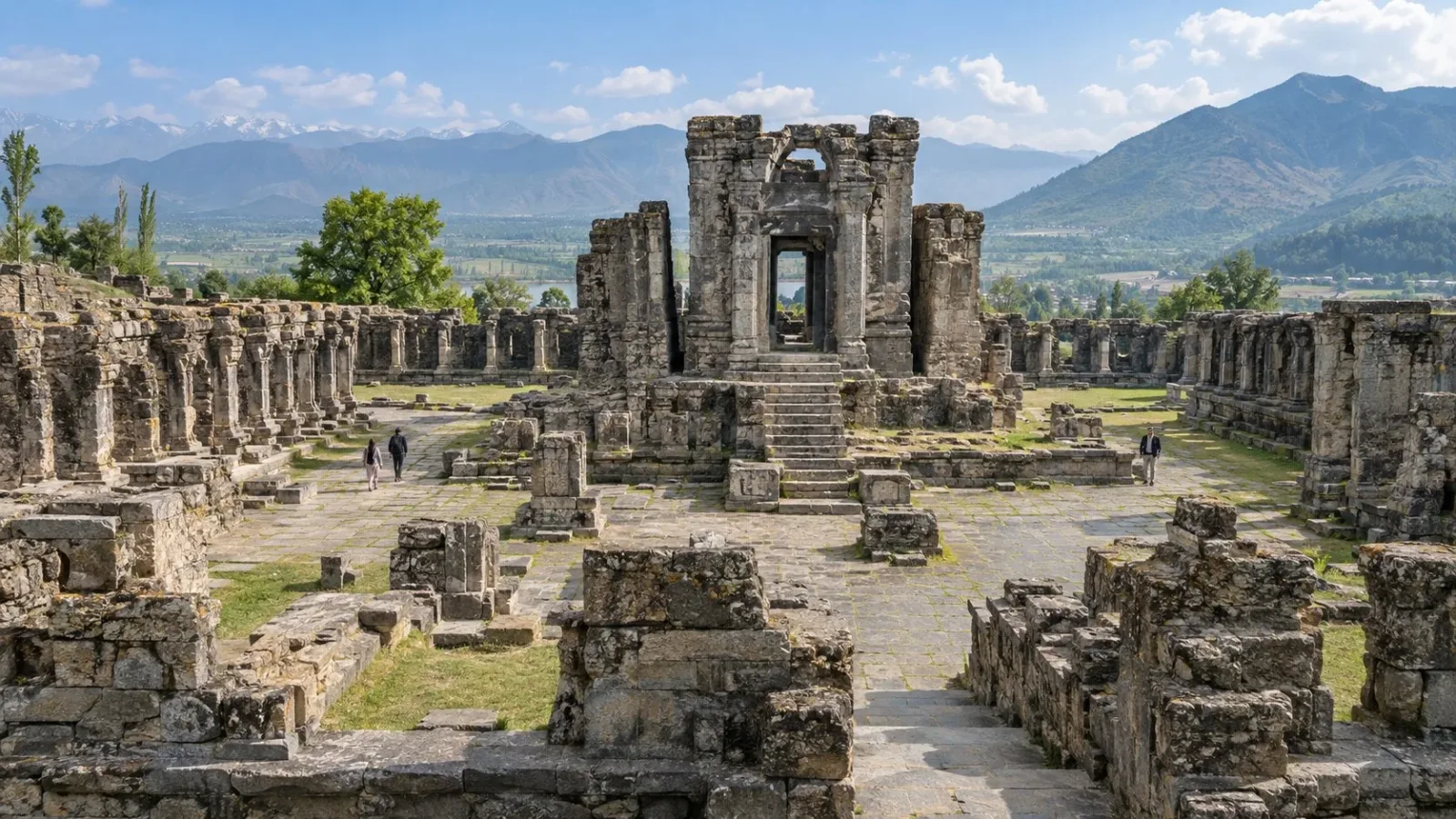
AI-generated fictional Martand ruined temple-inspired scene, not an exact monument layout, current visitor route or access record.
Martand is worth understanding as a ruined ensemble, not as a complete building whose missing parts a visitor must confidently fill in. The official descriptions identify a central shrine, a courtyard and surrounding colonnades. Those relationships are a useful starting point for reading the surviving place.
Start with the central shrine
The Anantnag district describes Martand as a temple dedicated to Surya and explicitly acknowledges its ruined state. National tourism describes the central shrine within a courtyard ensemble. Begin with that distinction between a principal structure and its setting, rather than a list of photo angles or smaller-shrine totals.
This is not an exact reconstruction of the original plan. The sources used here do not establish a complete account of every surviving fragment, building phase or lost roof. Nor does a religious dedication establish today's worship arrangements or admission to an interior.
Read the courtyard as part of the building
The courtyard and colonnades are not merely empty space around the main attraction. Their relationship to the central shrine helps explain the ensemble described by the official pages. Think about the main structure and its surrounding architectural boundary together, from the areas where visitors are currently permitted.
This guide does not supply a measured circuit, identify every carved figure or promise that an uninterrupted walk around the remains is open. Do not turn a description of a courtyard into permission to enter an unstable-looking or restricted area. Follow current barriers and site instructions.
Leave missing parts unresolved
A ruin can be understood without an exact image of how every roof, wall or column once looked. Ask what is actually supported by the surviving fabric and a reliable site explanation, and what is an interpretation. Do not present an imagined complete building as a verified view of its past.
This article leaves out the tourism page's long list of supposed stylistic influences, its black-stone description and precise counts and dimensions. It also makes no claim about exact construction dates, individual patrons or film locations. These details are not needed for the narrow shrine-courtyard relationship and have not been independently settled here.
Make a separate current visit plan
The source pages are not a live security, road or admission update. Confirm local travel advice, opening, last entry, closures, current visitor areas and any worship restrictions before setting out. Do not build an evening arrival around an undated tourism timetable.
Transport details also need a separate check: the district page names Jammu Tawi as nearest station, while national tourism names Anantnag. This guide does not choose between those descriptions or offer a railway connection. Verify the actual journey, permitted drop and return independently.
Check walking, steps, uneven surfaces, assistance and rest arrangements for your group. No step-free route, safe access to every ruin, panorama, guide service or fixed duration has been verified here. A selective permitted visit is enough; it does not need a film trail or a promise of unrestricted exploration.
Frequently asked questions
What is the main thing this guide explains?
The relationship of Martand's central shrine, courtyard and colonnades as a surviving ruined ensemble.
Does it reconstruct the original roof and every smaller shrine?
No. It leaves those details unresolved rather than turn an interpretation into a fact.
Which railway station should I use?
The cited official pages differ. This article does not resolve the transport choice; check the actual connection for your journey.
Are current access and safety confirmed?
No. Check local advice, closures, visitor areas and your group's route separately.
Does this article reserve a guide or transport?
No. Confirm the actual provider, language, meeting point, fee and return separately. A heritage description does not book a service.
Is there a fixed visit duration for every traveller?
No. This is a selective editorial outline. Check your group and actual route before adding further stops.
Official sources and limits
Official heritage descriptions support the named structures and architectural features, not current opening, final fees, combined ticket scope, services or continuous accessible routes. Verify the actual visit separately.

A Miranda House graduate and lawyer who traded courtrooms for slow travel. Cheshta travels with the batches we host ourselves, with a soft spot for travelling alongside elders.
Planning your next trip?
We'll handle insurance, hotels, airport assistance and the itinerary — the same way we do it for every trip.
Questions on this article
asked by readers, answered by us
Was this helpful?
one tap, no sign-up