




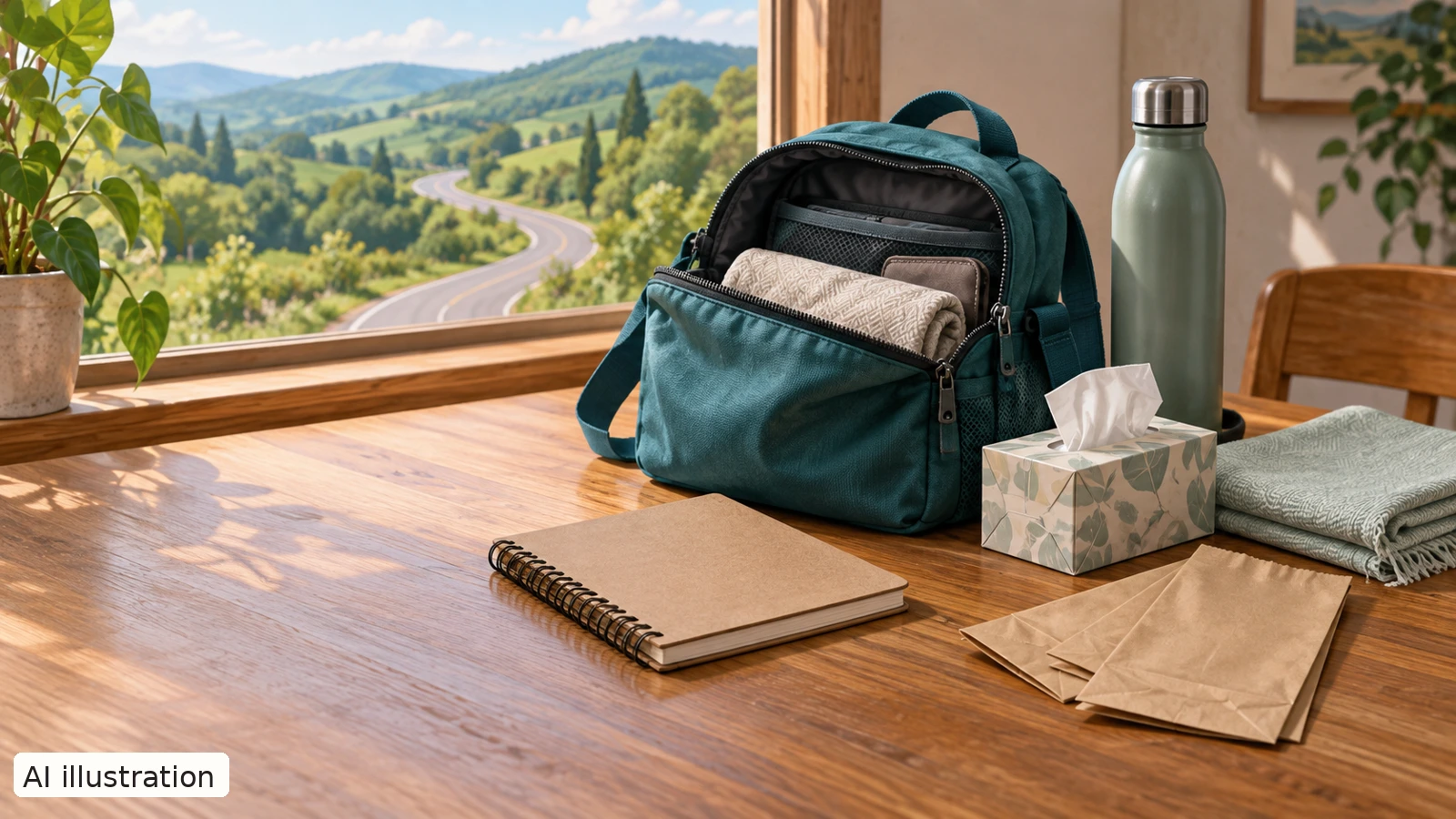
For a long winding drive, prepare before the first bend: put screens away, choose a safe forward view where possible, agree usable breaks and keep a small road bag within reach. These steps may reduce motion sickness; they cannot promise a symptom-free journey. This is general preparation, not a diagnosis or a medicine plan.
Before leaving: remove the tasks that make you look down
The NHS advises looking straight ahead at a fixed point such as the horizon and avoiding reading, films and electronic devices. CDC's 2026 Yellow Book also supports avoiding visual tasks and getting a horizon reference, while noting that behavioural measures are only partly effective. On a winding road, make the passenger who is prone to sickness free of map-reading, scrolling and video-watching duties. Save the hotel address before leaving and let another adult handle navigation where possible.
For an adult car passenger, NHS and CDC describe the front seat as one option for reducing motion. That is not advice to move a child into the front: Mayo Clinic says children should use age-appropriate seats and restraints. Keep every traveller correctly restrained and follow the vehicle's safety instructions. Do not lie across seats, undo a belt or lean out to obtain a view.
Agree breaks before the road narrows
NHS advises breaking up long journeys for fresh air, water or a walk. Ask the driver which safe, permitted stopping places are usable on the actual route. There is no fixed break interval that works for everyone. Tell the driver early if symptoms start, rather than asking for an abrupt stop on a blind bend. Leave the vehicle only when safely parked and permitted.
Rest before travel where possible: CDC notes that sleep deprivation can worsen motion sickness. NHS advises against heavy meals, spicy food and alcohol shortly before or during travel. Pack the person's usual light food if suitable, rather than treating an empty stomach or a special snack as a guaranteed fix.
A realistic small road bag
Our packing example is a secured small day bag with drinking water, tissues, plain sick bags, a spare light cloth and any regular personal essentials. Put the water and sick bag where the passenger can reach them without twisting around or opening a suitcase. Keep loose items out of the footwell and the driver's space. These are practical examples, not a medical kit, airline allowance or a claim that the illustrated bag has a measured capacity.
If a clinician or pharmacist recommends a medicine, keep it in its labelled packaging with the instructions they give you. Do not add a borrowed tablet, a new dose or a remedy just because a driver recommends it. Separate airline liquid rules apply if this road journey follows a flight.
Printable winding-road checklist
Print or save this before travel. Have another passenger read it if looking at a screen makes you feel worse. It is a preparation reminder, not permission to stop anywhere or change a child restraint.
Before the drive
- Agree safe stopping places with the driver, not a stop on a bend or narrow shoulder.
- Keep water, tissues and a sick bag reachable in a secured small bag.
- Avoid a heavy meal and alcohol. Ask a pharmacist or clinician about any medicine before travel.
While the vehicle moves
- Look ahead at a fixed distant point when possible; put reading and screens away.
- Keep your head supported and stay properly restrained. Children stay in their appropriate seat and restraint.
- Ask for comfortable fresh airflow when safe. Use audio or conversation instead of a phone task.
If you begin to feel sick
- Tell the driver early. Ask for the next safe, permitted place to stop.
- Take a break, sip water and get fresh air if you can do so safely.
- Get medical advice for severe, unusual or persistent symptoms. Do not keep taking unplanned tablets.
During the drive: a steady view, not another screen
Look ahead when a distant fixed point is visible. Mayo Clinic suggests keeping the head still against the seat back. NHS suggests fresh air where possible and closing the eyes while breathing slowly. Try comfortable airflow or calm audio rather than looking down at a phone. Do not force a window open or change seats while moving. If these steps are not helping, ask for a safe break rather than trying to endure the whole route in silence.
Keep medicine and remedy claims modest
CDC says motion-sickness medicines can cause drowsiness and have contraindications; ask a clinician or pharmacist about the traveller's age, other medicines and conditions before departure. This guide does not choose a drug, dose or timing, and does not establish whether a product is available or suitable in India. Do not use a sedating medicine and then drive. Children need their own professional advice, not a reduced adult dose.
NHS and Mayo mention ginger or wristbands, but CDC's Yellow Book describes weak or contradictory evidence for dietary remedies and no better-than-placebo results for acupressure bands in laboratory trials. Do not build the journey around either working. A label saying “natural” does not settle suitability.
If symptoms do not fit the usual pattern
Tell the driver and seek medical advice for severe, unusual or persistent symptoms, or if vomiting prevents you from keeping fluids down. Do not assume every headache, dizziness or vomiting episode on a hill road is ordinary travel sickness. This guide cannot assess the cause or replace urgent care when needed.
For the separate route-planning job, see our Bagdogra-to-Darjeeling transfer guide. For water excursions, use the different boat-trip choice guide.
Sources and scope
Sources read 28 October 2026. NHS page reviewed June 2023, next review June 2026; CDC Yellow Book is the 2026 edition, dated 23 April 2025; Mayo 21 January 2026. General information, not personal medical advice.

A Miranda House graduate and lawyer who traded courtrooms for slow travel. Cheshta travels with the batches we host ourselves, with a soft spot for travelling alongside elders.
Planning your next trip?
We'll handle insurance, hotels, airport assistance and the itinerary — the same way we do it for every trip.
Questions on this article
asked by readers, answered by us
Was this helpful?
one tap, no sign-up