




- Subject
- Historic Mumbai terminus architecture
- Focus
- Gothic Revival and Indian themes
- Ornament map
- Not provided
- Transport / tour
- Not covered
- Reviewed
- 17 November 2026
Reviewed: 17 November 2026. Selective heritage outline, not a ticket or access guarantee.
AI-generated fictional historic Mumbai terminus-inspired architectural scene, not an exact ornament map, engineering or current structural-condition record, transport instruction or visitor product.
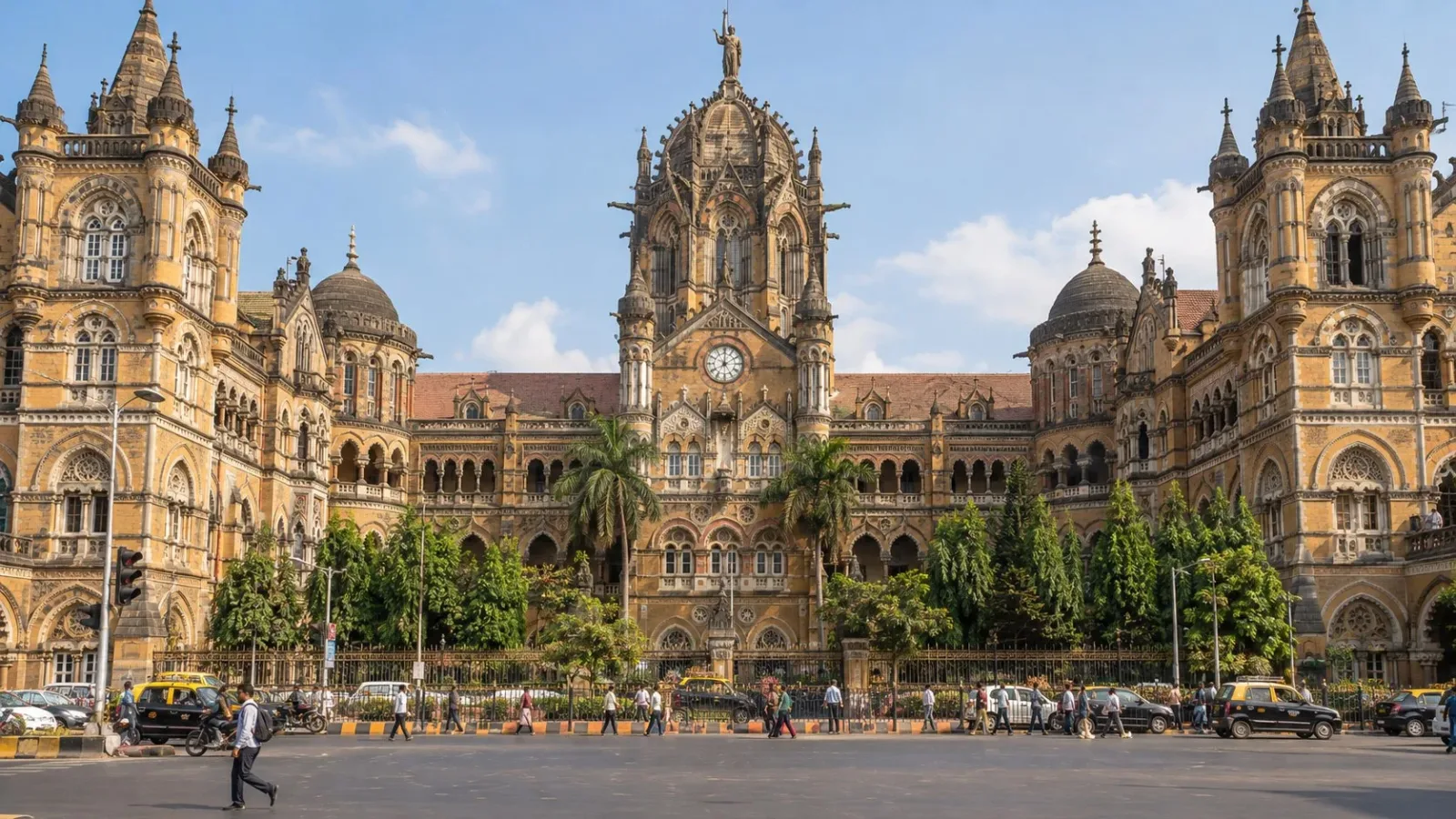
UNESCO describes Mumbai's historic terminus as Victorian Gothic Revival architecture blended with themes from Indian traditional architecture. The useful starting point is the relationship of those traditions, rather than a single label for the entire composition. This article is about architectural interpretation only.
Begin with architectural exchange
The UNESCO property is titled Chhatrapati Shivaji Terminus, formerly Victoria Terminus. Its description connects an architectural vocabulary developed from late-medieval Italian models with Indian architectural traditions. That connection is the subject here, not a transport journey.
An architectural exchange is more useful to consider as a relationship than as a competition over which tradition explains the whole building. Ask how different forms contribute to a single composition. This is a looking question, not a claim that every detail has an easily separable origin.
Look at broad forms together
UNESCO identifies the stone dome, turrets, pointed arches and the plan's relationship to traditional Indian palace architecture. Those broad forms give an alternative to collecting disconnected decorative names. Consider how a dome and turrets belong to the building's overall silhouette, and how arches articulate its composition.
This article provides no measured elevation, exact ornament map or attribution of each visible feature. A broad stylistic account should not become a claim that each arch, figure or surface belongs exclusively to one tradition.
Avoid a label for every ornament
UNESCO connects the building with the collaboration of British architects and Indian craftsmen. That helps explain why a simple imported-versus-local division is too narrow for this account. It does not identify the maker or intention of every detail.
If you study a particular motif, use evidence for that motif. Do not infer its meaning only from resemblance or an imagined picture. Nor does a heritage statement prove that every visible material is untouched original work.
Keep the description in scope
This is an architectural outline, not a construction timeline, conservation inspection or account of every later change. No exact material specification, engineering performance or present structural condition is established here.
The narrow goal is to understand why UNESCO describes a meeting of architectural traditions and how its named broad forms support that reading. No timetable, transfer instructions, service, tour, route or viewing product is described or verified. A clearer question about architecture is enough; the article does not need an exhaustive inventory to make its point.
Frequently asked questions
What is the main architectural idea?
UNESCO describes Victorian Gothic Revival architecture blended with themes from Indian traditional architecture.
Which broad forms does UNESCO name?
The stone dome, turrets, pointed arches and a plan related to traditional Indian palace architecture.
Does every ornament have an origin assigned here?
No. Specific attribution needs specific evidence.
Is this a transport or tour guide?
No. It is an architecture-only outline, not a verified service or visitor product.
Is this a current structural-condition assessment?
No. A heritage description is not a conservation inspection or current engineering report.
Does a broad stylistic label identify every detail?
No. Specific attribution needs evidence for the feature in question.
Official sources and limits
UNESCO supports this limited architectural reading, not an exact ornament or material map, untouched-original guarantee, engineering performance or current structural-condition assessment. No transport or visitor product is verified.

A Miranda House graduate and lawyer who traded courtrooms for slow travel. Cheshta travels with the batches we host ourselves, with a soft spot for travelling alongside elders.
Planning your next trip?
We'll handle insurance, hotels, airport assistance and the itinerary — the same way we do it for every trip.
Questions on this article
asked by readers, answered by us
Was this helpful?
one tap, no sign-up