




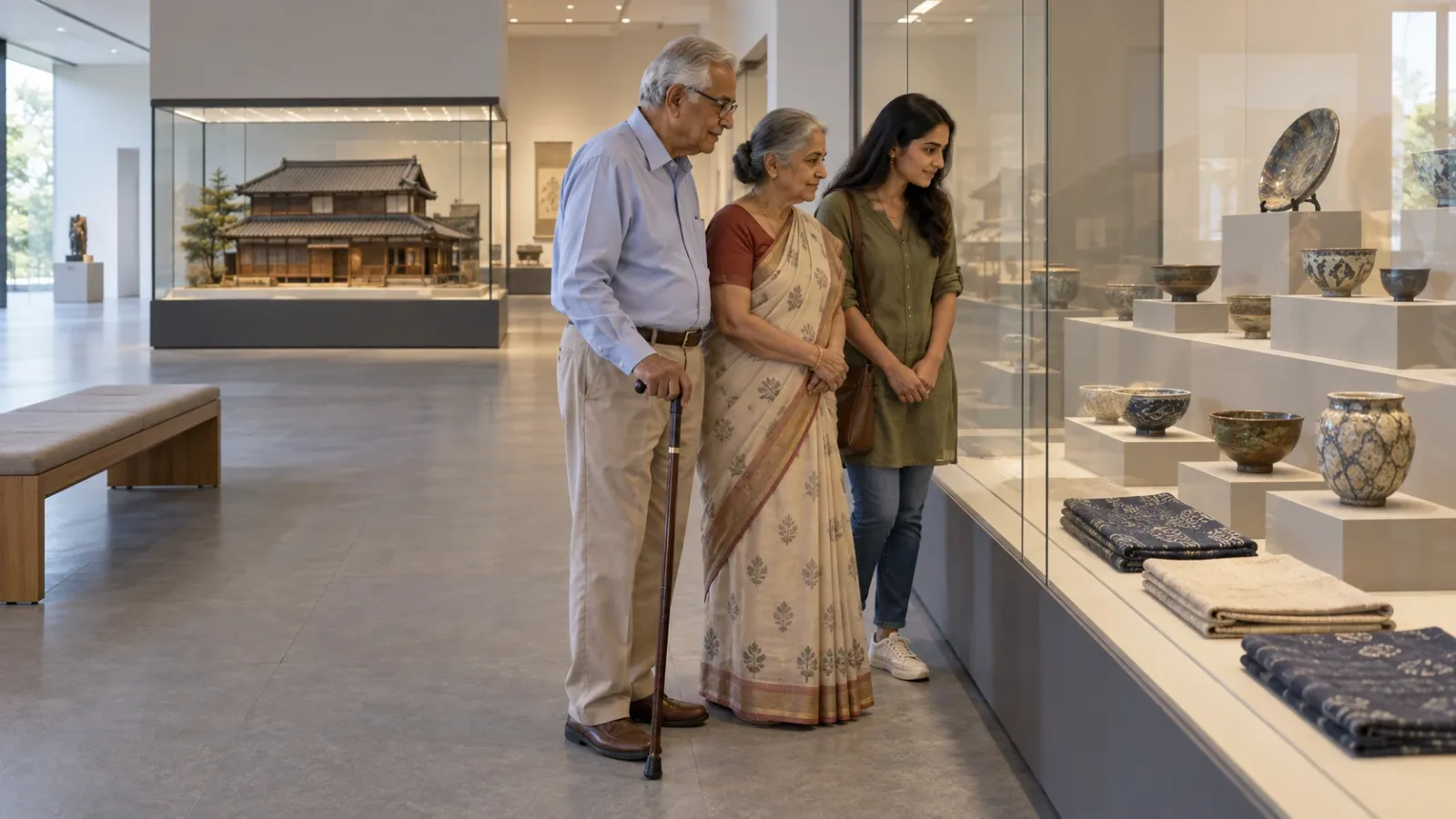
At the Nagasaki Museum of History and Culture, free entry to the building is not free entry to the permanent galleries. A family hoping to watch an Edo-period courtroom skit also needs to choose the right day, not just buy a museum ticket. Decide whether parents want overseas-exchange history, the reconstructed magistrate’s office or a scheduled activity before setting the pace.
The building, permanent exhibition and temporary show are separate
The current visitor-information page says entry to the museum building is free, while the permanent collection and temporary exhibitions have separate admission fees. The ordinary permanent-exhibition adult price is ¥630; the listed elementary, junior-high and high-school student price is ¥310. The lower amounts in brackets are for advance tickets and groups of 15 or more, not a senior discount.
Temporary-exhibition prices vary. A ticket for one area should not be assumed to include a special show, every activity or a workshop. Explain which exhibition the family actually wants and check its ticket conditions before paying. This article has not bought admission or reserved any places.
A reconstructed court is not a daily live performance
The operator’s current events page lists year-round costume dramas in the reconstructed magistrate’s office on Sundays, with several daytime sessions of around 20 minutes, included in the permanent-exhibition ticket. They recreate historical trials using records of cases judged by Nagasaki magistrates.
That is not an all-day show or a live performance guaranteed on any museum day. Check the actual date’s operation with the museum before making a session the reason for the visit. The English event listing does not establish English dialogue, Hindi translation, reserved seats or family participation in a role-play.
A video or a reconstructed courtroom can still be interesting when a live skit is not available, but it is a different experience. Do not tell parents they are going to “watch the trial” unless you have confirmed what will actually be presented.
This is overseas-exchange history, with some serious material
The operator’s museum description separates a Historical and Cultural Zone from the Japanese Government of Nagasaki Zone. Topics include exchange with Korea, China and the Netherlands, trade, local crafts and the reconstructed Tateyama magistrate’s office. The floor guide helps you choose rather than attempt every section.
The operator also identifies Hidden-Christian-related materials and judicial records. A pretty traditional room is not proof that all of its subject matter is light entertainment. Tell parents that some displays concern religious persecution and historical justice, then let them choose whether to spend time there.
The museum calls itself “Rekibun”. It is not Dejima, an atomic-bomb museum or a current government office. Use the full name and address, 1-1-1 Tateyama, Nagasaki, when arranging the outing so a driver does not substitute a different museum.
Pocket Curator explains exhibits, not a live interpreter
The operator’s exhibit-guide page offers Pocket Curator on a visitor’s smartphone or tablet. Its listed languages are Japanese, English, Korean and Chinese, with some content only in Japanese and English. Entering an exhibit number brings up text and audio commentary for the permanent gallery.
Hindi is not among the listed languages. Parents may prefer to pause with a few selected English explanations rather than follow a long route whose captions they cannot comfortably read. A family member explaining what they understand is not the same as a booked professional interpreter.
The same page says a museum tablet can be borrowed free if a visitor does not have a device. It does not establish stock when you arrive, a reserved tablet, headphones or personal language support. Ask about the loan and test the actual commentary before relying on it for the whole visit.
Indoor access still needs the actual route
The city’s specialist access page describes lifts, accessible toilets and wheelchair-friendly gallery provision. The current operator page lists ten free loan wheelchairs and four strollers and asks visitors to inform staff. These are published facilities, not equipment reserved for your family.
Ask about your chair, any assistance needs, the chosen gallery and the reconstructed-office route. An elevator to a gallery floor does not settle every historic-room threshold or where shoes may need attention. Use the floor guide with staff instead of assuming every doorway works identically.
If the visit depends on a loan chair, check collection, return, suitability and availability. A toilet symbol does not confirm its transfer space, and a rest-room listing does not reserve a seat. No access inspection or mobility assessment has been done by this article.
Craft workshops need a separate decision
The floor guide lists traditional craft workshop spaces, while the current events page lists activities with their own dates, fees and participation terms. That does not mean any craft named in a visitor review can be made on a walk-in visit. Ask what is actually running on your date, in which language, for whom and at what additional cost.
Do not merge a shop, a demonstration and a hands-on workshop into a single “included cultural experience”. The museum’s crafts collection may be enjoyable to view even if making something is unavailable or does not suit the family. No materials, teacher or activity slot is booked here.
Use the specific visitor page for hours
The current visitor-information table gives permanent-exhibition hours of 08:30–19:00 in April–November and 08:30–18:00 in December–March, with last admission 30 minutes earlier. It separately lists 10:00–18:00 for January 1–3. Do not apply restaurant, reference-room or workshop hours to gallery entry.
The museum lists the first and third Monday as closed days, the following day when that Monday is a public holiday, and December 28–31. It also warns that rooms may close temporarily for maintenance. Check current announcements and the actual date before departure; no future family date has been verified here.
Older pages and leaflets can show different closure rules or prices. An independent Japan Guide review is useful for the exhibition’s broad character, not a substitute for the current operator table or a guarantee of today’s display arrangement.
Keep lunch and the wider holiday separate
Restaurant Ginrei is a separate service with its own hours. A museum café or restaurant mention does not confirm vegetarian ingredients, the right seating, a meal included with admission or enough time before a skit. Settle any necessary lunch separately.
For a longer itinerary, use The Trip Keeper’s Japan trip page and specify the exhibitions, language needs, mobility route and interest in a confirmed Sunday session. Admission, workshop, interpreter, loan equipment, meals or transfers are not implied to be included. Last checked 9 November 2026. Hero: AI-generated fictional family and generic museum displays, not the actual museum, a courtroom performance or a booked activity.

A Miranda House graduate and lawyer who traded courtrooms for slow travel. Cheshta travels with the batches we host ourselves, with a soft spot for travelling alongside elders.
Planning your next trip?
We'll handle insurance, hotels, airport assistance and the itinerary — the same way we do it for every trip.
Questions on this article
asked by readers, answered by us
Was this helpful?
one tap, no sign-up