




Checked 12 November 2026. Norsk Folkemuseum can work better as one carefully chosen outdoor loop and one indoor exhibition than as a promise to enter every historic house. The museum's own access page warns about steep terrain and limited access to some buildings. Its more specific TIMESCAPE information offers a clearer indoor starting point for a family travelling with older parents.
The size of the collection is not your walking target
The Open-Air Museum page describes 160 buildings from rural and urban Norway, spanning the Middle Ages to the twentieth century. That tells you the scale of the collection, not how many interiors a family can enter on a particular afternoon.
Choose the part of the visit everyone can enjoy together before adding optional stops. The visitor page says most people spend two to four hours, but that is an operator estimate, not a minimum visit length or a reliable walking-time calculation for a parent. A shorter route is a planning choice, not a lesser version of the museum.
Wide gravel paths do not mean a completely level site
The official visitor information describes wide gravel paths and expansive outdoor areas. It also says some areas are steep or difficult terrain for wheelchairs, and that access to certain historical buildings is limited. Keep both halves of that description in the plan.
The site should not be labelled universally step-free merely because it has accessible facilities. The page does not establish gradient, gravel firmness, doorway width or turning space for every route and device. Ask about the exact route and mobility aid you intend to use. We have not verified a wheelchair-loan service, a guaranteed rest bench at every stop or a weather-proof outdoor surface.
Start with the areas the museum actually names
The visitor page identifies the Visitor Centre, with café, shop and accessible toilets, as a good-access area. It also names the buildings around Torget, reached by an outdoor lift, and the farmhouse and barn at the 1950s Trøndelag Farmstead, where accessible toilets are listed.
These named areas are more useful than a blanket claim about every house. They still do not prove a lift is functioning on your arrival day or every temporary activity has the same route. The page's Living Crafts Yard entry retains the wording 'Opening summer 2026'. That old expectation alone does not establish its actual operating or access status now, so it should not anchor the visit without confirmation.
TIMESCAPE has its own access description
The TIMESCAPE 1600–1914 universal-access page describes a step-free main entrance, a lift, tactile markings, contrast and lighting measures, low-level display cases and integrated rest areas. It also says the museum app provides text, audio and video guides in English and Norwegian.
This is exhibition-specific evidence. It makes TIMESCAPE a sensible indoor option to investigate first, but does not make every open-air building accessible. We have not verified Hindi interpretation, loan devices, offline app availability or whether a particular phone and assistive setup will work. Download and language details should be checked if the app is central to the family plan.
A stroller needs its own route check
The visitor information lists baby-changing facilities at the Visitor Centre and luggage storage there. Those are useful base facilities, but they are not a published permission to wheel a pram into every historical interior.
The primary pages used here do not establish a site-wide stroller-entry rule, loan-pram stock, secure pram parking, a nursing room or a baby carrier suitable for every building. Ask about the selected interiors and the return route before arriving with a sleeping child. Do not turn a wheelchair-access statement into a complete pram policy, or assume that folding a stroller solves every doorway and stair issue.
Winter access depends on the actual programme
The group-visit page broadly describes winter historic buildings as accessible from the outside, with indoor exhibitions open year-round. Yet a dated 2026 Christmas weekend programme describes selected decorated-house visits and guided activities. The specific programme can provide exceptions to the broad seasonal description.
Neither source means every house is open every winter day. Use the programme for the exact date, and ask which interiors and routes it covers. This guide does not repeat seasonal activity times as a permanent timetable. A guided visit to a historic house also does not establish a step-free route into that house.
Use the seasonal hours, then check exceptions
As checked, the visitor page lists the winter period from 5 October to 30 April as Tuesday to Sunday, 11:00–16:00, with Mondays closed. Its summer table has different hours, and the page separately lists holiday closures and specified Monday exceptions. Read the date-specific notice rather than treating 'winter' as one unchanging calendar rule.
The same page lists adult admission at NOK 200 and free admission for ages 0–17. It says advance tickets are not necessary for an ordinary visit, though online purchase may help during busy periods. Free child admission is not evidence that every special activity, snack or guided arrangement is included. Check any event and booking terms separately before paying.
The café has an opening-time conflict worth noticing
The visitor page's winter table lists Café Arkadia from 10:00 to 16:00 Tuesday to Sunday. The dedicated café page instead gives 11:00–16:00 Tuesday to Sunday. Both were visible when checked. Do not build a 10:00 warm-up stop around the earlier time without confirming it.
The café page says no museum ticket is needed to use the café. That does not reserve a table or guarantee a meal at a particular time. It says weekend, public-holiday and Christmas Market reservations are not accepted, while its weekday winter group arrangements are limited. Dietary availability, allergy handling, high chairs and space for a specific mobility device remain questions to settle directly, not promises in this guide.
Arrival and a private guide need separate confirmation
The visitor page places the museum at Museumsveien 10 on Bygdøy and names the Folkemuseet stop on bus 30. It also lists accessible parking outside the main entrance, about fifty metres away, and free companion admission with a valid companion card. A parking entry is not a reserved space; acceptance of a foreign companion document is not established here.
The page's ferry text gives a 2026 start date, not proof of a winter sailing for your visit. Verify transport with the current operator timetable rather than assuming a boat runs because a museum page mentions it. A bespoke museum tour is also a separate arrangement: the group page requires advance confirmation, charges in addition to admission and has seasonal limits. The existence of an English tour option is not a guaranteed guide for your chosen day.
For a family route built around these checks, The Trip Keeper's private-tour page explains family-specific planning, and the trip-planning page is a place to share dates and needs. Neither implies that museum tickets, transport, a guide or access assistance are automatically included.
Illustration and source limits
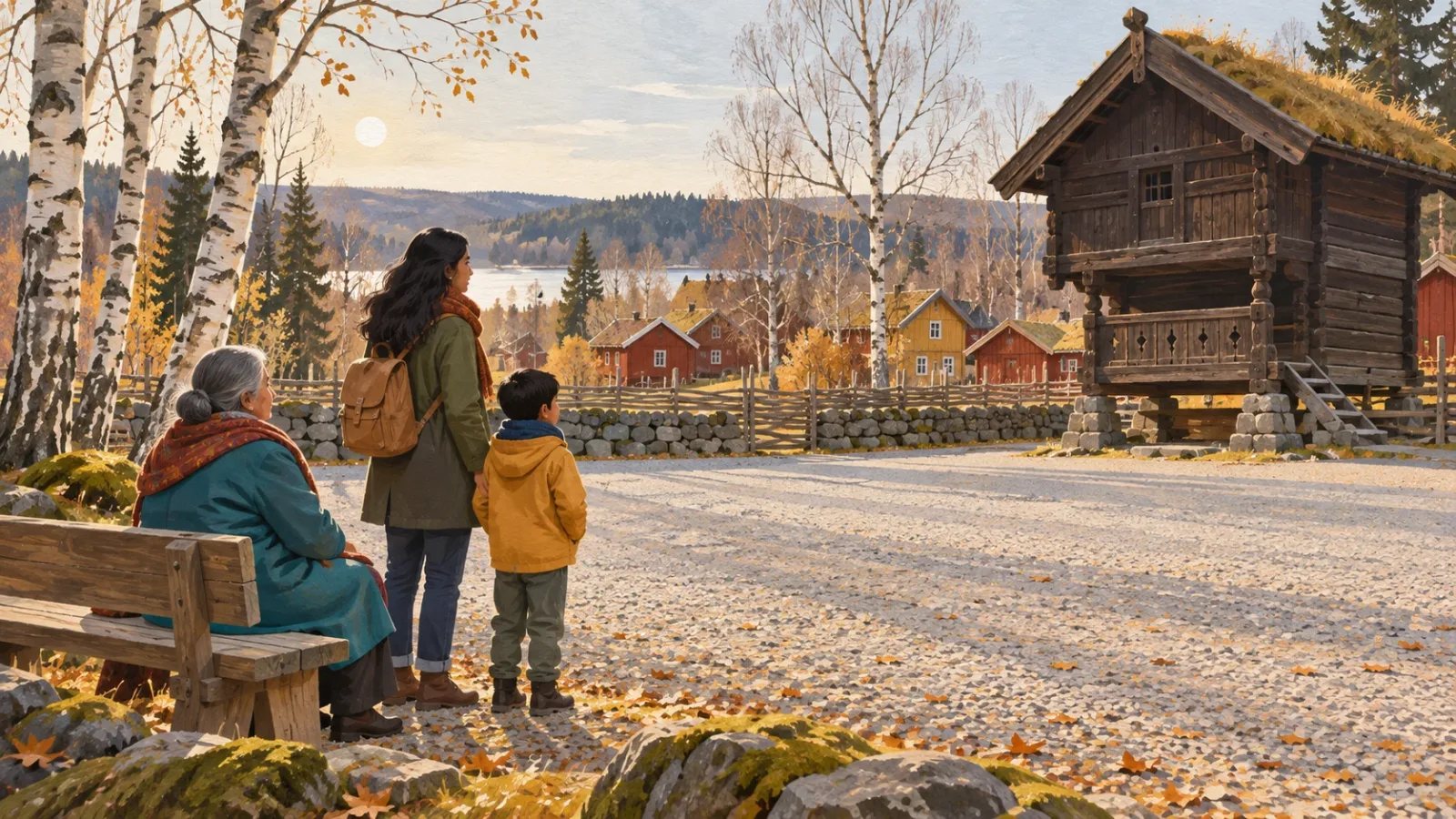
The hero is a fictional AI gouache and cut-paper illustration of a family taking a short break near an invented timber cottage. It is not a photograph of Norsk Folkemuseum, a real visitor or proof of an accessible path, a particular bench or an open building.
Seven operator pages support this guide, including visitor information, exhibition-specific access, food, group and seasonal programme pages. They are one institution's sources, not independent inspections. Café-hour differences, an old summer-opening expectation and generic winter wording are preserved rather than silently reconciled. Exact device fit, pram rules, live lift status and the day's open interiors remain checks for the actual visit.
- Visitor information: hours, tickets, access and facilities
- TIMESCAPE exhibition-specific universal-access information
- Café Arkadia: public access, hours and reservation limits
- Open-Air Museum: historic buildings and map
- Group visits: winter description and separately confirmed private tours
- Dated 2026 Christmas weekend programme: selected-house visits, not every-day access
- Indoor and open-air exhibition overview

A Miranda House graduate and lawyer who traded courtrooms for slow travel. Cheshta travels with the batches we host ourselves, with a soft spot for travelling alongside elders.
Planning your next trip?
We'll handle insurance, hotels, airport assistance and the itinerary — the same way we do it for every trip.
Questions on this article
asked by readers, answered by us
Was this helpful?
one tap, no sign-up