




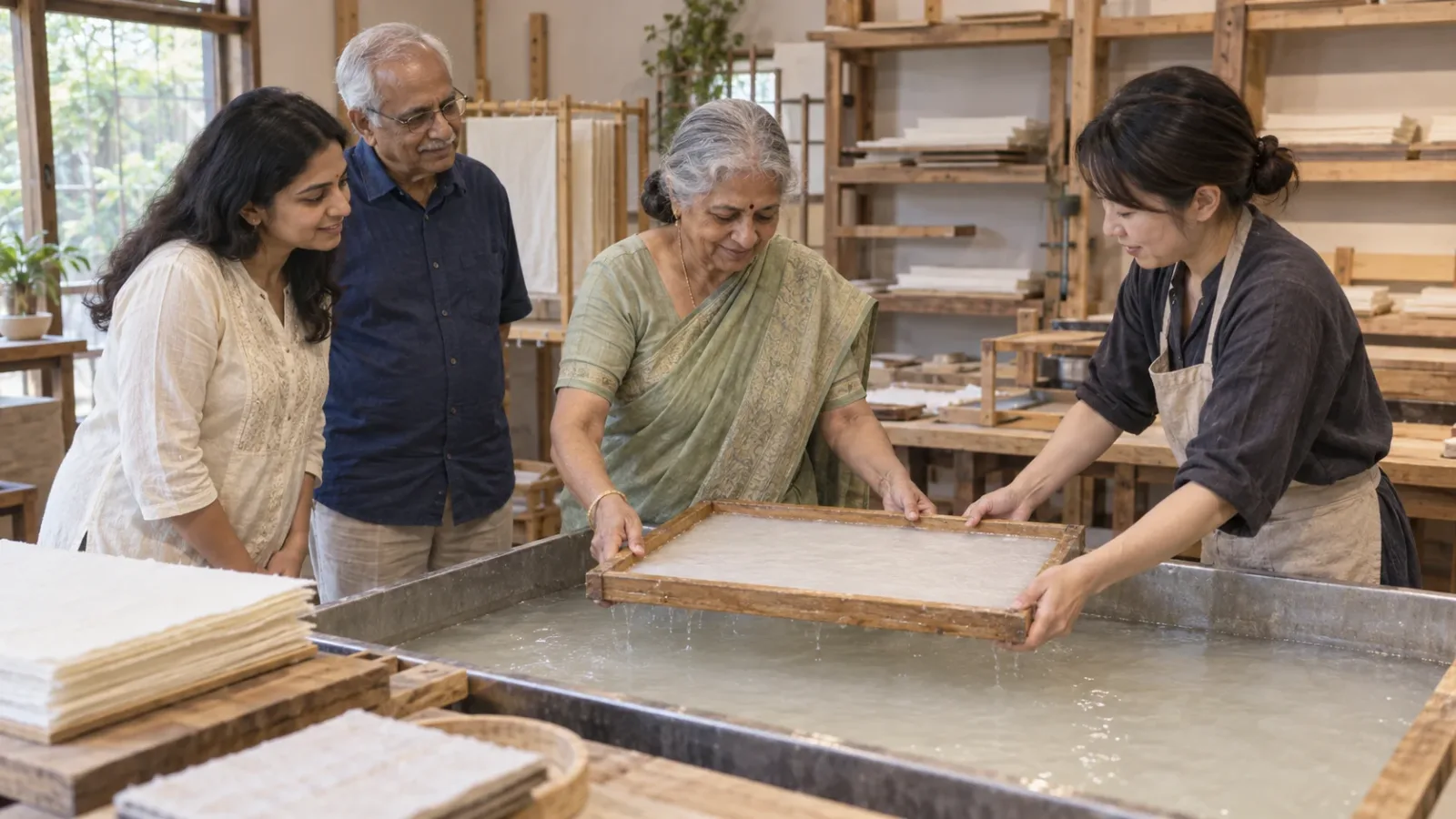
Ozu Washi in Tokyo can turn a family shopping stop into a hands-on memory: a sheet of paper parents made themselves. But the shop being open does not mean the papermaking studio is running, and booking three places does not buy a private class. Settle those two details before fitting this activity between the rest of your Nihonbashi plans.
Shop hours are not workshop hours
As checked on 9 November 2026, the operator homepage lists the shop Monday to Saturday, 10:00-18:00. The official English workshop page lists regular studio sessions Tuesday to Saturday at 10:30, 11:30, 14:00 and 15:00, lasting approximately 45 minutes. The studio is closed Monday, or the following day if Monday is a holiday; the business also closes Sundays and over New Year.
This distinction matters for parents: a Monday browse can still be a reasonable plan, but do not promise they will make paper just because the store is open. Confirm the actual workshop date and session rather than treating a broad shop listing as the activity calendar.
One sheet each, or a private session?
The current regular experience is up to four participants, with each person making one A4 sheet after an explanation. The English operator page says a group smaller than four may share with other guests. Ask for the private product if being alone together matters; do not infer privacy from a small family reservation.
The operator lists the private experience at ¥6,000 including tax per 45-minute slot, up to four participants. Multiple sheets can be made within the time, including drying, using the studio’s tools and materials. That is not unlimited time or a promise of a fixed number of finished sheets. Discuss special projects before booking and reserve the time you actually need.
If five people want to make paper, do not book a four-person slot and assume a chair can be added. Ask about an arrangement for the whole party. A parent coming only to watch is another question to settle: the checked workshop pages do not establish a universal free observer place for every adult companion.
Choose the paper before choosing the time
Current operator prices are ¥1,000 including tax per sheet for plain washi, ¥1,200 for the listed water-drop, watermark or lace experiences, and ¥1,500 for design washi. The Japanese workshop page dates the increase to 1 October 2025. These are the posted prices checked here, not a quote for extra private time or a customised family arrangement.
Design washi has a narrower timetable: 11:30 and 15:00 on the regular Tuesday-Saturday schedule. It allows patterns using the available coloured papers, fibres and other materials. Bringing your own material is not permission to embed anything: the operator asks for thin, flat, non-water-repellent materials. Ask before bringing a keepsake you cannot replace.
For a simple family memory, the basic one-sheet session may be enough. If parents especially want to choose and arrange decorations, ask for the design session instead of discovering after arrival that the booked slot is a different activity.
A finished sheet is included in the process, not a wet parcel to manage
The operator says the washi is dried during the workshop and can be taken home the same day. That makes the outcome clearer than an activity requiring a return visit for collection. Still, ask staff when to handle it and how to keep it flat; put space for the finished sheet in your day bag rather than folding it immediately.
A Daisuki Nippon personal account dated 10 November 2020 describes scooping the fibres, decorating and drying, which helps explain why the class is more than sitting at a craft table. Its older one-hour/five-person private description is not the current four-person, 45-minute operator product. Do not use an old visit as your booking specification.
Tell staff in advance if a parent wants help holding the frame or needs a seated alternative for parts of the process. The exact adapted task, workbench arrangement and assistance are unconfirmed here. A short indoor activity is not automatically effortless for every person.
English information does not mean a fluent English class
The English operator page says the experience is mostly conducted in Japanese, with staff English at intermediate or elementary level. It recommends arranging an interpreter if fluency is necessary. Do not promise Hindi guidance or a fluent private English teacher merely because you can read the booking information in English.
The GO TOKYO workshop entry updated 28 January 2026 lists an elevator and multi-purpose toilet. Those facility labels do not establish the whole route, working position or wheelchair clearance at the papermaking vat. Ask the studio about the exact arrangement your parent needs before committing to a session.
Book ahead, and read the stricter cancellation wording
The operator recommends reserving at least three days ahead; a walk-in is only possible if a place is open. Its Japanese page directs closer requests to a telephone enquiry. A listed session is not live availability, and this article does not confirm a place for your date.
The English page warns about same-day cancellation and a possible full session charge. The Japanese page is more specific: changes or cancellation must be communicated by 18:00 on the previous day, otherwise a 100% cancellation fee applies; it also covers no-shows after the reserved time. Ask which conditions your confirmation applies, and do not assume that waiting until the morning is free.
Photography is another boundary. The operator permits personal-use photography in the workshop, subject to not disturbing others, but its Japanese page generally prohibits photography elsewhere in the building and highlights marked areas, screened material and artworks. Permission to photograph your paper is not permission to film the galleries.
Why an old price can make a current plan look wrong
Time Out’s February 2025 entry still shows ¥800 for a sheet and ¥5,000 for a private lesson. Those figures precede the operator’s dated October 2025 increase. Good Luck Trip’s operator-supervised entry updated 30 August 2026 supports same-day take-home and advance booking, but its broad shop hours should still not replace the studio schedule.
For the wider family route, The Trip Keeper’s Japan trip page can start a conversation about pace and free time. This article does not imply that a workshop place, private studio slot or interpreter is included in any package. Last checked 9 November 2026. Hero: AI-generated fictional family in a generic papermaking studio, not a photograph of Ozu Washi.

A Miranda House graduate and lawyer who traded courtrooms for slow travel. Cheshta travels with the batches we host ourselves, with a soft spot for travelling alongside elders.
Planning your next trip?
We'll handle insurance, hotels, airport assistance and the itinerary — the same way we do it for every trip.
Questions on this article
asked by readers, answered by us
Was this helpful?
one tap, no sign-up