




- Place
- Santiniketan
- Focus
- Learning, art and landscape
- Setting
- Continuing university
- Class attendance
- Not included
- Reviewed
- 17 November 2026
Reviewed: 17 November 2026. Selective heritage outline, not a ticket or access guarantee.
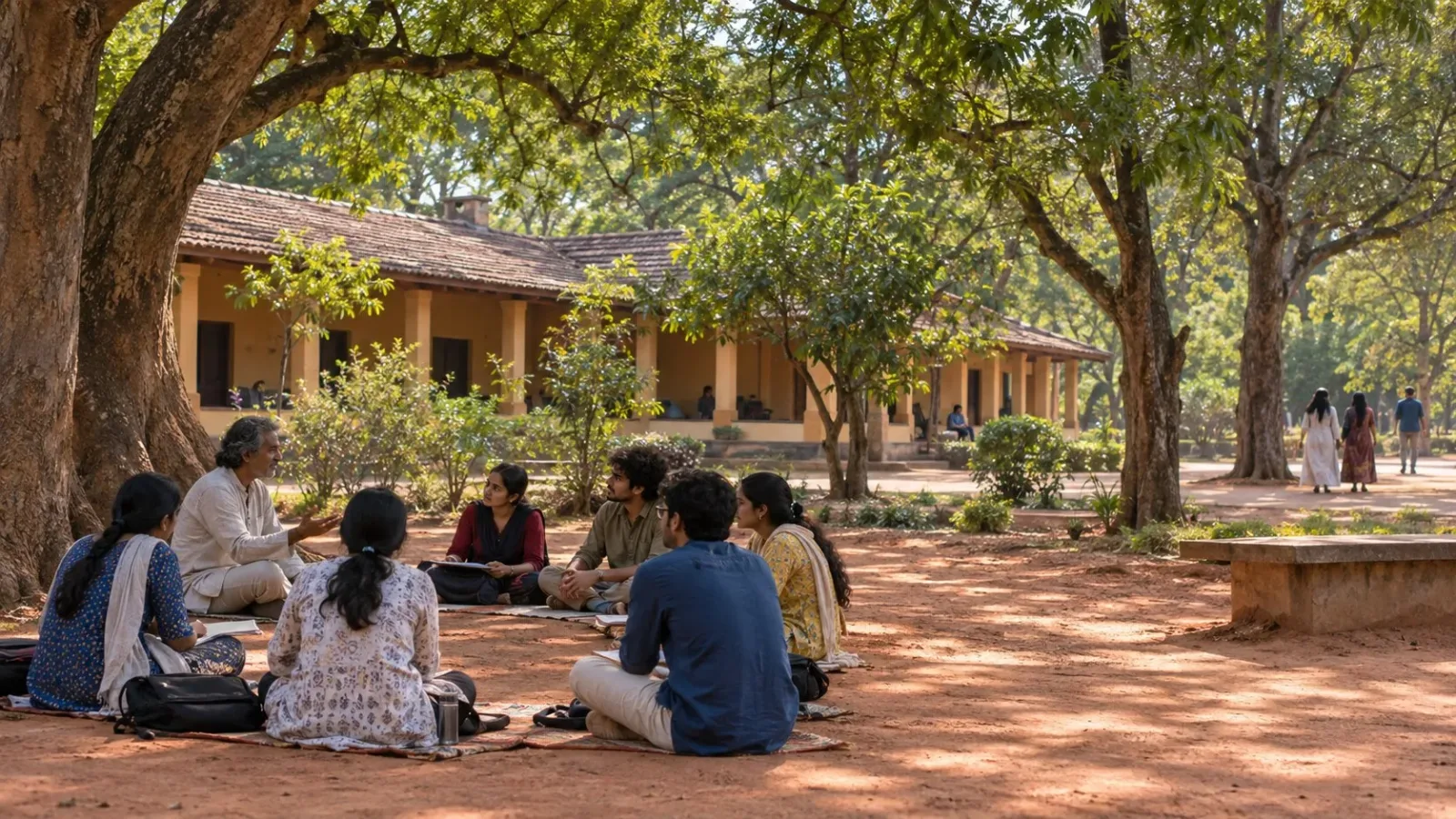
AI-generated fictional Santiniketan open-air learning-inspired scene, not an exact monument layout, current visitor route or access record.
Santiniketan is not best understood as a list of old buildings or objects connected with Tagore. UNESCO describes an educational and artistic vision expressed through buildings, artworks, gardens and open spaces within a continuing university setting. The useful question is how that setting gives form to an idea of learning.
Begin with an educational idea
The property statement connects Rabindranath Tagore's model of education with nature, music and the arts. It describes an open-air teaching idea in which learning spaces were arranged under trees. That is context for understanding the historic place, not today's class timetable or a promise that visitors can watch teaching.
This article is not an archaeological room plan or a ranking of universities. It does not assign a former activity to every visible space. Begin with the relationship of learning and environment rather than a hunt for a particular desk, relic or photograph.
Read art and buildings within the setting
UNESCO describes experimentation with building materials, techniques and forms, drawing on local traditions and wider exchanges. It treats artworks, pavilions, gardens and buildings as related parts of the educational landscape. Look for that relationship in the areas you are permitted to visit, rather than isolate one building as the whole story.
This is not a material-identification checklist or a claim that every surface is untouched original work. The source itself recognises changes of use, additions and conservation needs. A historic description of a mural, window or garden does not establish its present visibility or condition.
Respect a continuing institution
The property remains part of the Visva-Bharati campus in the UNESCO account. Educational use and visitor interest are not interchangeable. A place being culturally important does not grant entry to classes, offices, studios, residences or every outdoor area.
Ask before photographing people, teaching or work in progress, and follow current institutional restrictions. No interaction with students or teachers, art workshop, performance or festival is included here. A description of continuing traditions is not a reserved cultural programme.
Confirm a limited visitor plan
Check with the university or responsible visitor authority which areas are currently open, what registration or ID is needed, the actual gate, visit arrangements and any restrictions for your date. A named area in the heritage statement is not a complete visitor itinerary or an interior-access entitlement.
If a particular artwork or building matters, ask whether it can actually be seen. Confirm any tour's availability, language, meeting point, cost and scope separately. This guide books none of them and does not establish museum or collection admission.
Check walking, surfaces, steps, rest points, toilets, assistance and the return for your group. No shade throughout, quiet campus, step-free circuit or fixed duration is verified. A focused visit can end with a clearer sense of how art, learning and environment were brought together, without turning an active institution into a visitor's checklist.
Frequently asked questions
What is the main subject here?
The relationship of educational ideas, art, buildings and open space at Santiniketan.
Does historic open-air teaching mean I can attend a class?
No. It describes an educational idea, not a current visitor permission.
Is this a museum-object list or archaeological cell plan?
No. The focus is a continuing learning-and-art setting, not a collection or excavated room layout.
Are tours, interiors and festivals included?
No. Confirm actual university visitor arrangements and any separate programme directly.
Does this article reserve a guide or transport?
No. Confirm the actual provider, language, meeting point, fee and return separately. A heritage description does not book a service.
Is there a fixed visit duration for every traveller?
No. This is a selective editorial outline. Check your group and actual route before adding further stops.
Official sources and limits
Official heritage descriptions support the named structures and architectural features, not current opening, final fees, combined ticket scope, services or continuous accessible routes. Verify the actual visit separately.

A Miranda House graduate and lawyer who traded courtrooms for slow travel. Cheshta travels with the batches we host ourselves, with a soft spot for travelling alongside elders.
Planning your next trip?
We'll handle insurance, hotels, airport assistance and the itinerary — the same way we do it for every trip.
Questions on this article
asked by readers, answered by us
Was this helpful?
one tap, no sign-up