




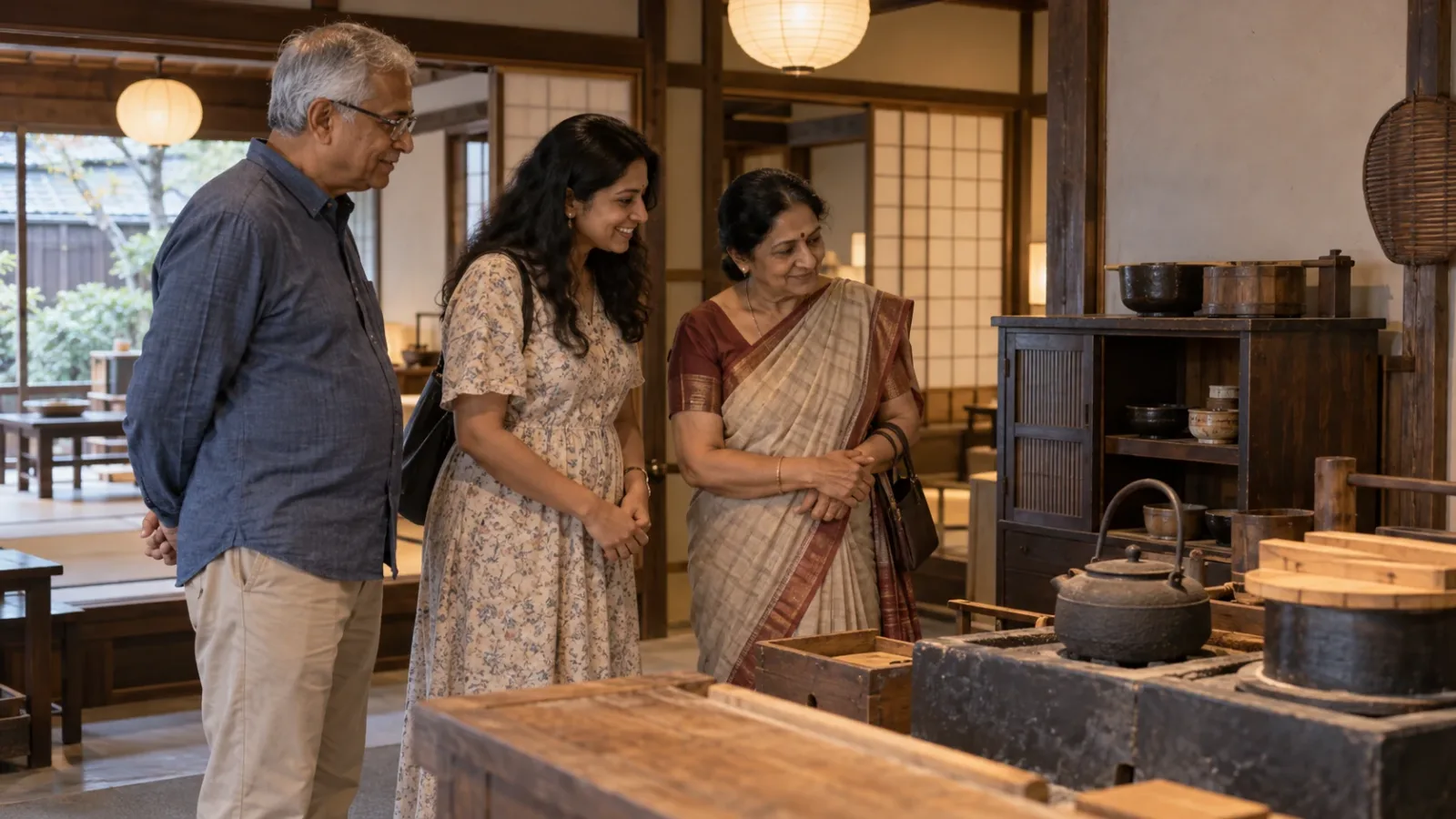
Shitamachi Museum can give parents something more personal than another list of famous buildings: a kitchen, household tools and a small neighbourhood shop that invite comparisons with their own childhood. But the museum reopened after a major renovation in March 2025. An old two-floor review or an old lift notice is not a complete guide to the visit now.
The recreated neighbourhood changed, not just the paint
The current museum floor guide describes the first-floor recreation as Showa 30s neighbourhood life in Sakamoto, now Negishi 3-chome. The Taito City reopening report explains the change clearly: the previous recreation was set in the Taisho era, while the new setting is the 1950s. Do not sell this as an unchanged Edo-period house or use a pre-renovation photograph as the current room plan.
The new first floor includes a lantern shop, a tenement home and an alley. That is a useful starting point for a family conversation about cooking, water, storage or working from home. Parents do not need to be experts in Japanese history to notice the familiar and unfamiliar parts of everyday life.
Start with one household question, not a race through all floors
Ask what parents would enjoy comparing with home: a kitchen tool, a cupboard, the arrangement of a small shop, or an alley shared by neighbours. Choose one theme first. This is a suggested way to enjoy the collection, not a museum programme or a promise that a guide will run a private family session.
The operator's English exhibition guide now describes all three floors. The second floor covers changes in Shitamachi through historical objects, while the third adds a hands-on space and temporary exhibition room. The current Japanese floor guide also describes the third-floor information corner and a view towards Shinobazu Pond. An old two-floor description leaves out part of the renovated museum.
A lift listing does not settle access inside every recreated home
Tokyo's Universal Design Navigation listing lists an elevator and a wheelchair-user toilet. The current museum floor guide places the barrier-free toilet on the first floor. Those are useful specific facts. They do not prove that every raised domestic interior, threshold or hands-on position is equally usable by every parent.
A May 2025 first-person visit describes taking shoes off to enter the recreated room. Treat that as a visitor account rather than a universal rule for every display. If shoe removal, a raised floor or sitting low would be difficult, ask staff which route can be viewed without entering that room. Do not equate seeing the exhibition with needing to take every possible route inside it.
Confirm the actual route before promising a completely step-free family visit. Ask where parents can pause, whether the lift reaches the floors you want, and which rooms can be enjoyed from the outer route. Seating at a convenient point, wheelchair availability and individual assistance have not been confirmed here.
The old elevator notice has a date, even when the sidebar looks current
An operator elevator notice dated 18 July 2018 remains searchable. Its text describes an old lift problem and staff-assisted use, and its surrounding page now shows current monthly closure information. The refreshed sidebar does not turn that 2018 notice into a new 2026 outage report.
The museum has since been renovated, and the current access listing includes a lift. Do not tell parents the lift is broken today from the old notice alone. Equally, a listing is not live proof of operation at the moment of arrival. A parent who cannot use stairs needs a direct current check rather than either confident extreme.
Touching some household objects is not permission to handle everything
The reopening report explains that visitors can handle daily-life objects, many donated by local residents, and asks that they be treated carefully. The third-floor information area also has a tools-experience corner. This is an invitation to an interactive museum, not permission to open every cabinet, move every object or operate something without instruction.
Use the current signs and staff guidance for the item in front of you. Parents can also simply look and talk about what they recognise. No particular demonstration, craft lesson or staffed hands-on activity is booked by this article.
English information is not a reserved English tour
The museum provides an English exhibition page and an English visitor-information page. That helps with preparation. It does not confirm a Hindi audio guide, Hindi-speaking staff, a live English guide on your date or interpretation of every display.
The operator's group guidance explicitly distinguishes prior contact from a reservation and says it does not provide an on-the-day museum tour. That group guidance is not proof of an individual-family tour entitlement. If explanation in a particular language is essential, ask what is actually available before building the day around it.
Last entry and closing time are different
The current visitor guide gives 9:30–16:30 hours, with admission ending at 16:00. A 16:00 admission cutoff is not a promise of a leisurely all-floor visit afterwards. Choose an arrival that leaves the amount of time your own family wants, rather than arriving close to the cutoff and rushing parents.
The normal closure is Monday, moving to the next weekday when Monday is a public holiday, plus the year-end period and other temporary closures. Check the museum's current calendar for the actual date. A walk through Ueno Park does not itself establish that the museum will be open when you reach it.
The number in brackets is a group rate, not a senior discount
The published general admission is 300 yen. The 200 yen figure in brackets is the rate for groups of twenty or more. Do not present that bracketed amount as a senior price or assume that two parents make a discount group.
There are separate school-age and local-resident/student provisions. Do not apply those to visiting adult parents. If any concession matters, confirm the exact eligibility and accepted proof with the museum. This guide makes no claim that an overseas document qualifies for a concession and no ticket has been purchased.
Keep the address and the rest of the day simple
The museum lists 2-1 Uenokoen, Taito City. Use that exact venue when planning the stop. Short published walking estimates are not an assessment of a parent's route through a station, crossings or park. Plan from the actual starting point, walking needs and weather rather than using an advertised number of minutes as a guarantee.
Use The Trip Keeper's Japan trip page for the wider holiday conversation. Museum admission, a private guide, Hindi interpretation, transport or special assistance is not implied to be included in a package. Last checked 9 November 2026. Hero: AI-generated fictional family in a generic reconstructed Japanese domestic museum setting, not the actual Shitamachi rooms, confirmed seating, staff or access route.

A Miranda House graduate and lawyer who traded courtrooms for slow travel. Cheshta travels with the batches we host ourselves, with a soft spot for travelling alongside elders.
Planning your next trip?
We'll handle insurance, hotels, airport assistance and the itinerary — the same way we do it for every trip.
Questions on this article
asked by readers, answered by us
Was this helpful?
one tap, no sign-up