




December to February is when most Indian families choose Singapore: school holidays, wedding-season escapes, and a direct flight into summer clothes while Delhi shivers. It is also the northeast monsoon, Singapore's wettest quarter, wrapped around its two biggest festive seasons. The trade-off is simple: you get the city at its most decorated and lively, and you pay for it in rain plans and peak pricing. Here is the honest month-by-month picture for 2026-27, and the order in which to book things.
December: the wettest and most festive month
December is climatologically Singapore's wettest month. The northeast monsoon arrives in surges: widespread, sometimes heavy rain that can sit over the island for a few days at a stretch, with windy spells of 25 to 35 km/h, broken by brighter gaps. Afternoon and early-evening thundery showers are routine. Temperatures stay in the familiar 25 to 31 degree band, so "wet" never means "cold".
What you get in exchange is Singapore's best-dressed season. Orchard Road's Christmas light-up runs through the month, Gardens by the Bay hosts the ticketed Christmas Wonderland with its extra Garden Rhapsody shows (from 27 November into early January), and Marina Bay closes the year with its New Year's Eve fireworks. The crowd reality: mid-December through the first week of January is the year's busiest stretch for both flights and hotels, because Indian, Australian and regional school holidays all overlap. Book this period first and furthest ahead.
January: the swing month
January is the monsoon's transition month, and its character depends entirely on timing. Early January can stay properly wet; the official climate records show Januarys ranging from a near-record 818 mm to an almost bone-dry 15 mm. Statistically the rain usually eases in the later half as the monsoon tips into its dry phase, and the festive crowds thin after the first week. Prices follow: from the second week of January, airfares and hotel rates soften noticeably. If your dates are flexible, mid-to-late January is the sweet spot of this whole window: still occasionally showery, but cheaper, quieter and greener than you will ever see it.
February: the driest month, and the biggest festival
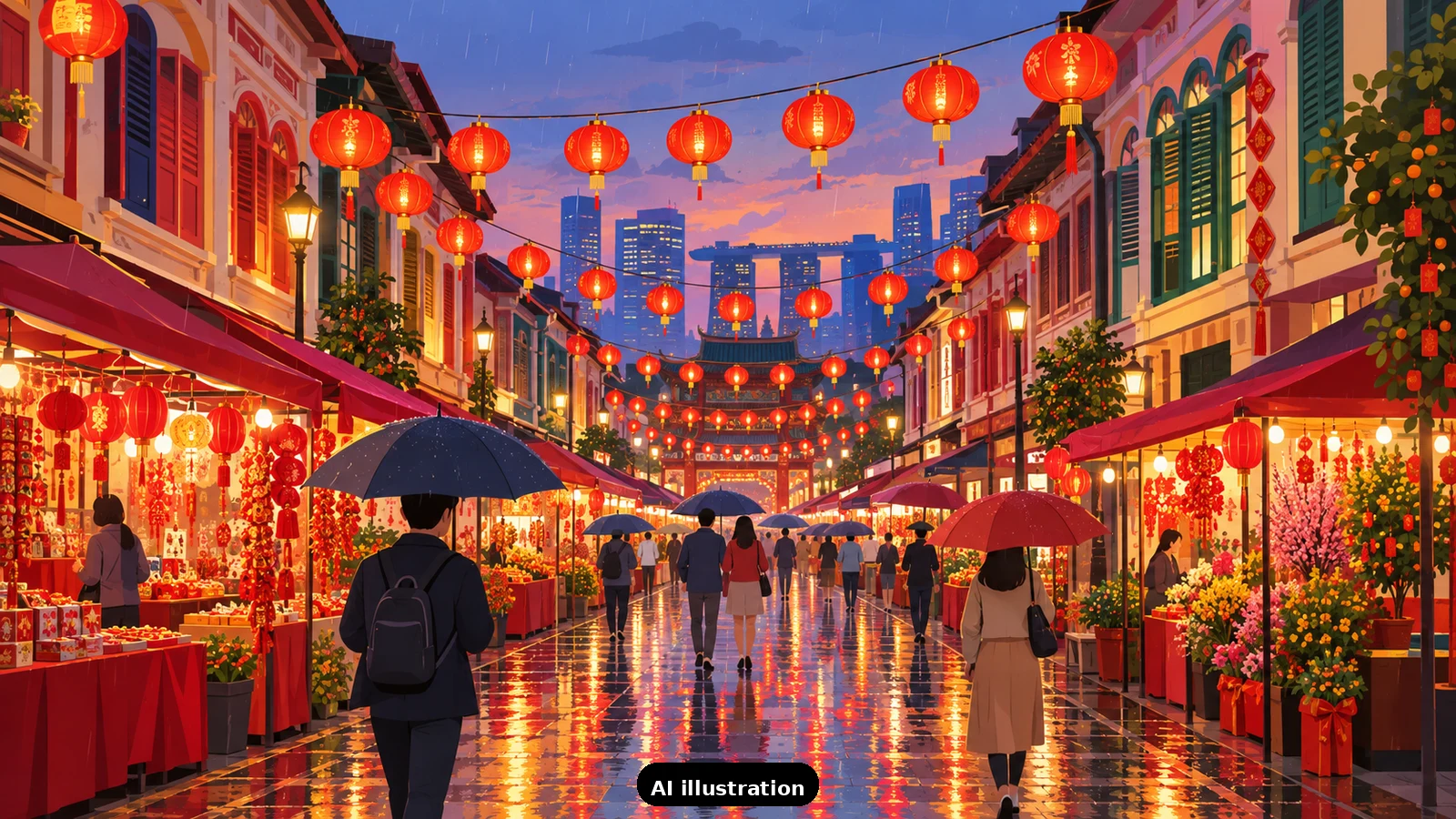
February is Singapore's driest month, averaging roughly 160 mm of rain, with windy, often bright days as the monsoon's dry phase peaks. It is the easiest of the three months to plan outdoor days around. The catch is the calendar: Chinese New Year falls on Saturday 6 and Sunday 7 February 2027 (Monday 8 February is the public holiday). The Chinatown light-up and street bazaar run for weeks before it, and the Chingay parade and the River Hongbao lantern carnival at Gardens by the Bay follow in the fortnight after.
The practical trade-off nobody tells you: during the first two days of Chinese New Year, much of Chinese-run Singapore closes - hawker stalls, family restaurants, independent shops. The city does not stop (Little India and Kampong Glam carry on almost unaffected, and malls stay open), but your eating plans need adjusting, and hotel rates climb through the festival window. Come for it deliberately and it is the most atmospheric week of the year; stumble into it unprepared and you will be standing outside shuttered hawker centres wondering what happened.
What to book first, in order
- Flights (10-12 weeks ahead, earlier for late December): the Christmas-New Year fortnight sells out and prices steeply; mid-January and early February (pre-CNY) are the value dates.
- Hotels (same sweep): Marina Bay and Sentosa properties peak hardest over Christmas-New Year and Chinese New Year; Bugis and Little India hold value better.
- Christmas Wonderland and Chingay tickets (when announced): Wonderland is date-ticketed, and Chingay grandstand seats sell through SISTIC well ahead, though the parade route has free viewing.
- Universal Studios and headline attractions (2-4 weeks ahead): USS runs super-peak pricing in December; dated tickets are cheaper than walk-up.
- Popular restaurants for CNY reunion-dinner week: the ones that stay open run set menus and book out.
Packing and daily tactics for the monsoon
- Carry a compact umbrella every day. December rain arrives fast; locals treat umbrellas like keys. A light rain jacket beats a poncho in the wind.
- Plan indoors after 2 PM in December: the thundery shower window is afternoon to early evening. Mornings are your outdoor hours.
- Use the covered city: the MRT network, mall linkways and covered walkways mean you can cross the centre in heavy rain without getting wet.
- Don't fear the rain forecast: "80% chance of rain" in Singapore usually means a heavy hour, not a washed-out day. Only multi-day monsoon surges genuinely reshape plans, and December is when they happen.
- Footwear: quick-dry sandals or shoes you do not mind soaking; pavements pond briefly after downpours.
Bottom line
Pick late December for the full festive spectacle and accept rain gear and peak prices. Pick mid-to-late January for the best value and the most forgiving crowds. Pick February for the driest weather, and if your dates touch 6 to 8 February 2027, lean into Chinese New Year properly: see the bazaar, watch the lanterns and book everything early. There is no bad choice in this window, only an unprepared one.

A Miranda House graduate and lawyer who traded courtrooms for slow travel. Cheshta travels with the batches we host ourselves, with a soft spot for travelling alongside elders.
Planning your next trip?
We'll handle insurance, hotels, airport assistance and the itinerary — the same way we do it for every trip.
Questions on this article
asked by readers, answered by us
Was this helpful?
one tap, no sign-up