




- Subject
- Solar saltworks inputs
- Division account
- Sea, subsoil, lake brines
- Technology page
- Sea and subsoil brines
- Site/product assessment
- Not supplied
- Reviewed
- 17 November 2026
Reviewed: 17 November 2026. Input-source explanation, not a production or product guide.
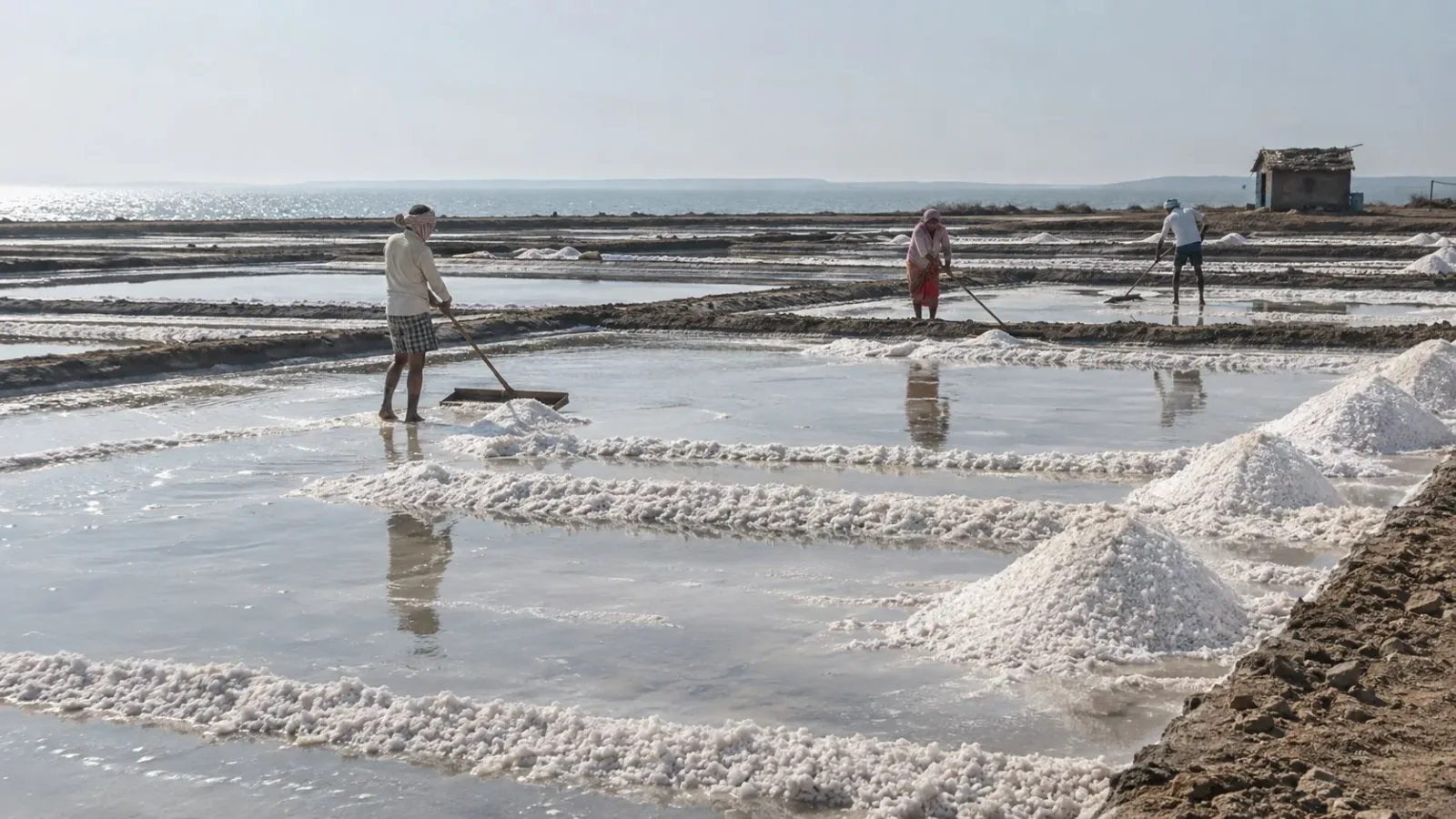
AI-generated fictional Indian-solar-saltworks-inspired scene, not a documented site, identified brine source, operating procedure, product assessment or current operation/access record.
A solar saltworks need not be understood only through a picture of the sea. CSIR-CSMCRI names sea, subsoil and lake brines in its account of designing solar saltworks. The narrow point is the source of the brine, the salty water used as an input.
Separate the input from the saltworks
The institute's Salt and Marine Chemicals Division describes design and layout of solar saltworks suited to sea, subsoil or lake brine. The input is therefore not restricted to seawater in that account.
Its separate technology page also lists sea and subsoil brines as raw materials. Read that shorter list alongside the division's broader statement without adding a source the pages do not name.
The terms identify inputs in the institute's description. They are not instructions for finding, collecting or processing salty water.
Read the source categories within the institute's scope
Sea, subsoil and lake refer here to where the described brine comes from. The distinction concerns the input to solar saltworks, not three grades of finished salt.
The account does not say that every saltworks uses every source. Nor does this article assign one of those inputs to a particular site from its location, a photograph or the appearance of its salt.
This is not a wider explanation of groundwater, lake formation or salt chemistry. No production sequence, concentration measurement, equipment arrangement or operating method is supplied.
Keep the distinction separate from a site or product claim
A research institute's capability description is not an inspection of an individual saltworks. It does not establish that a named site is operating, accepting visitors or offering a demonstration.
The source categories also do not certify a packet of salt. No composition, purity, food suitability, health benefit or product authenticity is inferred from them here. The article does not compare salts or recommend a purchase.
The takeaway stays within the institute's account: sea, subsoil and lake brines are named inputs for solar saltworks. That is a material-source distinction, not a production lesson or an assessment of a particular place or product.
Frequently asked questions
Does CSIR-CSMCRI describe seawater as the only input?
No. Its division account also names subsoil and lake brines.
Does the separate technology page name lake brine too?
That page lists sea and subsoil brines; the lake-brine category comes from the division account.
Does every saltworks use all the named sources?
No such universal claim is made here.
Can these categories certify a salt product or confirm a visit?
No. Neither an individual product assessment nor a current visitor arrangement is established.
Does this explain how to produce salt?
No. No collection, concentration, equipment or operating sequence is supplied.
Does source category establish a quality grade?
No. Brine-source categories are not treated as grades or a certification of finished salt.
Official sources and limits
CSIR-CSMCRI supports the named brine inputs, with lake brine attributed only to the division account. No production procedure, individual-site inspection, product certification or current access is established.

A Miranda House graduate and lawyer who traded courtrooms for slow travel. Cheshta travels with the batches we host ourselves, with a soft spot for travelling alongside elders.
Planning your next trip?
We'll handle insurance, hotels, airport assistance and the itinerary — the same way we do it for every trip.
Questions on this article
asked by readers, answered by us
Was this helpful?
one tap, no sign-up