




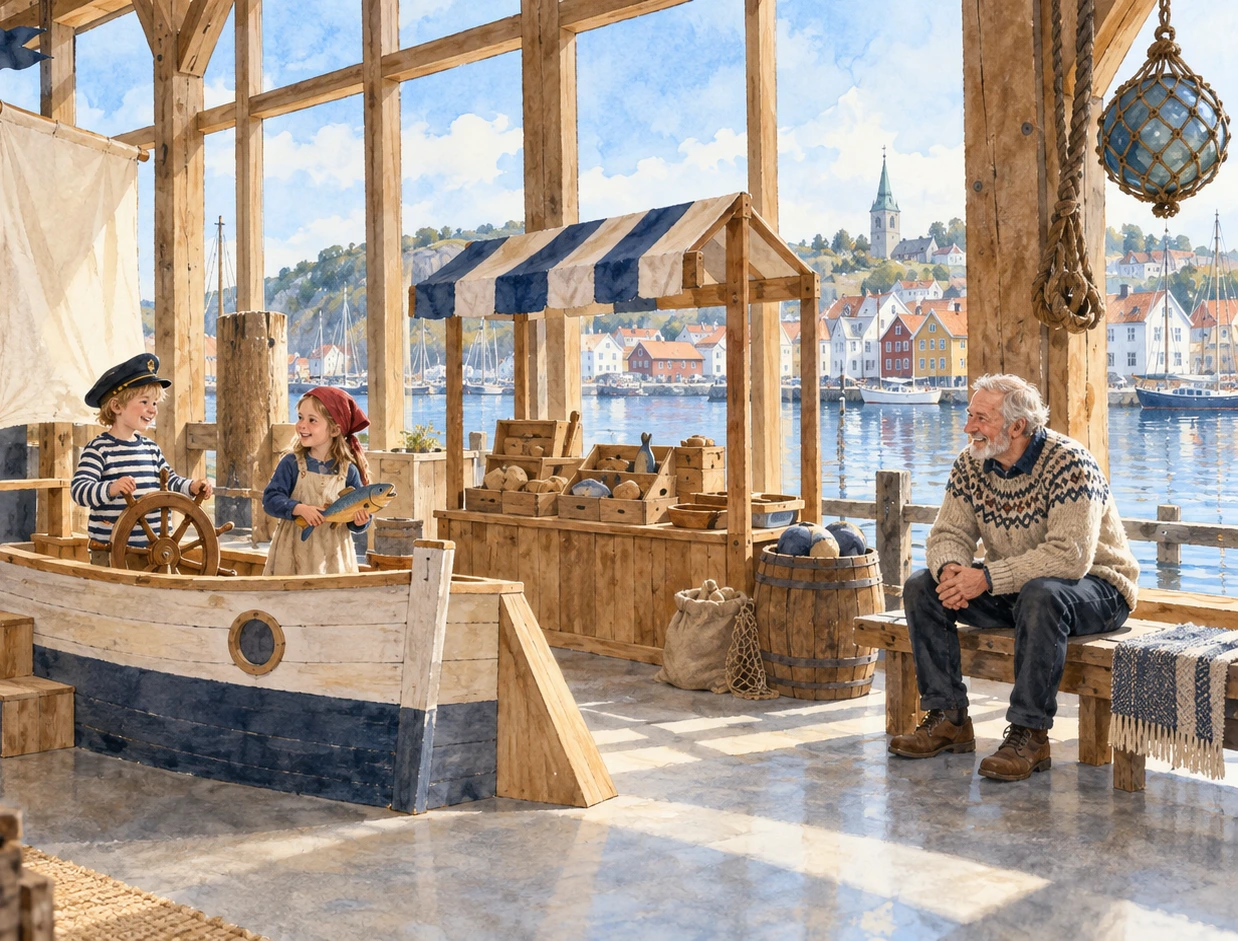
Plan Stavanger Maritime Museum as an indoor harbour-history visit first. The children's pretend boat in Working at the Docks is not the same experience as stepping aboard Anna af Sand or Wyvern, the museum's historic vessels.
That distinction makes a family plan less fragile. You can choose the museum for roleplay and exhibitions without promising a child a real ship visit that has not been arranged. For a parent using a wheelchair, the building route needs its own check too: this is a historic warehouse complex, not a fully step-free museum.
These notes were checked on 12 November 2026 against six museum-operated pages. They are planning guidance, not a confirmed booking, vessel visit or guarantee of access to a particular room.
Start with the indoor quayside, not the real ships
The Working at the Docks page describes a recreated quayside marketplace inspired by late-1950s Stavanger. Children can dress up and make stories through roleplay on a fjord boat, at a post office, in a warehouse, in a shop and at a market stall. The current exhibition listing also includes it as an interactive children's exhibition.
That gives the visit a simple family focus: let children choose a role while adults follow the harbour story. This is an indoor exhibition activity, not evidence of a scheduled sailing, a staffed lesson in English or access to every historic vessel.
The museum's visit-planning page says children up to and including primary-school age must be accompanied by an adult throughout the visit. Treat the exhibition as shared play, not a supervised drop-off service.
Anna af Sand and Wyvern need a separate plan
The museum-vessels page identifies two historic sailing vessels and says both are sailed by volunteer crews. The visit-planning page is more important for deciding whether you can board: it says visits are by prior arrangement or during selected events, for example when the vessels are moored in Vågen harbour.
Do not turn that into daily open boarding, an included sailing trip or a guarantee that both vessels will be at the quay on your date. The museum opening timetable is not a vessel-boarding timetable.
If boarding is the main reason for your visit, ask which vessel can be visited, when, and what the boarding route requires before committing to the day. This research does not establish step-free vessel access, a suitable gangway for a particular wheelchair, or permission to board without an arrangement.
The accessible ground floor is not the whole museum
The visitor-information page calls wheelchair access partial. It says the ground floor is fully wheelchair accessible, the rest of the museum is only partly accessible, and the top floor is not wheelchair accessible. Some environmental exhibitions have narrow doorways that may be difficult with modern wheelchairs. Some rooms are dark.
The visit-planning page independently says full step-free access is not possible in these listed historic buildings. One accessible toilet is reported. The museum also says it does not currently provide dedicated facilities for visitors with visual or hearing impairments.
For a mixed-generation family, ask for a route that matches the actual chair, doorway needs and tolerance for darker rooms. A useful question is whether the particular children's exhibition and the cafe can be reached by that route on your date. The broad ground-floor statement does not independently locate every activity or confirm a continuous step-free route to it.
It is reasonable to plan a shorter shared visit rather than make upstairs completion the measure of a successful outing. That is a planning suggestion, not a claim that a particular bench or resting place is available in every gallery.
Check the hours and leave enough time for play
At the time checked, the visitor-information timetable lists Tuesday to Sunday, 11:00-16:00, with Monday closed. The planning page describes a summer pattern of daily opening, 10:00-16:00, and Tuesday-Sunday, 11:00-16:00, outside summer. It does not give exact summer boundary dates in the text used here.
Use the live timetable for the date you actually intend to visit, especially around holidays. Do not carry the summer Monday opening into a winter plan. The museum's own typical visit estimate is around 1½-2 hours, and it says families often stay longer. This is a guide to pacing, not an allotted session or a promise that two hours is enough for every family.
The address reported is Strandkaien 22, Stavanger. Paid parking is listed at Strandkaien. No parking-space reservation or step-free route from a particular parking bay has been verified here.
Admission: the age-18 wording needs checking
The visitor-information page lists adult admission at NOK 170 and describes children aged 0-18 as free. The planning page also gives NOK 170 for adults, but uses “under 18” for free child and young-person admission. Those phrases do not settle an 18-year-old's price in the same way.
If someone in the family is exactly 18, confirm the current ticket category rather than assume. Students are described as free, with valid student identification required on the information page. These are checked web prices, not a payment quote locked for a future visit.
The planning page says a ticket covers MUST museums that are open on the same day. That is not all museums in Stavanger, transport between them, access to closed buildings, a ship visit or every special activity. Choose any second museum because your family wants it, and check its opening and access separately.
A cafe stop can be a smaller visit
The cafe and gift-shop page says no museum ticket is needed to use the cafe. It lists hot and cold drinks and a small selection of sweet and savoury snacks, and says the cafe and shop follow the museum's opening hours.
This is a useful alternative if the family only wants a harbour-side pause. It does not establish a free museum visit, a full restaurant menu, dietary suitability or an independently checked step-free cafe route. Ask about those needs before relying on them.
The planning page separately describes Stranden Colonial as a summer-season option with an entrance from Nedre Strandgate. Do not promise that seasonal tea-room experience on a November visit.
Build the day around what is actually confirmed
A practical order is to confirm the day's museum hours, ask about the rooms your family can reach, choose the indoor exhibition, then add a vessel visit only when it is arranged. Schools and kindergartens have separate advance-booking requirements; that is not proof every ordinary family needs an education booking.
For a wider Norway holiday, private-tour planning can start with your family's pace and access needs. Use the trip-planning page to share those details. No museum admission, ship visit or transport is represented here as included in a TripKeeper package.
Sources and illustration
Checked 12 November 2026. The age-18 price boundary, room-specific route and vessel boarding remain items to confirm for your actual visit. The hero is a fictional AI illustration of an invented play gallery, not a photograph of this museum, its exhibits, seating or accessibility.
- Visitor information: partial access, prices and hours
- Plan your visit: family roleplay, visit length and conditional vessel visits
- Current exhibition listing
- Working at the Docks: indoor roleplay exhibition
- Museum vessels: two historic vessels and volunteer crews
- Cafe and gift shop: no museum ticket needed for cafe

A Miranda House graduate and lawyer who traded courtrooms for slow travel. Cheshta travels with the batches we host ourselves, with a soft spot for travelling alongside elders.
Planning your next trip?
We'll handle insurance, hotels, airport assistance and the itinerary — the same way we do it for every trip.
Questions on this article
asked by readers, answered by us
Was this helpful?
one tap, no sign-up