




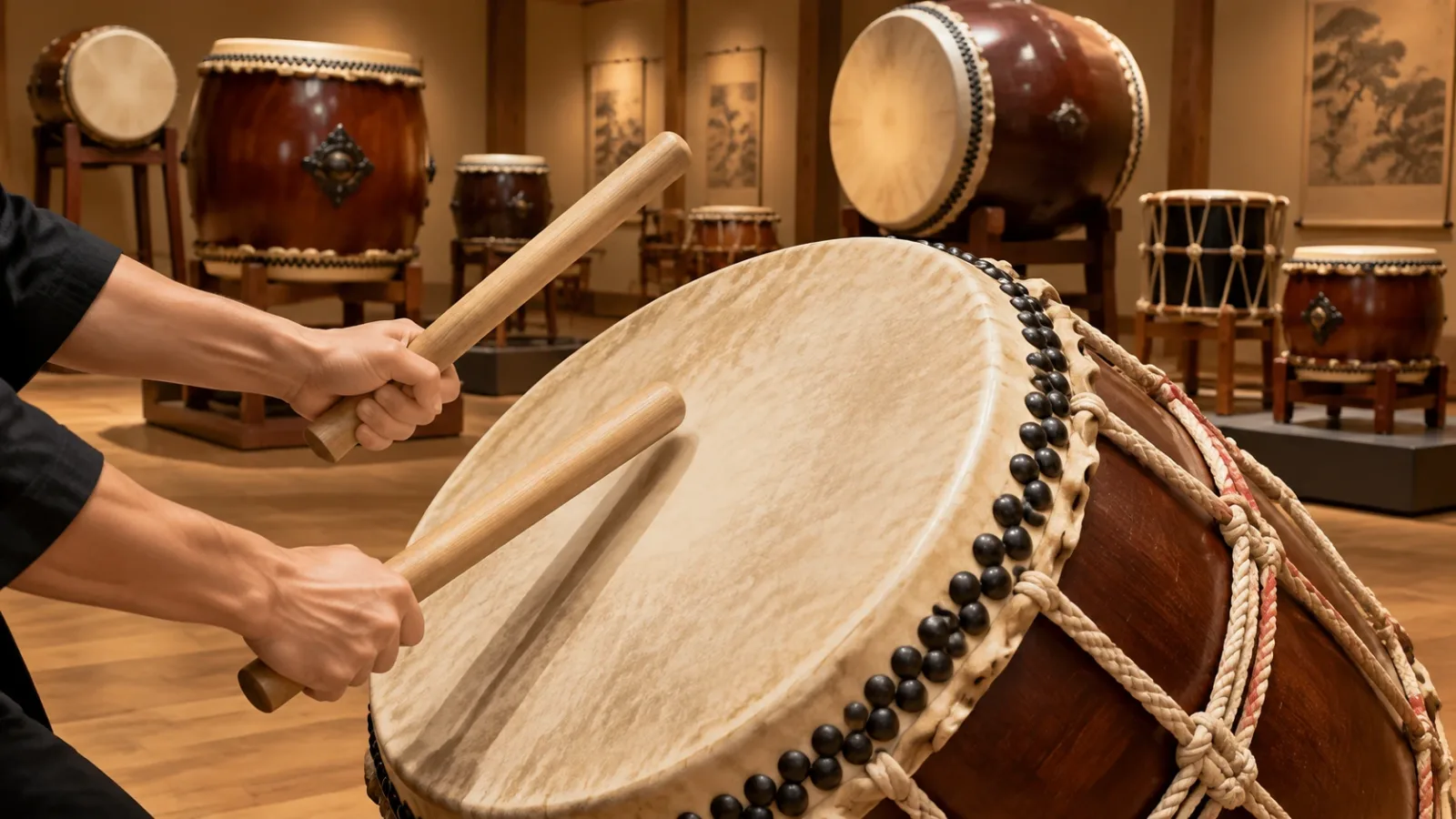
Checked 9 November 2026. AI illustration shows hands holding drumsticks above a taiko drum in a fictional Japanese drum gallery, not the actual Taikokan, equipment or confirmed activity. Confirm the selected date, activity, language and access directly.
Choose a museum visit or a taught session first
Miyamoto Unosuke’s Taikokan page describes a museum with playable exhibits. That is different from reserving an instructor-led taiko lesson. A parent who wants to listen and try a few marked drums may want a different outing from someone expecting a full taught performance routine. Decide which experience the family actually wants before comparing ticket prices.
The musical-note mark is permission, not the size of the drum
The operator says exhibits with the musical-note mark, ♪, on their cards may be played and asks visitors to seek staff assistance. Do not infer permission because a drum is within reach, because another visitor touched it or because a travel page says the museum is hands-on. Ask which exhibit to try and how to use the sticks or hands for that instrument.
Use 15:00 last entry, not a later tourism shorthand
The operator currently lists opening 11:00-16:00 with final admission at 15:00. GO TOKYO’s 25 December 2025 listing instead says last entry 30 minutes before closing. Checked on 9 November 2026, that is a meaningful mismatch. Plan around the operator’s earlier cutoff and reconfirm the visit date; a closing time is not the same as the time the family can still enter.
Old 10:00-17:00 hours should not drive the day
Asakusa Station’s guide describes the collection and museum setting, but gives 10:00-17:00 hours. Those do not match the current operator page. Keep its background description separate from live practical planning. The operator lists Monday closure except when Monday is a holiday, and Tuesday closure. Check dated notices for your day instead of assuming a shop being open proves the museum is admitting visitors.
Museum admission is not an all-inclusive lesson price
The operator lists adult admission ¥500 and child admission ¥150. It does not define the child age band in the rate block we checked, so ask before assigning a child price. Do not treat either amount as a private lesson, a guaranteed demonstration, a group host or a reserved instrument. Payment method and any arrangements for your group should be confirmed with the museum.
A marketplace workshop needs its own inclusions
Klook lists a separate live show and workshop under the Miyamoto-Unosuke Drum Museum name. Its description mentions instructor guidance, but the page read did not establish your date’s final price, duration or whether ordinary museum admission is included. Ask those questions on the actual selected product. A family-friendly or all-ages label does not establish a chair, quiet space or an individual access arrangement.
The company’s school and museum are different offers
Miyamoto’s performance page separately lists the HIBIKUS taiko school, Iyasaka Project performances and the Drum Museum. Do not carry a school lesson schedule into museum admission or assume a performance happens during every museum visit. If a taught course matters, ask for its exact provider, venue, language and booking confirmation, rather than arriving with only the museum name.
An upper-floor museum is not the ground-floor shop
GO TOKYO places the museum on 4F of Miyamoto Unosuke’s Nishi-Asakusa store at 2-1-1 Nishi Asakusa, Taito City. It lists an elevator and multi-purpose toilet. These are useful leads, not a complete door-to-seat access promise. Ask where to enter, which lift to use, whether the route fits your needs and where a parent can sit between exhibits.
Plan for other visitors playing, not a silent gallery
Because marked exhibits can be played, do not promise a silent museum or a fixed sound level. If a parent prefers less sound, ask about suitable visit timing, seating and whether a short look without playing is possible. Keep the option to leave early; do not frame loud drumming as a health benefit or as something every family member has to try.
Collection size is not the number of available instruments
The operator describes a collection of around 800 drums. That is not a promise that all 800 are on display, playable or available for your family at once. WOW U’s listing also describes marked playable exhibits, but its broad headline should not replace the museum’s card-by-card permission. Let the visit be a chance to discover what is currently shown rather than a checklist of promised instruments.
Keep language and a guide separate from the admission ticket
GO TOKYO lists Japanese and English facility information; that does not confirm a Hindi-speaking instructor or a private English tour with admission. If interpretation is important, arrange it for the selected visit or workshop. For the wider route, Japan tour packages can start a planning enquiry, but this article does not state that a museum ticket or lesson is included.
Source notes
Operator museum page, Operator performance page, GO TOKYO, December 2025, Asakusa Station guide, Klook workshop listing, WOW U museum listing. Operator hours take precedence over conflicting guide hours. Marketplace descriptions are not confirmed workshop availability, price or access.

A Miranda House graduate and lawyer who traded courtrooms for slow travel. Cheshta travels with the batches we host ourselves, with a soft spot for travelling alongside elders.
Planning your next trip?
We'll handle insurance, hotels, airport assistance and the itinerary — the same way we do it for every trip.
Questions on this article
asked by readers, answered by us
Was this helpful?
one tap, no sign-up