




- Source
- Toronto Zoo account
- Long train
- Upper-tail coverts
- True tail
- Separate, short
- Display time
- Not established
- Reviewed
- 17 November 2026
Reviewed: 17 November 2026. Selective heritage outline, not a ticket or access guarantee.
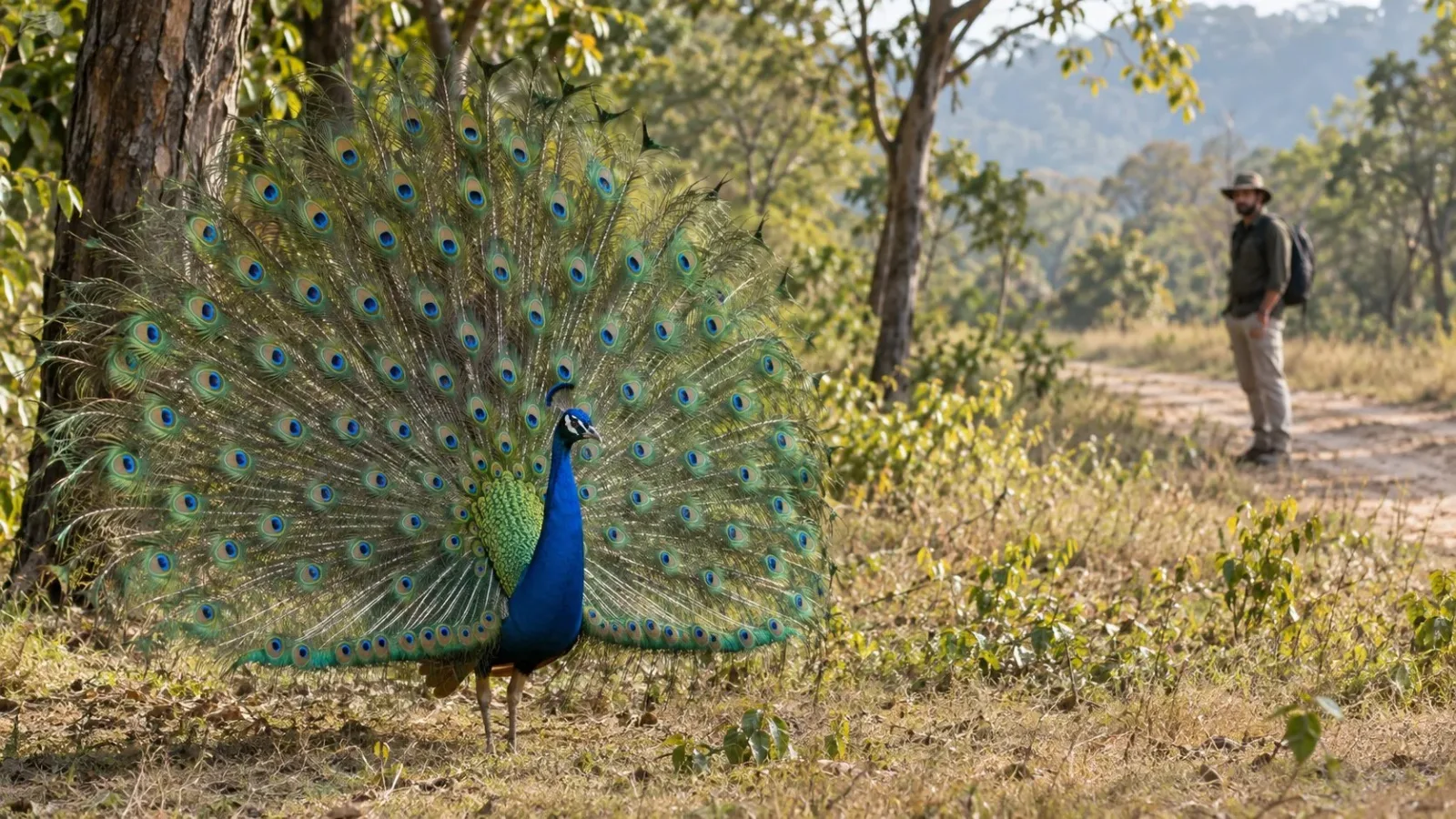
AI-generated fictional wildlife scene, not a feather-group diagram, identified individual, current sighting, display schedule or suggested approach distance.
The Indian peacock's long ornamental feathers are often called its tail. Toronto Zoo's species account makes a more precise distinction: the long train consists of greatly elongated upper-tail coverts, not the true tail feathers. It describes the true tail itself as short. These are different feather groups, even when everyday language gives the whole scene one name.
Understand what the account calls the train
Toronto Zoo identifies the upper-tail coverts on the male's back as the elongated ornamental feathers that form the train. The term names the feather group described in this account. It does not mean that every long feather visible in a photograph can be identified from its outline alone.
The focus is the relationship between the train and the true tail. It is not an explanation of how feather colour is produced, how a feather develops or why a particular bird has its present appearance.
Keep the true tail distinct
The same account explicitly says that the train is not made of true tail feathers and describes the true tail as short. Calling the long ornamental group the train preserves that distinction.
This is a description of parts, not an assessment of an individual bird. Feather appearance is not used here to judge its age, health, condition or reproductive success. Nor does a loose feather become an identified specimen simply because it resembles part of a train.
Leave behaviour and sightings outside the explanation
Naming a feather group does not establish when a bird will spread it or what a particular movement means. This article makes no claim about courtship, mate choice, seasonal feather change, calls or defensive behaviour.
It also verifies no present bird population, place to see a displaying peacock, visitor route, admission or accompanied wildlife visit. A species account is not a live sighting report. The useful point remains anatomical: the long train and the shorter true tail are not the same feather group.
Frequently asked questions
Is the peacock's train made of true tail feathers?
Toronto Zoo's account says it consists of elongated upper-tail coverts, not true tail feathers.
Does the bird still have a true tail?
Yes. The same account distinguishes a short true tail from the train.
Can the train tell us an individual bird's age or condition here?
No. This article does not diagnose an individual from its feathers.
Does this establish when or where a peacock will display?
No. No display schedule or current sighting is confirmed.
Does this explain feather colour or growth?
No colour-production or feather-development account is supplied.
Does this identify a loose feather?
No loose feather or individual bird is identified.
Official sources and limits
Institutional zoo account attributed feather-group distinction only. No colour mechanism, age/health assessment, behaviour, display calendar, current sighting, loose-feather identification, wildlife route or access claim.

A Miranda House graduate and lawyer who traded courtrooms for slow travel. Cheshta travels with the batches we host ourselves, with a soft spot for travelling alongside elders.
Planning your next trip?
We'll handle insurance, hotels, airport assistance and the itinerary — the same way we do it for every trip.
Questions on this article
asked by readers, answered by us
Was this helpful?
one tap, no sign-up