




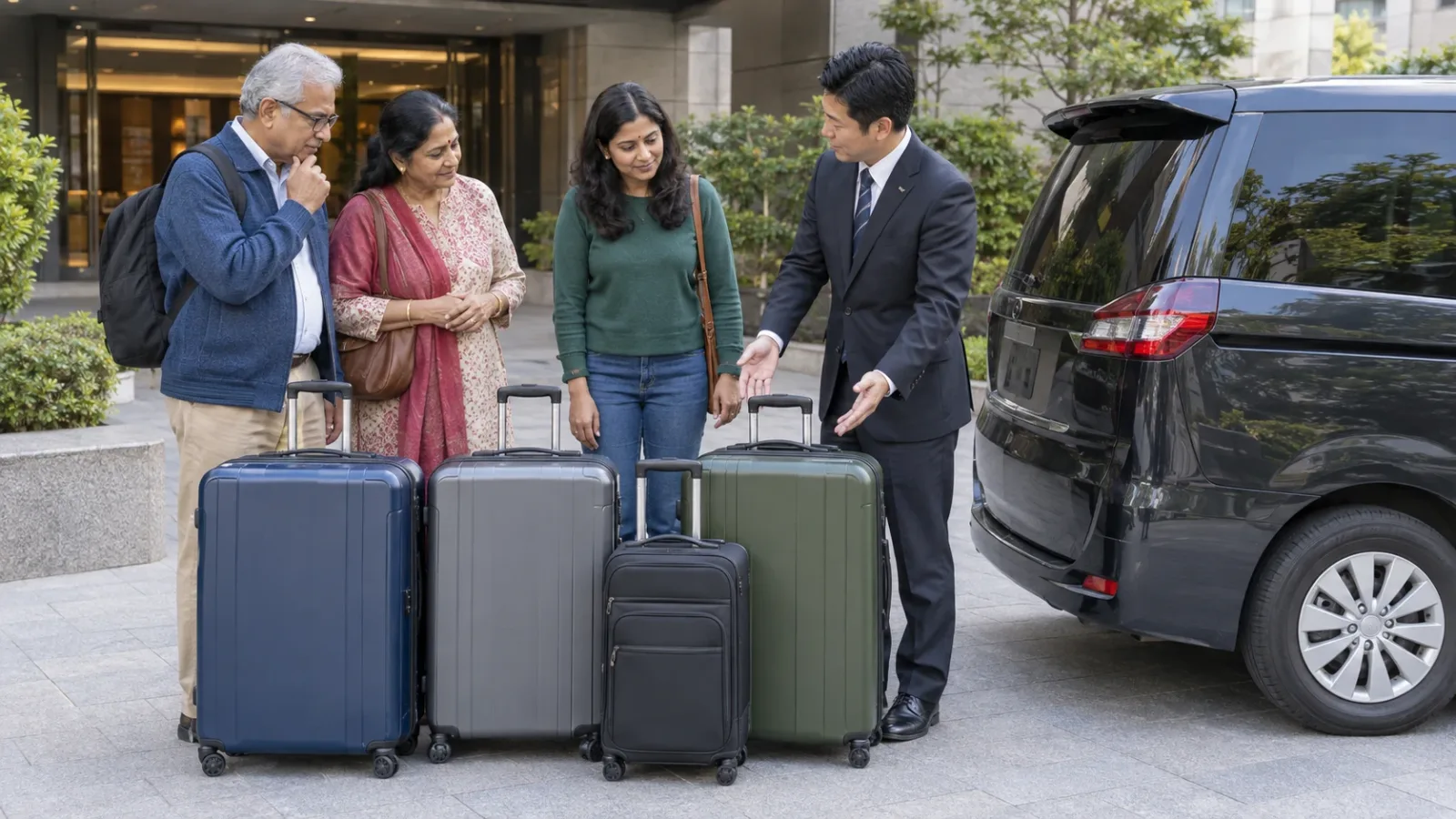
Your parents and you make three passengers. The taxi listing says four seats, so one car seems settled. Then there are three large suitcases, a smaller case and the bags everyone wants to keep close. The passenger count fits; the luggage plan has not yet been confirmed.
For a Tokyo taxi, ask about people and bags in the same request. A four-passenger capacity is not a four-large-suitcase promise. Even a minivan's usable luggage space can change when more of its seats are occupied.
The operator's luggage estimate matters more than the roof height
km Taxi's vehicle FAQ gives a useful, specific example. It describes its JPN Taxi as carrying four passengers and estimates room in its luggage area for about two 80-litre suitcases. That is an estimate for this operator and vehicle type, not a rule for every Tokyo taxi.
The same FAQ makes the seating trade-off clear for its minivans:
| km Taxi's stated minivan arrangement | Published luggage guide |
|---|---|
| At the five-to-six-passenger maximum | About two 50-litre suitcases |
| Four passengers | About three 80-litre suitcases plus one 50-litre suitcase |
These are loading guidelines, not a reservation for your cases. The lesson is not “a minivan always takes four bags.” It is that the same broad vehicle category may have less bag space when you use all the seats. Confirm the actual model, seating layout and your luggage together.
Do not silently transfer one fleet's numbers to another
Hinomaru's Tokyo fleet page lists four passengers and up to two suitcases for its JAPAN TAXI and Sienta, and six passengers with an estimated allowance of up to four suitcases for its Alphard. It also labels the load as an estimate. That is a different operator's guide, not proof that every Alphard, every suitcase size and every seating arrangement will match.
Nihon Kotsu's vehicle list describes its Alphard as having a maximum of six passengers but recommends four to five. It notes an additional vehicle-selection charge. A maximum seat count, a comfortable family layout and the bag allowance are separate questions.
The manufacturer gives another reason not to use suitcase count alone. A Toyota dealer-hosted JPN Taxi brochure dated May 2026 shows a two-suitcase example with specified dimensions and warns that size and shape can prevent loading. Toyota's October 2017 launch release is historical context, not a current fleet booking promise. Neither means two cases of any shape must fit.
Send the information that can settle the car choice
Before requesting a vehicle, make one list: adults and children separately; each large and small case with height, width and depth; backpacks; stroller; folding wheelchair or other bulky items. Include handles, wheels and awkward shapes when describing the load. A photo can help the operator understand it, but ask for confirmation rather than treating the photo as approval.
For example: “Three adults, three large cases with these dimensions, one small case and two backpacks. Can one specified vehicle carry everyone and all luggage in the intended seating arrangement? What extra charges and booking conditions apply?” State the pickup address and destination too, so the operator can confirm its service area.
An independent Japanese taxi guide dated July 2026 also recommends giving passenger numbers and actual case sizes together. Its general advice is useful; the operator still has to confirm the vehicle you can book.
A wheelchair arrangement changes the question
A folded wheelchair being carried as luggage and a passenger remaining seated in a wheelchair are different requests. Do not simply add “wheelchair-friendly” to a four-person booking and assume all four seats remain available.
km's FAQ says that, for its wheelchair-in-vehicle arrangement, one accompanying passenger may travel with the wheelchair user. It also says the driver cannot provide hands-on bodily assistance. That is km's stated arrangement, not a universal limit for every accessible taxi. Hinomaru's English capacity wording is not used here to promise room for two wheelchair users; ask the operator to confirm the exact occupied-wheelchair layout.
Give the device's dimensions and whether it folds, say whether the passenger transfers to a car seat, and ask about the ramp, securing system, passenger space and assistance. No particular device fit, lifting help or accessible vehicle availability has been verified for your trip.
Compare the complete arrangement, not just one meter
A larger specified car may have a vehicle-selection or wagon charge as well as pickup, reservation and journey charges. Hinomaru publishes separate wagon and reservation terms; Nihon Kotsu notes a vehicle-selection charge. Ask for the full terms for your chosen provider, including cancellation and waiting, rather than copying a single fleet's number into a Japan-wide budget.
If one vehicle cannot be confirmed, compare a suitable larger vehicle with two taxis. With two cars, decide who travels with each parent, split bags deliberately and give both drivers the same destination. Keep essential items with the person who needs them. Do not assume two independently dispatched cars will arrive or travel together.
For the wider holiday, compare TripKeeper's Japan travel options. This link does not include a promised taxi model, luggage capacity or accessible transfer.
Questions families ask
Does a four-passenger taxi take four large suitcases?
Not automatically. km's JPN Taxi FAQ estimates about two 80-litre suitcases; other fleets and models need their own confirmation.
Does a six-passenger minivan solve all luggage problems?
No. km publishes different luggage estimates at maximum seating and with four passengers. Confirm the layout and actual bags.
Is a folded wheelchair the same booking as staying seated in it?
No. Tell the operator whether the passenger transfers and give the device dimensions. Confirm passengers, securing and help separately.
Will a normal taxi request guarantee the larger car?
Do not assume that. Confirm the specific vehicle arrangement, any selection fee and availability before relying on it.
Checked 9 November 2026. No taxi was booked, no price is held and no physical loading test was done. Figures are named operators' estimates, not nationwide guarantees. Hero image is a fictional AI illustration, not a model-specific loading diagram.

A Miranda House graduate and lawyer who traded courtrooms for slow travel. Cheshta travels with the batches we host ourselves, with a soft spot for travelling alongside elders.
Planning your next trip?
We'll handle insurance, hotels, airport assistance and the itinerary — the same way we do it for every trip.
Was this helpful?
one tap, no sign-up