




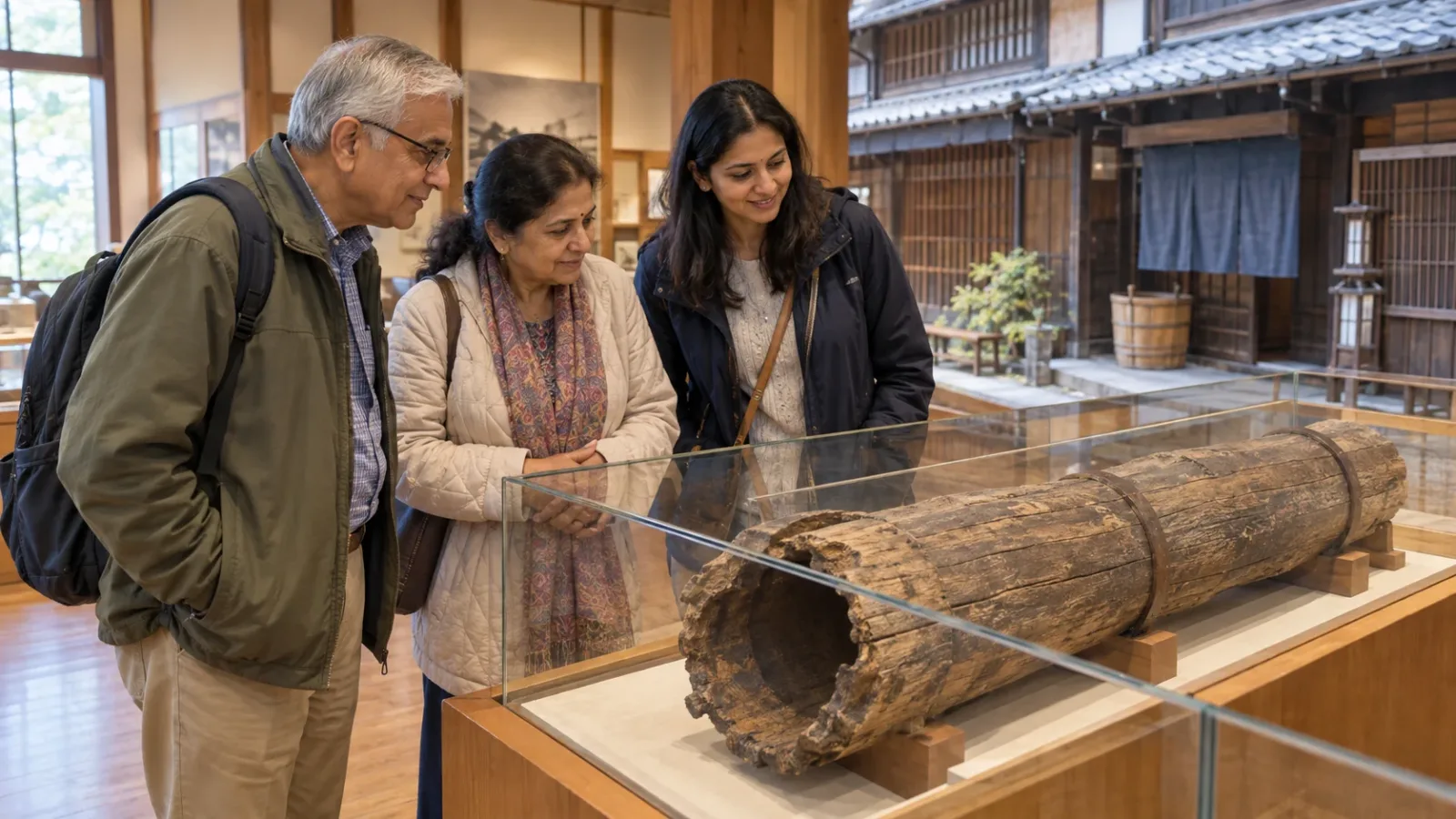
Tokyo has two different water museums that are easy to confuse in a family plan. The Waterworks Historical Museum is in Hongo, Bunkyo. The Water Science Museum is in Ariake, Koto. One is a good candidate for parents interested in old Tokyo and everyday engineering; the other puts more weight on hands-on science. Do not send a driver a shortened name and expect the right building.
Choose the subject before choosing the address
For Hongo, save “Tokyo Waterworks Historical Museum / 東京都水道歴史館,2-7-1 Hongo, Bunkyo-ku” from its official English page. For Ariake, save “Tokyo Water Science Museum / 東京都水の科学館,3-1-8 Ariake, Koto-ku” from its official information page. They are not two entrances or floors of one attraction.
Choose Hongo if parents would enjoy wooden water conduits, reconstructed Edo daily life and the change to modern city water supply. Choose Ariake if the family wants experiments, interactive displays and the possibility of a timed visit to the underground Ariake water-supply facility. Neither is an ordinary swimming pool or a place to promise parents a water-park afternoon.
Hongo starts upstairs, with Edo water history
The Historical Museum floor guide recommends starting on 2 F for Edo waterworks, then seeing the modern waterworks displays on 1 F. The 3 F has a library and lecture hall. A room on the top floor is not automatically another gallery that everyone needs to visit.
The GO TOKYO description also frames Hongo around water supply, historic households and interactive learning. For a parent who likes everyday history, choose two or three questions: how water reached a home, why wooden pipes were used, and what changed with modern systems. The subject can connect to familiar household life without turning the visit into a technical exam.
English audio at Hongo is not the Japanese AR tour
The current Hongo visitor guide lists free audio guidance in Japanese, English, Chinese and Korean. It separately lists a Japanese-only AR guide and Japanese/English explanations through two-dimensional codes on a smartphone. These are different tools. Do not choose the AR device assuming it is simply the English audio with pictures.
No Hindi audio or Hindi-led tour was confirmed. A parent who understands some English can try selected audio stops; a companion can explain a few objects in Hindi. Ask reception which device and earphones are available instead of assuming that one handset can be shared in a particular way.
A March 2024 firsthand family account found the audio guide helpful and describes spending over an hour listening. That is a useful clue about the style of visit, not a guarantee of quiet galleries, a fixed duration or today's device-sharing setup. Skip audio stops when parents have had enough.
Ariake theatre and underground tours use separate timed tickets
The Water Science Museum visit page distinguishes free exploration from the Aqua Trip theatre and Aqua Tour of the underground water-supply facility. Those two experiences use numbered tickets with times, distributed at information. The page says advance reservations for those experiences are not accepted.
Free building admission therefore does not reserve a theatre place or an underground tour. Ask at information about that day's times and spaces before promising either. The operator gives a general 60–90-minute visit estimate that varies with crowding; it is not a queue-free guarantee or a promise that every experience fits that window.
The science-museum facility page still carries notes about limits on tour numbers and frequency. Do not convert an old blog's timetable into a current departure schedule. The exact instruction language, any Hindi support and an adapted underground route are unconfirmed here; ask about the particular experience.
The two museums do not have the same Monday closure
Hongo normally closes on the fourth Monday of the month, with a holiday-related move to the following day. Ariake normally closes on Mondays, also with a holiday-related change. Both list a year-end closure period and normal hours 9:30–17:00 with last admission 16:30. Check the chosen museum's current calendar, not a generic “Tokyo water museum” listing.
That difference can matter when the family has only one spare morning. Do not assume Hongo is shut every Monday because Ariake is, or that Ariake follows Hongo's once-a-month pattern. A current special-event notice may add another condition, so confirm the visit date separately.
A seven-person family needs the Hongo group rule
Hongo's current guide says seven or more visitors need advance group reservation, including self-guided visits. It explicitly says the previous threshold of five changed to seven from the 2026 fiscal year. Old instructions for five people should not be copied into a new family plan.
Ariake's group page asks groups of around ten or more, and school groups, to apply. That is a separate process and does not turn the timed theatre/tour tickets into advance-reserved experiences. Use the correct museum's rule for the actual party, and do not split a group on paper to bypass it.
Check the rest and toilet plan, not only the lift icon
Hongo's visitor guide lists an elevator connecting 1 F–3 F, a multipurpose toilet on 1 F and one loan wheelchair. One wheelchair is not reserved stock for a particular parent. Ask about availability and the actual entrance route if those features determine whether the visit works.
The museum also continues to publish a 15 June 2026 drainage notice warning that 3 F toilets may be unavailable and directing visitors toward 1 F/2 F toilets. It is not a blanket closure of every toilet. Check with reception on arrival, especially before going upstairs; do not send a parent to 3 F on an old floor-map assumption.
Ariake's official information asks wheelchair visitors to consult the museum in advance. That is not confirmation that every activity has the same access or seating arrangement. Describe what the parent needs and ask separately about the galleries, theatre and underground tour.
Neither is a dependable indoor lunch stop
Hongo prohibits food and drink in the exhibition rooms and says it has no group lunch space. Its guide lists a bottle-dispenser drinking station, but that does not permit a picnic among the exhibits. Follow the location-specific drinking instructions rather than applying a general museum rule to every room.
Ariake's own pages conflict: its group FAQ allows meals outside on benches or lawn when usable, while its facility guide still carries a notice asking visitors not to eat anywhere on the grounds. Do not rely on an outdoor picnic without current staff confirmation. Plan lunch elsewhere if that answer matters to the family.
Pick one museum, with an optional second interest
For parents who enjoy old streets and household history, Hongo plus a few chosen audio stops is the more direct fit. For a mixed-age family keen on doing rather than reading, Ariake is worth considering, provided its timed activities and actual language work for everyone. This is a fit judgement, not an accessibility certification or a promise that a parent will enjoy every display.
Use The Trip Keeper's Japan trip page to discuss the wider holiday. Neither museum, a reserved group visit, timed tour, Hindi interpretation, wheelchair arrangement, lunch or transport is implied to be included in a package. Last checked 9 November 2026. Hero: AI-generated fictional family viewing a generic wooden water-conduit display, not the actual Hongo or Ariake layout, exhibit, access route or reserved seating.

A Miranda House graduate and lawyer who traded courtrooms for slow travel. Cheshta travels with the batches we host ourselves, with a soft spot for travelling alongside elders.
Planning your next trip?
We'll handle insurance, hotels, airport assistance and the itinerary — the same way we do it for every trip.
Questions on this article
asked by readers, answered by us
Was this helpful?
one tap, no sign-up