




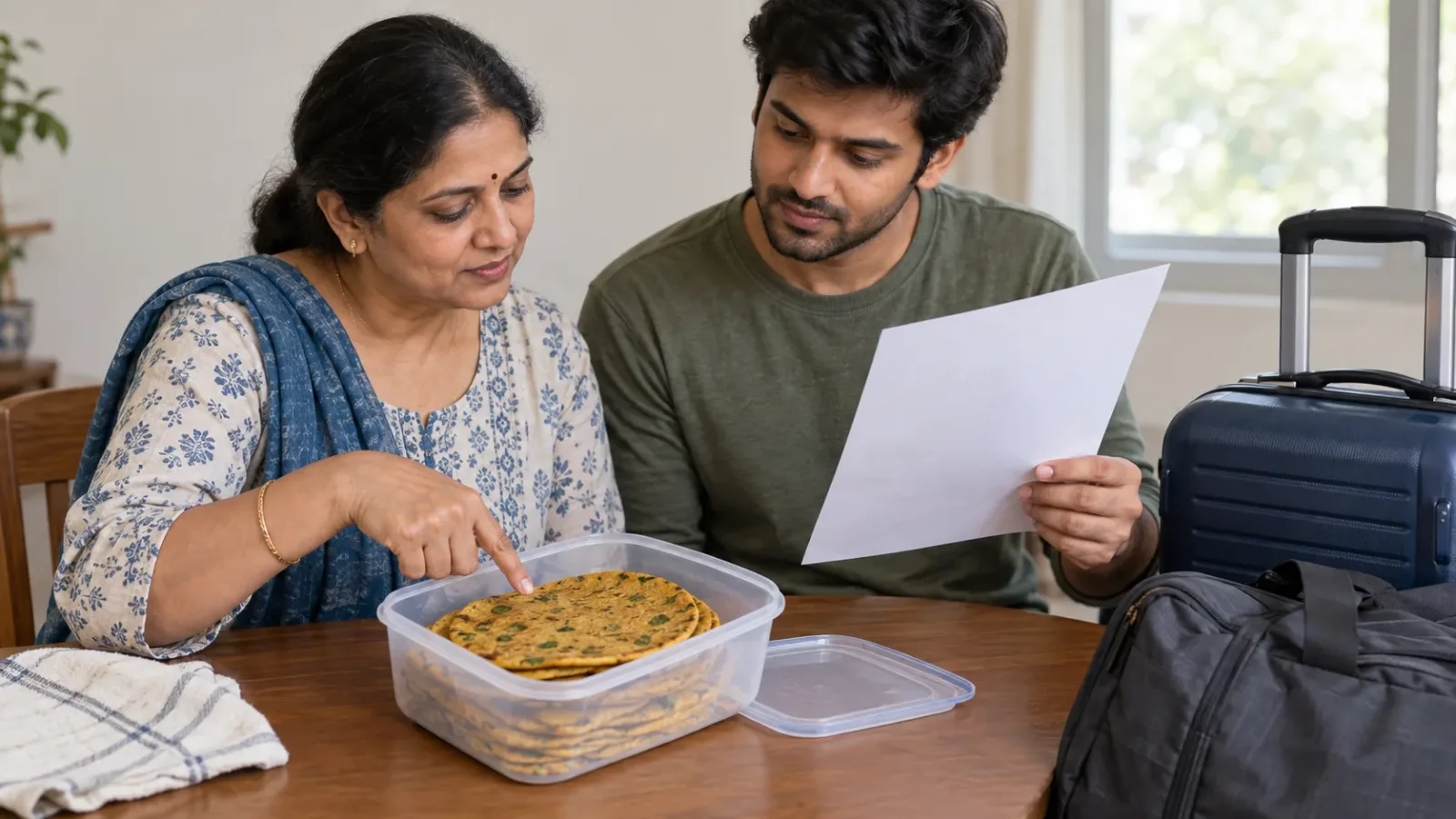
Before taking homemade thepla abroad, check the actual recipe and the whole journey, not only whether someone else carried a similar snack. Homemade, vegetarian, cooked, dry and sealed are different descriptions. None by itself is permission to pass a checkpoint or enter another country.
AI-generated fictional photograph of a family checking homemade thepla before packing. Not an actual inspection, approved product or proof of import permission.
Write down the recipe you actually made
List the flour, fenugreek or other leaves, spices, oil and every other ingredient actually used. Include curd, milk, ghee, butter, egg, filling or topping if present; do not assume that every household's thepla has the same recipe. Describe whether leaves were fresh or dried before cooking, how the food was cooked, where it was made, the quantity and whether it needs refrigeration.
Say that it is homemade. A family-written ingredient sheet can help explain the contents, but it is not a manufacturer's label, import permit, processing certificate or proof that the item meets a shelf-stability condition. Do not rename the food simply as bread to fit a convenient category. Ask the authority which category applies to this specific preparation.
Make a route checklist before a packing checklist
Write the departure airport, operating airline for each flight, connection airports and every country where you expect to enter or collect and recheck baggage. Check what applies to the actual transit arrangement; do not assume that a connection never creates an import or screening question.
Keep three answers separate: whether the operating airline accepts the item, whether each checkpoint accepts it in the chosen bag, and whether the relevant destination or transit border permits its entry. A cabin-food answer is not customs or biosecurity clearance. Putting food in checked baggage does not settle the border question either.
Australia: ask about the preparation, not just the name
Australia's agriculture department lists conditions for biscuits, bread, cakes and pastries, including personal consumption, being fully cooked and shelf stable, containing no meat, and conditions for fillings or toppings. It directs travellers to BICON for detailed import conditions and items not covered by the list. This does not establish that your homemade thepla falls within that category or satisfies every condition.
The same page gives different conditions for dairy products. Do not decide on your own that a spoon of curd or ghee in a mixed recipe is irrelevant, or that every dairy-containing mixed food is governed in exactly the same way as a block of cheese. Give the actual recipe and processing to the official lookup or authority. Australian Border Force's food page also directs travellers to the agriculture guidance and explains that food can require declaration and inspection. Neither page is a blanket approval for homemade thepla.
New Zealand: declaration and admission are different
New Zealand MPI's India-specific guidance says all food brought into New Zealand must be declared, including cooking ingredients and cooked or preserved vegetables. It says packaging and processing affect assessment, and some declared items may still be confiscated, destroyed or need treatment.
Use that page to check the actual food and declaration process, not as a promise that a familiar Indian snack will be released. Keep the recipe and food accessible for an honest explanation if requested. This article does not promise a particular inspection time, acceptance decision, fine exemption or free treatment.
United States: check ingredients and origin
US CBP's agricultural-products guidance describes declaration of plant and animal products and assessment by agriculture specialists. Its restricted-items guide discusses bakery items but also the restrictions that can apply to ingredients and origin. Neither makes every homemade mixed flatbread automatically admissible.
Do not copy a penalty amount, an old form number or a categorical ingredient answer from a general packing blog. Check the current official process for your journey and ask about the exact recipe if classification is unclear. A relative's previous successful arrival is not a decision about your food.
Ask the airline and checkpoint their own question
Ask each operating airline whether this homemade food is accepted in the intended bag and whether it may be consumed on that flight. Check the actual checkpoint authority separately, especially if you also plan to carry chutney, pickle, oil or another item with a different consistency. Give the real item and quantity; do not assume a solid-food answer covers its accompaniments.
IndiGo's onboard FAQ was read, but its relevant revision date was not established. The US TSA bread page displays a last-updated date of 24 April 2018 and concerns US screening, not permission for an Indian departure or food import. No current, route-specific airline acceptance, cabin quantity, liquid allowance or checkpoint clearance for homemade thepla is confirmed here. Use a dated applicable official answer before relying on a rule.
Keep the border plan honest and the backup simple
If the item is confirmed, pack it securely in a clean container without disguising what it contains. Keep the recipe and any official reply with the travel information. Follow the actual declaration questions and ask an officer when uncertain. Declaration does not create import permission, and no statement here limits the outcome to simple confiscation.
If the answer remains unclear, leave the item behind and plan a suitable food option at the destination. This article gives no unrefrigerated storage duration, food-safety guarantee or promise that an airline will store or reheat homemade food. Keep the dietary requirement separate from a demand to carry one particular batch.
Reviewed 14 November 2026 against the seven official pages linked above. Relevant revision dates for the Australia, New Zealand, US CBP and IndiGo pages were not established; the TSA date is older and jurisdiction-specific. They support the bounded lookup workflow, not worldwide thepla clearance. Product classification and route-specific permission remain unconfirmed. No food was inspected, no authority or airline contacted, and no special travel service or meal is included by reading this guide.

A Miranda House graduate and lawyer who traded courtrooms for slow travel. Cheshta travels with the batches we host ourselves, with a soft spot for travelling alongside elders.
Planning your next trip?
We'll handle insurance, hotels, airport assistance and the itinerary — the same way we do it for every trip.
Questions on this article
asked by readers, answered by us
Was this helpful?
one tap, no sign-up