




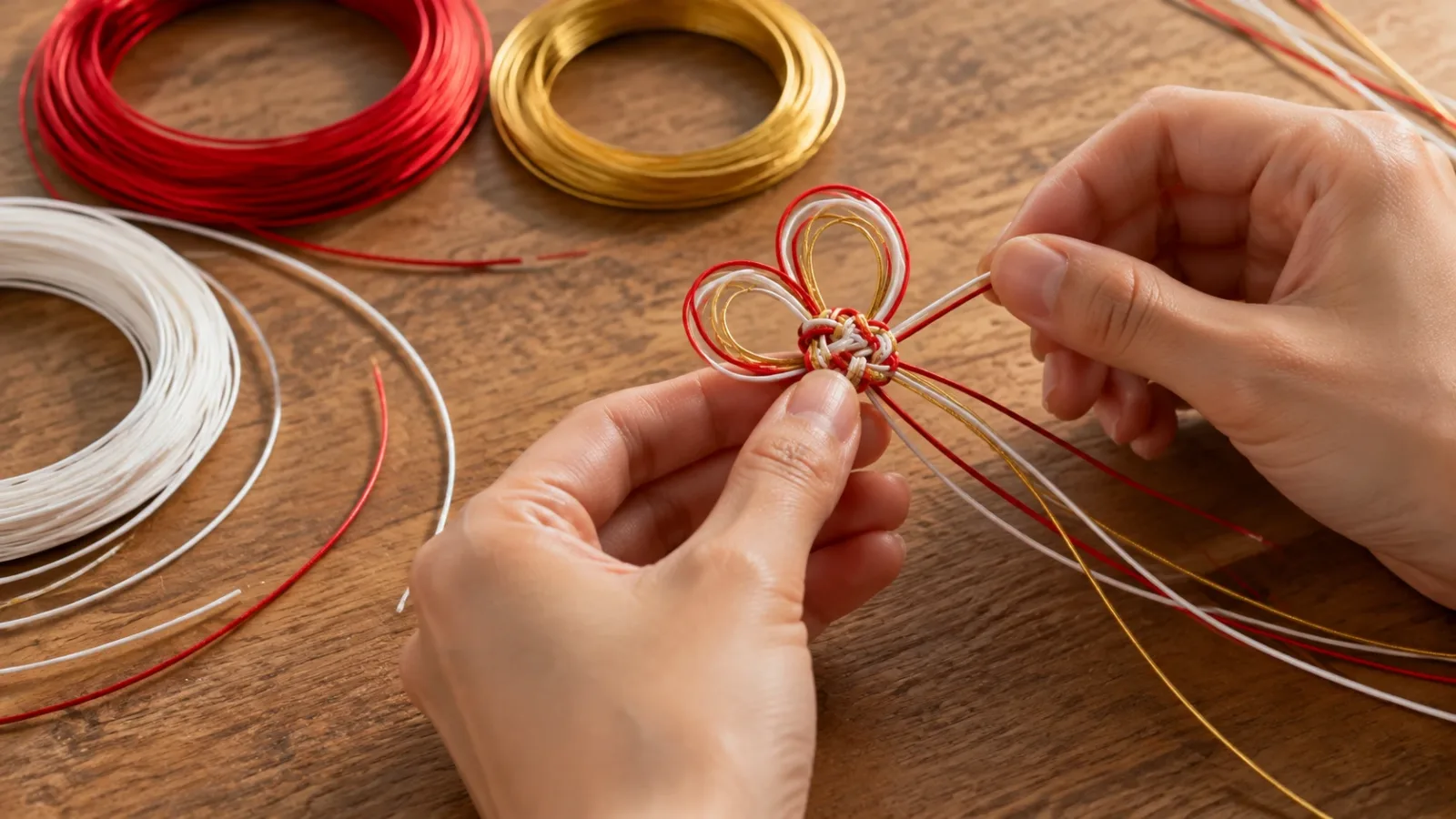
Checked 9 November 2026. AI illustration shows hands tying a decorative knot in red, white and gold paper cords at a fictional craft table, not the actual Tsuda venue, equipment or confirmed activity. Confirm the selected date, activity, language and access directly.
One instructor means one shared activity
The operator’s current workshop page says one instructor is assigned to each group and all participants must select the same activity. Its Japanese note says different motifs cannot be made separately, though different fittings for the same flower motif may sometimes be possible if discussed.
So a parent choosing a necklace and another choosing a spiral charm is not a confirmed mixed menu. Send the actual choices before booking and ask what can be taught together. Different colours are not the same as different construction steps.
If family members want very different projects, ask about separate sessions and the complete cost before committing. Do not create several bookings simply to get around the shared-activity instruction or assume a second instructor will appear.
Use the current item price, not an older necklace listing
The operator lists a spiral charm/key-ring project at ¥1,500 including tax, around 30 minutes. A flower brooch or flower charm is listed at ¥2,750, around 30–60 minutes. A necklace is ¥4,400, around 60 minutes. Choose the actual item rather than treating the lowest figure as a price for every accessory.
The city tourism necklace listing shows ¥3,850, 30–60 minutes and capacity 12. The operator now shows the necklace at ¥4,400 and groups of two to nine. Those details conflict; use the operator’s current item and group limits for planning, then confirm the final booking total.
Two people making the listed ¥2,750 flower item add to ¥5,500, not a verified checkout total. Ask whether the desired fitting changes the price and how an accompanying observer is counted. A finished accessory bought downstairs is not automatically priced like the workshop.
Saturday shop hours do not mean Saturday classes
The operator accepts workshops Monday to Friday, 10:00–15:00, excluding Japanese national holidays. The shop itself lists weekday hours of 10:00–18:00 and Saturday 10:00–12:00. That Saturday morning shopping window is not a Saturday workshop.
Reservations are accepted for groups of two to nine participants. A solo maker with a parent only watching has not automatically met the two-participant minimum. Likewise, a family of ten cannot rely on the tourism page’s larger capacity without asking the operator.
The operator says a confirmation email follows booking. Check its date, time, item, headcount and price. If the city tourism enquiry form is used instead, that page explicitly says the enquiry is not yet a confirmed booking.
Do not arrive early expecting an extra lesson
The operator asks visitors to arrive at the booked time because there may be a booking immediately before or after. Early arrivals may have to wait until their slot, and the workshop ends within its allotted time. Build a small approach buffer without treating it as extra teaching time.
The roughly 30-minute and 60-minute labels are item-specific estimates, not a promise of hotel-to-hotel duration or extra time to change projects after starting. Ask how much help and finishing support are included before choosing a more involved item.
The city tourism listing says to contact the provider if cancelling and says no cancellation fee is charged there. This article has not verified a new direct-booking confirmation’s deposit, payment or change terms; read those actual terms before relying on a free cancellation assumption.
Small knots can be more demanding than they look
The city tourism writer’s workshop account describes repeatedly realigning small cords and needing the instructor to fix mistakes. The city’s interview with a Tsuda artist also says visitors can find the work harder than expected. These are reasons to choose thoughtfully, not a prediction that any parent cannot do it.
The operator specifically says the spiral charm can be done by elementary-school children, with guardian support needed in lower grades. Do not extend that note to every item, every younger child or a promise of independent work while adults focus on their own pieces.
A Kizuna Travel visit account describes flowers, spheres and instructor help. One person’s successful necklace is not proof that a parent will enjoy the same small hand movements. Ask about a sample demonstration, lighting, chair, breaks and the amount of help before deciding.
The workshop is upstairs; English booking text is not English teaching
The operator places the workshop on the second floor alongside earlier works and historical materials. Neither that description nor the city’s location notes confirm a continuous step-free route, lift, accessible toilet or reserved resting seat. Ask about the actual entrance and stairs before paying.
Parts of the operator’s booking page have English explanations. That does not establish English or Hindi instruction during the hands-on session, an interpreter or translated instructions for the chosen item. Ask what language the teacher uses and what support is available.
Kanazawa Kurumi’s English workshop page is a different provider at 1-15 Yasuecho, with a two-hour accessory workshop advertised at ¥8,800. Its address, timetable and teaching arrangements cannot be transferred to Tsuda at Nomachi merely because both use the word mizuhiki.
A downstairs shop visit can be a different plan
The Tsuda shop’s own site gives the address as 1-1-36 Nomachi, Kanazawa. Use that exact business and address for the final approach, not another mizuhiki shop. The first-floor shop and its finished pieces are a different activity from a booked upstairs lesson.
If parents would rather browse than tie small knots, ask about a shop visit and current opening. Do not promise a live artisan demonstration, a particular product in stock, a place to wait for an hour or a purchase-free booked workshop seat.
For the wider trip, share the weekday, shared project, maker/observer count, language and access needs through The Trip Keeper Japan planning page. Lessons, fittings, interpreters, meals and transfers are not promised package inclusions. Checked 9 November 2026. The reused AI hero shows a fictional Indian family planning in a generic lounge, not Tsuda’s shop, classroom or a finished mizuhiki item.

A Miranda House graduate and lawyer who traded courtrooms for slow travel. Cheshta travels with the batches we host ourselves, with a soft spot for travelling alongside elders.
Planning your next trip?
We'll handle insurance, hotels, airport assistance and the itinerary — the same way we do it for every trip.
Questions on this article
asked by readers, answered by us
Was this helpful?
one tap, no sign-up