




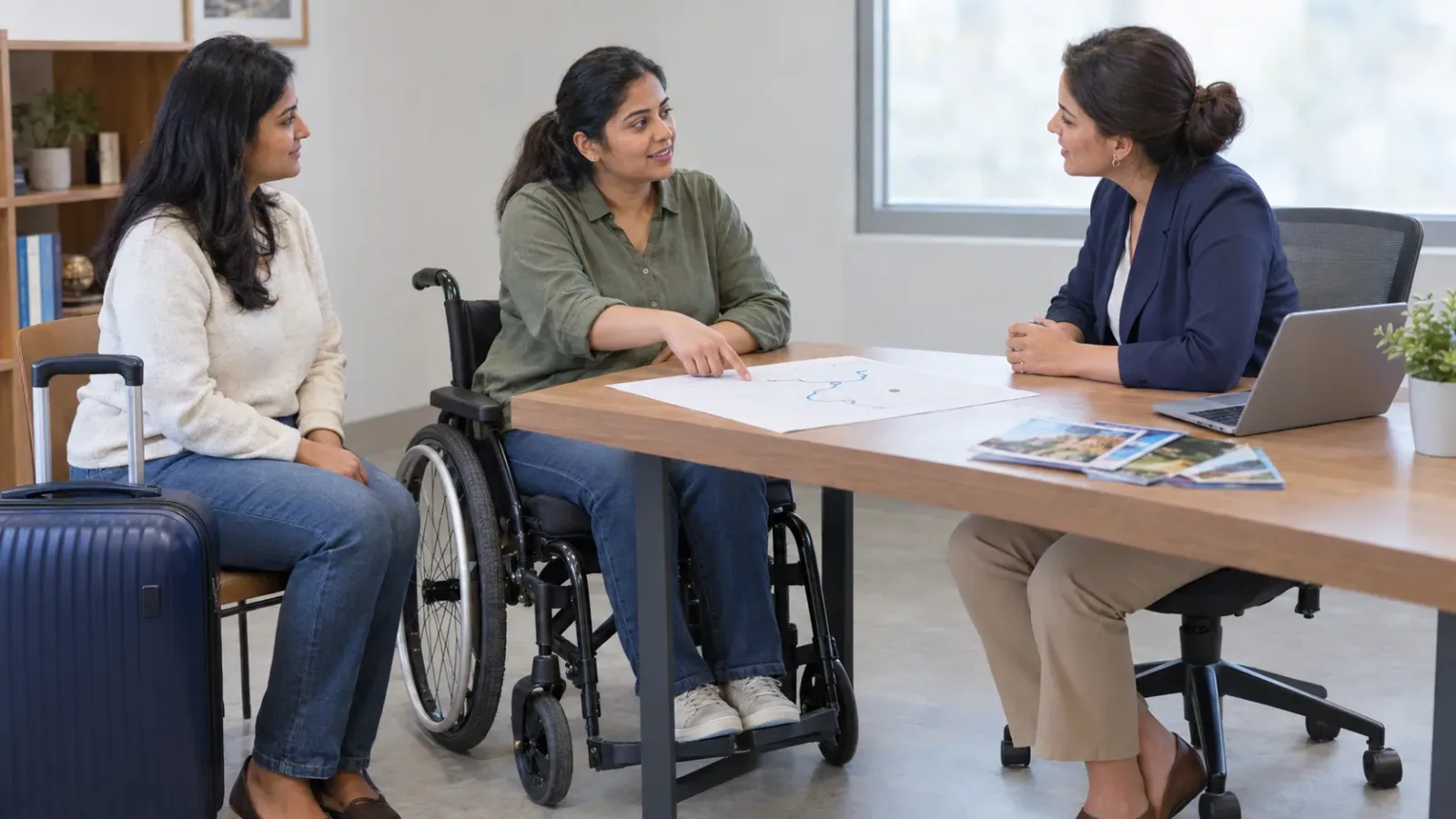
Ask a tour operator to name the toilet stops and show why the actual facilities fit the wheelchair user. "Western toilet", "accessible coach" and "wheelchair-friendly tour" do not answer whether someone can reach the cubicle, enter it, position their own chair and use the required equipment. Get the necessary details before paying, with a workable alternative if a stop closes.
AI-generated fictional photograph of a wheelchair user, her sister and a travel organiser discussing access before a trip. Not an actual customer, operator, toilet facility or care arrangement.
Describe the facilities needed, with the traveller's consent
Ask the traveller which practical details matter: staying in their own chair to reach the toilet, clear door opening, turning space, side of transfer, fixed support rails, space for a companion, or an adult changing bench and hoist. Share the functional request they approve, not a full medical history. This is not a guide to lifting, transfers or choosing clinical equipment.
Give the operator the relevant chair dimensions and any other information the traveller wants used for the fit check. Ask for actual measurements and recent photos of the toilet and its approach. Do not replace this comparison with a universal doorway number or assume that a manual chair, powered chair and mobility scooter have identical requirements.
Ask what the label actually promises
Intrepid's on-trip FAQ says toilet types depend on the areas visited and some trips do not have western toilets. Even a seated toilet, however, does not establish wheelchair access. Ask separately about the approach, entrance, layout and equipment.
Its accessible-travel page says suitability is individual, some destinations lack accessible infrastructure, and possible reasonable adjustments should be discussed before booking. It also says extensive itinerary changes may not be possible and completing an existing itinerary generally includes looking after yourself without the leader's supervision or other assistance. An enquiry route is not a promise that every group tour can meet every toilet or personal-support need.
Check every part of the route to the cubicle
For each proposed stop, ask where the vehicle drops off, how far the usable toilet is, and whether the entire route has steps, steep sections, rough ground or narrow doors. Ask about any lift, its usable size and the alternative if it is unavailable. A level restaurant entrance does not prove its toilet is on the same level.
Inside, ask for the clear doorway, threshold, space to turn and position the actual chair, the side or sides with usable transfer space, and the location of rails. If a companion needs to help, ask whether both can enter with privacy and whether assistance arrangements meet the traveller's established needs. Photos should show the whole layout, not only a close-up of the toilet bowl. Do not attempt an unfamiliar transfer because a guide calls the room accessible.
A Changing Places facility is a different question
The Changing Places explanation dated 16 June 2021 distinguishes its facilities from standard accessible toilets. It describes an adult-sized height-adjustable changing bench, hoist, extra space for the user and carers, and a centrally positioned toilet. That distinction matters if the traveller needs more than a conventional accessible cubicle.
Ask for the exact facility, equipment details, working status, access arrangements and any compatible supplies the user must bring. Do not assume a baby-changing table is adult equipment, that every accessible toilet has a hoist, or that any sling fits any hoist. Where compatibility or support is uncertain, get advice from the appropriate supplier or professional who knows the traveller's established arrangement. No handling technique or clinical fit is prescribed here.
Check the key, opening and permission to enter
The Changing Places installation FAQ says access arrangements are decided by the venue: examples include open access, a RADAR key, staff access or a membership scheme. Do not assume one key or one badge opens every facility worldwide. Ask where to get access, which staff member can help, and whether that desk will be open at the planned time.
As a bounded example, the National Gallery's Roden Centre visual story identifies a ground-floor Changing Places facility, a RADAR-key arrangement with keys available from security or a Gallery Host, and equipment including a hoist. The same page describes different centre access for booked groups and individuals at different times. A facility listed inside a building is not automatically an anytime roadside stop; confirm the applicable entrance and access for your date.
Kew's toilet-facilities page lists locations, identifies Changing Places at Brentford Gate, notes that some toilets may close temporarily, and describes The Botanical's single unit as for diners only. These examples show why a map pin needs an opening, admission and permitted-use check. They do not establish your itinerary or a toilet's live status.
Make the stops part of the booked itinerary
Ask the operator to put the named primary and backup facilities into each day's route, including attraction time, transfers and meal stops. Ask how the longest planned gap between usable facilities is calculated and compare it with the traveller's own requirements. There is no universal safe interval in this guide.
Confirm whether the driver can make the agreed detour, whether the group must stay on a fixed schedule, and whether parking, waiting, admission or extra guide time costs more. A private vehicle does not automatically mean unlimited changes, while a shared tour may have constraints the family cannot solve on the day. For road-transfer timing, use our toilet-stop planning guide; this checklist adds the wheelchair-user facility fit.
Agree support and a real fallback
Ask who provides the agreed practical help, what the guide and driver will and will not do, and whether a companion or separately arranged professional support is needed. Do not infer personal toileting or lifting assistance from the word escorted. A public facility's equipment does not itself include a person trained and authorised to help your traveller use it.
Ask when the operator last checked the stop and how closures or changed access reach the actual guide. Agree what happens if the planned facility cannot be used: a verified alternative, a shorter route, a return to a confirmed base, or a different itinerary. Keep any extra cost and cancellation or change terms in writing. Do not treat carrying a wheelchair up stairs or using a toilet floor as the fallback.
A short enquiry you can adapt
"We are considering [tour and date]. With the traveller's agreement, these are the facilities required: [functional needs and relevant chair details]. Please name each planned and backup toilet stop, confirm the step-free route and actual cubicle layout, and send recent photos or measurements. Please explain opening, keys, admission or purchase conditions, equipment and support limits, the longest planned gap, and any extra costs. Which points can you confirm before we pay, and what happens if a required facility is unavailable?"
If the answer remains "the guide will find somewhere", the necessary toilet plan is still unconfirmed. Ask for the missing evidence or compare a different itinerary before committing. This guide does not certify a tour, venue, caregiver or piece of equipment as suitable.
Reviewed 14 November 2026 against the six primary pages linked above. Changing Places' explanatory article is dated 16 June 2021; relevant current revision dates for the other pages were not established. Named operators and UK venues illustrate questions, not live opening, universal legal standards, available equipment or booked assistance. Facility suitability must be checked against the actual traveller, route and date.

A Miranda House graduate and lawyer who traded courtrooms for slow travel. Cheshta travels with the batches we host ourselves, with a soft spot for travelling alongside elders.
Planning your next trip?
We'll handle insurance, hotels, airport assistance and the itinerary — the same way we do it for every trip.
Questions on this article
asked by readers, answered by us
Was this helpful?
one tap, no sign-up