




- Subject
- Yana rock outcrops
- Source material
- Limestone
- Process discussed
- Natural dissolution
- Architectural excavation
- Different subject
- Reviewed
- 17 November 2026
Reviewed: 17 November 2026. Natural-landform explanation, not a cave-exploration or access guide.
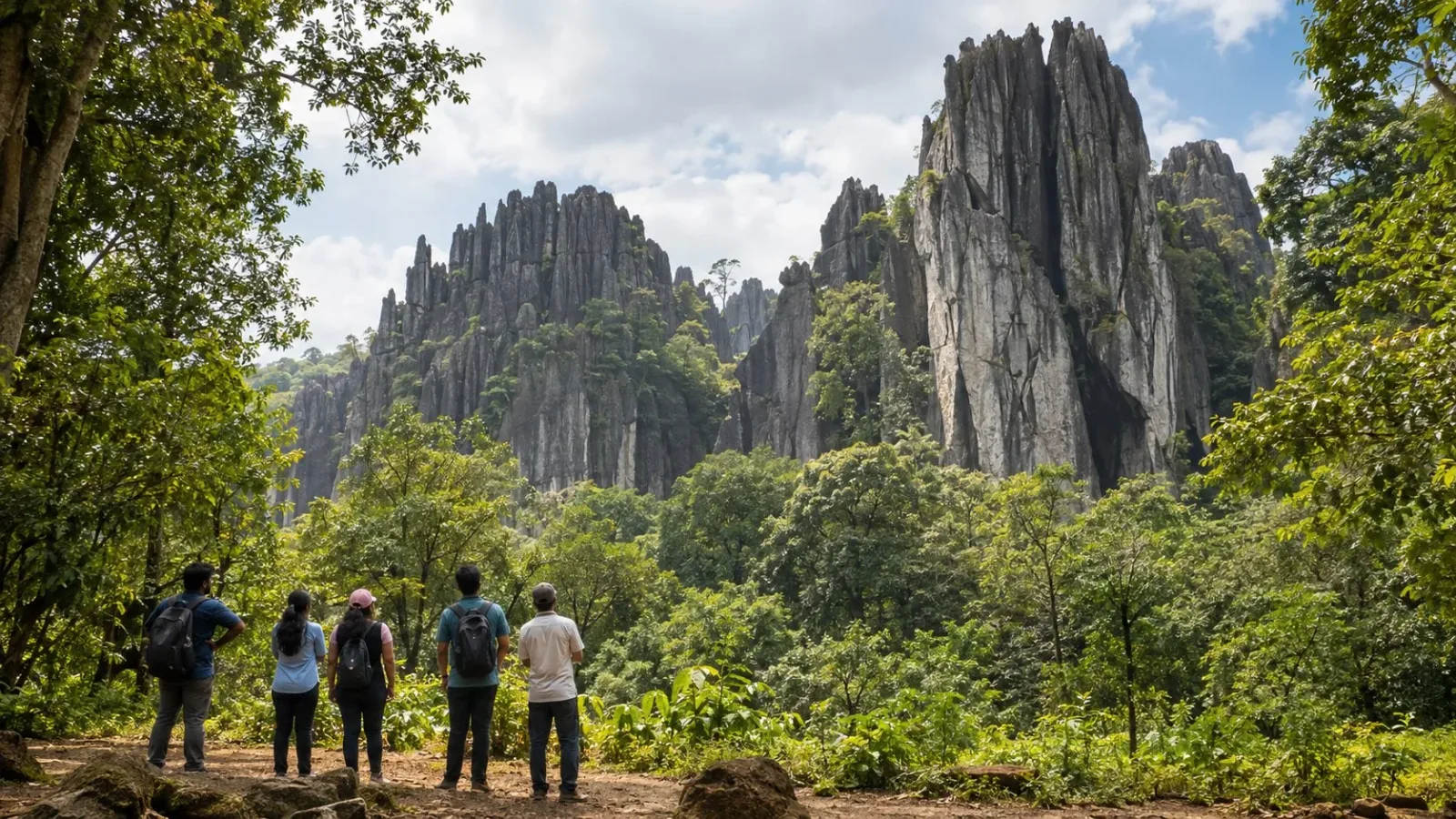
AI-generated fictional Yana-inspired scene, not an exact formation, identified cleft, measured geology, current path, viewpoint or access record.
At Yana, begin with a natural rock landform rather than assume that the word cave means an excavated monument. Uttara Kannada district describes the Bhairaveshwara and Mohini rock outcrops as karst limestone. Karnataka Tourism explains chemical dissolution along fractures as part of the landscape's formation.
Identify the subject as an outcrop
The district account names Bhairaveshwara Shikhara and Mohini Shikhara in its description of Yana's rock formations. These names identify the natural features discussed by the source. They do not by themselves describe rooms, columns or a building plan.
The limestone identification is a material description. It does not establish that every dark rock in a photograph is one of the named formations. This article provides no photographic identification or explanation for the colour of an individual surface.
Understand the dissolution explanation
Karnataka Tourism describes the rock as dolomitic limestone and explains that chemical dissolution by percolating rainwater widened fractures and joints. It relates that process to karst landforms, including towers and clefts. The explanation concerns a natural process shaping rock.
Keep that account qualitative. No geological age, rate of change or dimensions are needed here. This article does not reconstruct each stage of formation or assign the same process history to every opening in an image.
Separate natural form from architecture
A cleft described through dissolution is not the same kind of subject as a chamber described through human excavation. That difference helps make sense of the tourism account without reading architectural features into every rock opening.
The point is not to deny the place's religious associations. Those associations and the physical formation of the rocks answer different questions. A religious name does not, on its own, establish how a rock mass formed or that it was carved into its overall shape.
Keep names and photographs within their limits
A photograph can illustrate an outcrop without explaining its whole history. The source descriptions, rather than a resemblance to a tower or temple, support this account's natural-landform focus. No individual fissure or cave is identified here.
Nor is an opening an invitation to enter, climb, collect or test stone. This account gives no route, shrine visit, cave exploration or present viewing arrangement. Its limited purpose is to distinguish the natural karst explanation from the idea of an excavated rock-cut monument.
Frequently asked questions
What physical subject do the sources describe?
Named limestone rock outcrops at Yana and a natural karst process.
What process does Karnataka Tourism explain?
Chemical dissolution by percolating rainwater widening fractures and joints.
Does a religious name prove that the whole rock form was carved?
No. Naming and physical formation are different questions.
Does this account propose entering clefts or exploring caves?
No. It supplies no such activity or arrangement.
Does this give a geological age or rate of change?
No. The dissolution explanation stays qualitative without age, dimensions or change rates.
Does a photograph identify every fissure or named formation?
No. This article gives no individual fissure, cave or surface identification.
Official sources and limits
District and state tourism accounts support the named limestone outcrops and qualitative natural-dissolution explanation. No geological age, rate, exact photographic identification, exploration or current access is established.

A Miranda House graduate and lawyer who traded courtrooms for slow travel. Cheshta travels with the batches we host ourselves, with a soft spot for travelling alongside elders.
Planning your next trip?
We'll handle insurance, hotels, airport assistance and the itinerary — the same way we do it for every trip.
Questions on this article
asked by readers, answered by us
Was this helpful?
one tap, no sign-up