




- Source account
- India State Party submission
- Crop described
- Wet rice
- Connected use
- Fish rearing in fields
- Current farm survey
- Not supplied
- Reviewed
- 17 November 2026
Reviewed: 17 November 2026. Selective heritage outline, not a ticket or access guarantee.
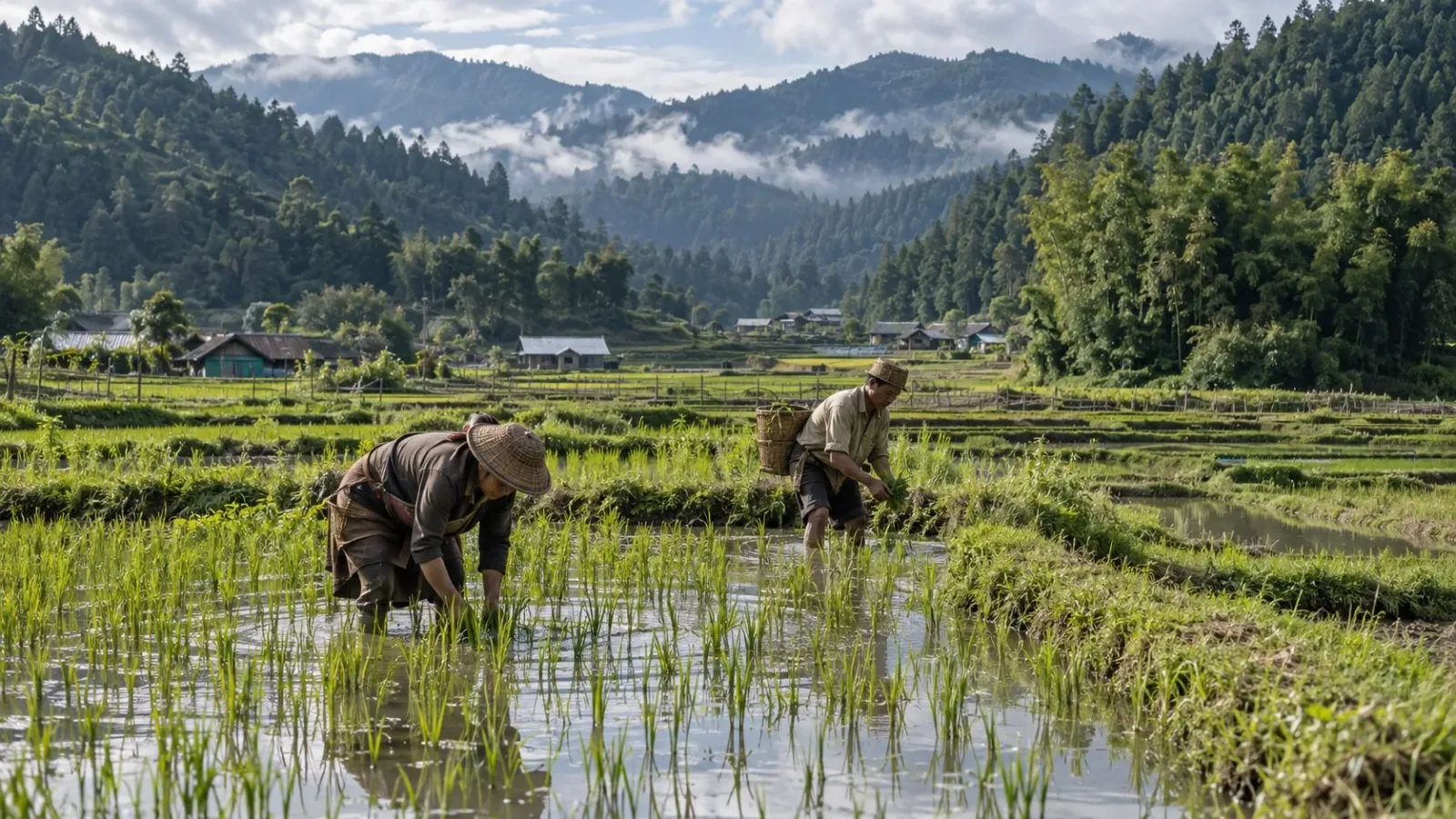
AI-generated fictional farming landscape, not an identified community member, exact farm, verified rice-fish operation, crop calendar, historical reconstruction or current entry permission.
India's Apatani Cultural Landscape submission, hosted by UNESCO's World Heritage Centre, describes wet-rice cultivation in Ziro Valley with fish also reared in the fields. The useful subject is that shared cultivation relationship: paddy and fish belong to the same field-system account.
Read the field as more than a crop image
The submission identifies wet-rice cultivation on the valley's relatively flat cultivated land. It then describes rice-fish cultivation in which fish are reared alongside paddy in the fields.
Read those statements together. In this account, the fish are not merely wildlife imagined in a scenic waterway nearby. Fish rearing is part of the described cultivated use of the fields.
This does not identify a fish species, a particular farm or the activity visible in a photograph. Water in a field is not enough to establish what is being reared there now.
Keep the rice-and-fish relationship together
The source's explanation places a crop and fish rearing within a connected field system. That gives the landscape a working relationship beyond the appearance of green paddy or reflective water.
Keep the conclusion modest. The account does not become a statement here that every Ziro plot uses the same arrangement, that all rice cultivation includes fish, or that both will be visible during a visit.
No stocking, feeding, drainage, irrigation or harvesting method is supplied. There is no crop calendar, fish inventory, yield comparison or claim about the condition of a particular field.
Separate the landscape account from today's farm
The source is India's State Party submission for a Tentative List, not an independent current survey of every farm. Its publication on the World Heritage Centre's site is not treated here as a final World Heritage inscription or an endorsement of every claim in the submission.
This article uses the explicit rice-and-fish relationship without adopting broad claims of perfect ecological balance, universal community practice or guaranteed environmental results. It gives no verdict on fertilisers, water quality, food suitability or present farm management.
Understanding a working field does not establish permission to enter it, follow an embankment, handle equipment or join cultivation. No farm visit, demonstration, harvest or meal is arranged here.
The narrow takeaway is enough: the submitted landscape account connects wet-rice cultivation and fish rearing in the fields. It explains a documented land-use relationship, not what a traveller will encounter on a particular day.
Frequently asked questions
How are rice and fish connected in this source?
The submission describes fish reared alongside paddy in the fields.
Does that mean every plot follows the same arrangement?
No such universal claim is made here.
Is this a current farm survey or final World Heritage inscription?
No. The source is India's Tentative List submission hosted by the World Heritage Centre.
Does this confirm fish sightings, farm entry or a harvest activity?
No. It establishes none of those arrangements or encounters.
Does the account guarantee ecological perfection?
No universal ecological or environmental result is adopted.
Does it teach stocking, feeding or harvesting?
No farming or fish-rearing instructions are supplied.
Official sources and limits
Submitted wet-rice/fish-rearing relationship only. Tentative-list submission is not final inscription or independent current survey. No universal practice, species, yield, ecological perfection, farm method, food suitability or current visitor access claim.

A Miranda House graduate and lawyer who traded courtrooms for slow travel. Cheshta travels with the batches we host ourselves, with a soft spot for travelling alongside elders.
Planning your next trip?
We'll handle insurance, hotels, airport assistance and the itinerary — the same way we do it for every trip.
Questions on this article
asked by readers, answered by us
Was this helpful?
one tap, no sign-up