




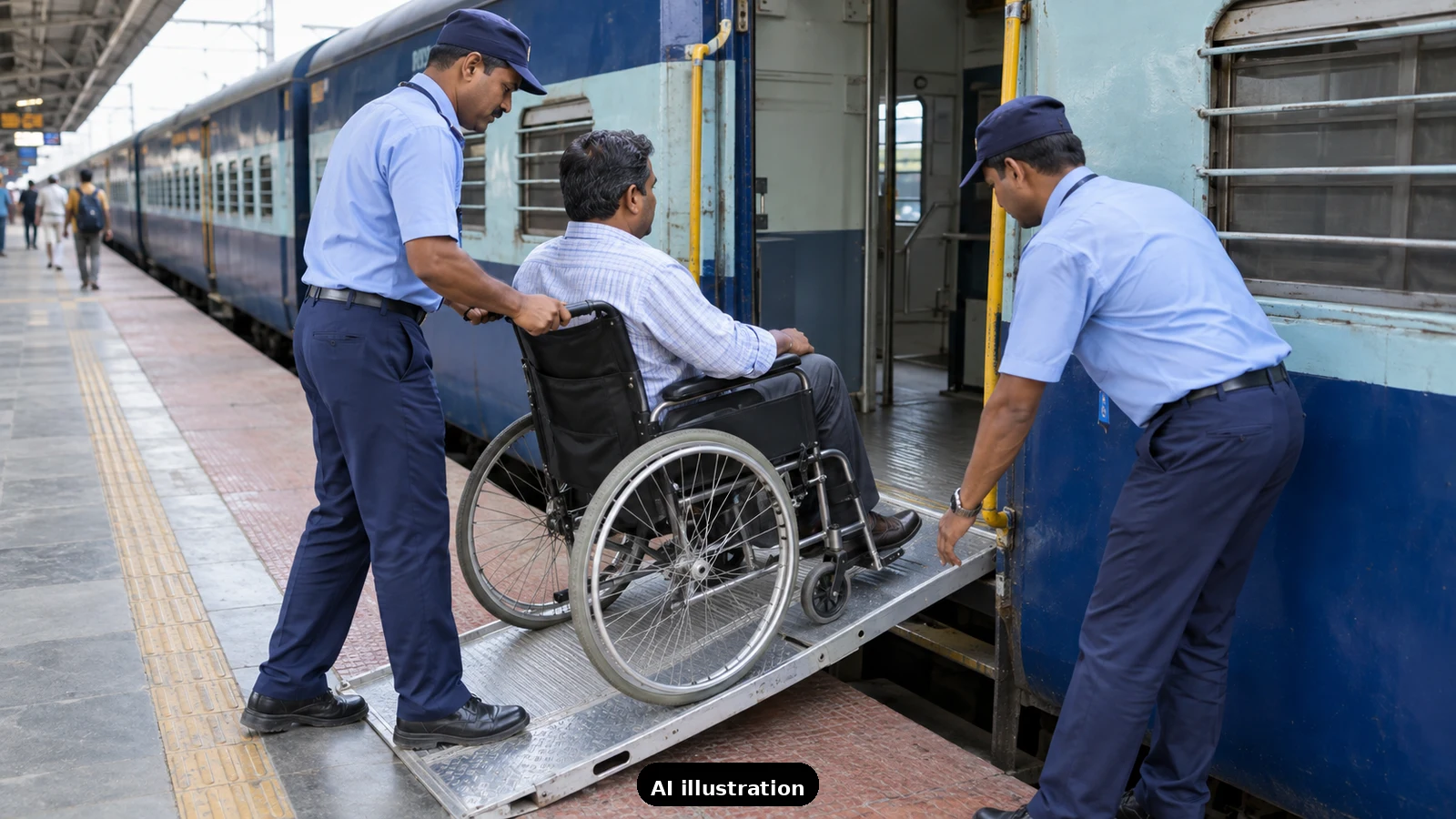
Short answer: yes - wheelchair users board Indian trains with portable ramps at many stations, and where no ramp exists, railway staff bridge the gap with muscle and coordination. But a portable ramp is not standard equipment at every platform, so the reliable plan is not the ramp itself: it is booking the disabled-friendly SLRD coach (which has a wider entrance door and wheelchair space) and arranging assistance in advance through RailMadad on 139. The ramp then becomes a welcome extra, not a single point of failure.
The coach designed for this: SLRD. Most Mail and Express trains with ICF-design coaches carry an SLRD coach - a second-class cum luggage cum guard van with a disabled-friendly compartment. These are built for wheelchair-borne passengers: a wider entrance door, wider berths, space earmarked for the wheelchair inside the compartment, and a larger adapted toilet with grab rails. Fully air-conditioned Garib Rath trains have an AC disabled-friendly compartment in the power cars. Booking into the SLRD compartment - through the Divyangjan quota when reserving - puts the traveller in the coach whose door a wheelchair actually fits through. That matters more than any ramp.
Where portable ramps fit in. Station ramps for barrier-free entry to the building are a planned standard facility at A-1, A and B category stations, and some stations and zones keep portable ramps for the platform-to-coach gap - but availability is uneven, and they live with station staff, not on the platform edge. The way to get one is to ask in advance: call RailMadad (139) a day or two before travel, state that a wheelchair user is boarding, and ask what the station will arrange. When staff know a wheelchair is coming, they meet the train ready - with a ramp if they have one, or with enough hands if they do not.
When there is no ramp: how boarding actually goes. Two to four staff or family members lift the occupied wheelchair the short step into the coach - a routine manoeuvre at Indian stations, done daily, and safe when unhurried. The rules that keep it safe: nobody lifts until everyone is in position, the wheelchair's brakes are off only while rolling, the passenger keeps feet on the footrests, and the lift happens before the general boarding rush, not inside it. Boarding early - the SLRD coach is at the train's end, near the guard - avoids the crowd entirely.
The advance-arrangement checklist. One: book the SLRD compartment through the disabled quota, or the nearest accessible berth. Two: call RailMadad 139, register the assistance request with station, train and date. Three: at nominated stations, book the station wheelchair via IRCTC's e-wheelchair service for the platform side. Four: on the day, arrive early and find the TTE or guard - the SLRD coach is their office, and they coordinate the boarding. Five: at the destination, the same request through RailMadad covers the deboarding too.
How TripKeeper plans wheelchair travel by train. When we plan rail journeys for wheelchair users, we book the right coach, arrange station assistance at both ends, and confirm what each station can provide before the travel day - so boarding is a procedure, not an improvisation. If you would like that planning for your family, send us a trip-planning inquiry.

A Miranda House graduate and lawyer who traded courtrooms for slow travel. Cheshta travels with the batches we host ourselves, with a soft spot for travelling alongside elders.
Planning your next trip?
We'll handle insurance, hotels, airport assistance and the itinerary — the same way we do it for every trip.
Questions on this article
asked by readers, answered by us
Was this helpful?
one tap, no sign-up